New robot surgery leads to faster recovery times

 Gordon Anderson/BBC
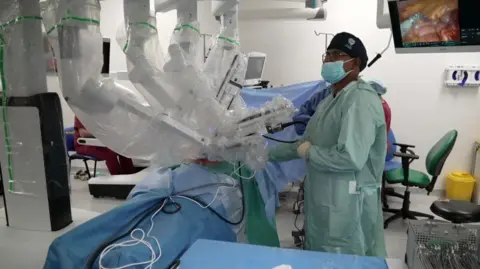
Patients in Hertfordshire are among the first to benefit from the most advanced robotic surgery technology ever used by the NHS.
West Hertfordshire Teaching Hospitals NHS Trust said the new DV5 robot, which costs £3m, will speed up recovery times for cancer surgery and cut waiting lists.
It is designed to operate with higher levels of precision and minimise tissue damage from surgery by allowing surgeons to feel more resistance as they operate.
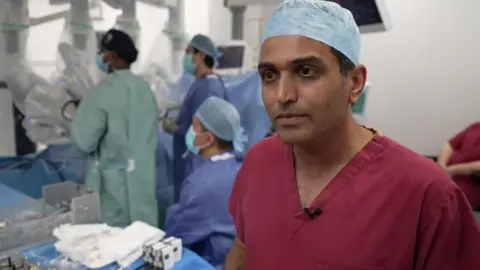
Head of the robotic programme and colorectal surgeon at the trust Dr Vanash Patel said it was "a game changer".
"What patients care most about is when they'll be able to get back to normal after surgery," he added.
"We've already seen with our robotic service that patients are recovering faster and that they're getting home earlier."
 Gordon Anderson/BBC
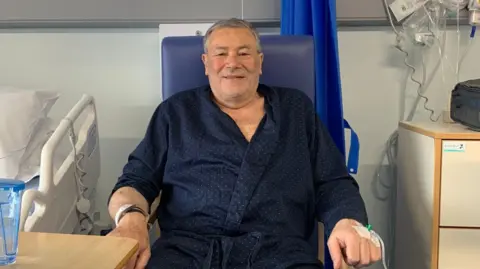
Patient Michael Benjamin, 79, from Bushey, Hertfordshire had an operation, assisted by the robot, to remove a potentially cancerous tumour on his bowel.
He was treated at Watford General Hospital, which is one of three hospitals run by the trust.
Colorectal surgeon Dr James Hollingshead performed the operation using a console to control the robot's movements with his hands and looking through a headset.
Dr Patel joined in from a second console to offer his thoughts.
The medical team expected Michael to be in hospital for two days to recover as opposed to spending five or six nights there.
Once he is released, he will be monitored at home by their virtual hospital, a team of doctors and nurses taking measurements of patients using wearable technology.
 Gordon Anderson/BBC
The DV5 robot has ten thousand times more computing power than the trust's previous equipment.
Dr Patel said it had ultra-high definition vision with better precision which allowed them to do better operations.
"This robot is going to let the surgeons get a sense of touch again, a sense that we lost with traditional robotic surgery and I believe that that sense of touch is going to lead to less tissue trauma, less tissue damage and patients are going to recover faster" he added.
The arrival of the DV5 robot at Watford General Hospital will free up an existing system to be moved to St Albans City Hospital to treat day cases like hernias and gall bladder removals in high volumes.
Do you have a story suggestion for Beds, Herts or Bucks? Contact us below.
Follow Beds, Herts and Bucks news on BBC Sounds, Facebook, Instagram and X.
