Black Country towns' trains return after 60 years

 Chris Blakemore/BBC
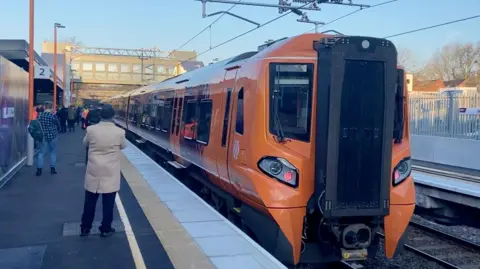
Two Black Country towns have welcomed trains for the first time in 60 years following the opening of new stations.
The Willenhall and Darlaston stations are part of a £185m project to reinstate rail links across the West Midlands not used in decades.
The stations have been added to the Shrewsbury to Birmingham New Street service via Wolverhampton.
Lucy Elwell, who lives close to the new Willenhall station, said she planned to use it straight away, adding: "I literally live a few doors down so it's going to be quite helpful to just hop on the train whenever."
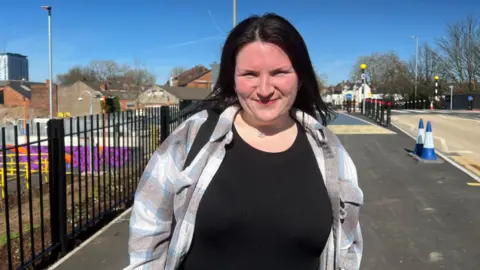
She added: "I don't drive, I just get the bus. So definitely it's gonna be so much use."
The openings come a few weeks before three other new stations - Moseley Village, Kings Heath and Pineapple Road - open on the Camp Hill Line in south Birmingham, which will give residents access to neighbourhood rail services for the first time since World War Two.
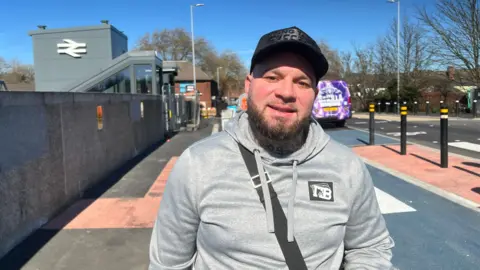
Social media influencer Liam Johnson Clarke, known online as Liam Inside the Baller, said Willenhall’s station was a boost for the area.
"It's massive for the town," he said.
"It's a real positive. It's good for the younger and older generation.
"Sometimes it can be doom and gloom, but having money pumped back into the town hopefully uplifts people and brings more business to the town centre."
The first service to call on Thursday morning left Birmingham New Street about 06:26 GMT, due at Darlaston at 06:47 and Willenhall at 06:50.
Services will now run roughly hourly on weekdays and Saturdays, though trains will not stop at either station on Sundays.
A return ticket from Willenhall to Birmingham New Street costs £8.90 at peak times and £6.40 off-peak, whereas from Darlaston a peak return costs £8 and an off-peak ticket is £5.90.
 Getty Images
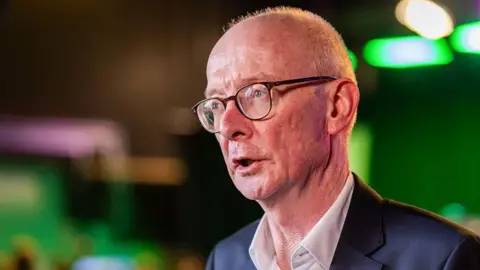
Pat McFadden, the MP for Wolverhampton South East which covers Willenhall, said the new stations were great news for the area.
The government minister explained he had been to see them recently, describing them as "clean, modern and easy to use".
"It will be so much more convenient for people to be able to get on the train in their home town," he told BBC Radio WM.
"This is going to save people a massive amount of time [and] it's going to enable people to take up jobs they probably couldn't have taken up.
"It's a transport boost, it's a morale boost and it's an economic boost to both towns."
 West Midlands Combined Authority
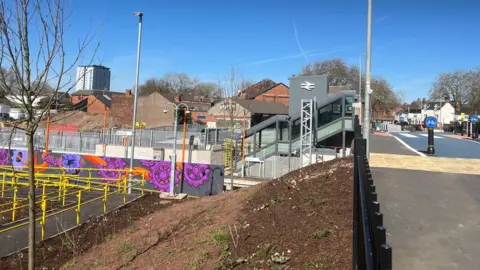
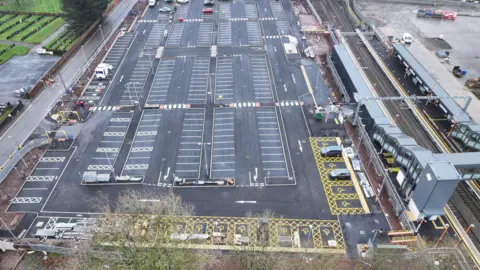
Each station has sheltered platforms, accessible lifts, ticket machines and cycle racks, with 300 parking spaces at Darlaston and 33 at Willenhall.
Walsall Council leader Mike Bird previously described the openings as "a major milestone for communities and a real boost for the borough's future".
Rail services last stopped at both sites in 1965, which were shut as a result of the Beeching cuts, which led to the closure of 5,000 miles of track and more than 2,000 stations.
Follow BBC Birmingham on BBC Sounds, Facebook, X and Instagram.
