Man who exposed human rights abuses in China granted US asylum

 Getty Images
A Chinese national who exposed human rights abuses in Xinjiang has been granted asylum in the United States, after an immigration judge found he had a "well founded fear" of persecution if he returned to China.
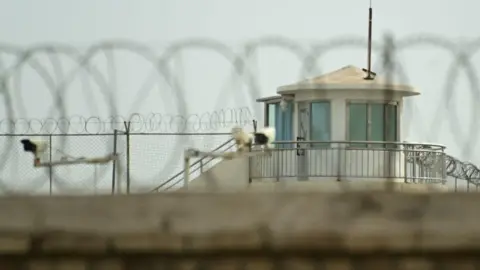
In 2020, Guan Heng secretly filmed detention facilitates in the north-western Chinese region, where human rights groups say more than one million ethnic Uyghurs have been detained against their will.
Guan, 38, applied for asylum after arriving in the US illegally in 2021, but was detained in August as part of a mass deportation campaign by the Trump administration.
Plans to deport him to Uganda were dropped in December after his situation raised public concerns.
When asked during Wednesday's hearing if his plan in filming the detention facilities and releasing the video a few days before his arrival in the US was to give himself grounds for an asylum claim, Guan said it was not.
"I sympathised with the Uyghurs who were persecuted," he replied, via video link from the US correctional facility where he was being held.
Guan published most of the footage on YouTube after leaving China, having first travelled to Hong Kong and then Ecuador, the Bahamas, and eventually Florida.
The videos show him travelling to parts of Xinjiang and filming what he describes as "concentration camps".
Several countries, including the US, UK, Canada and the Netherlands, have accused China of committing crimes against humanity and possibly genocide against the Uyghur Muslim population in Xinjiang.
A UN human rights committee in 2018 said it had credible reports that China was holding up to a million people in "counter-extremism centres" in the region, which is largely cut off to international media and observers.
China denies all allegations of human rights abuses in Xinjiang and describes the centres as "re-education camps" to prevent terrorism and root out Islamist extremism.
Meanwhile, Uyghurs in exile continue to recount stories of terrified or disappeared relatives.
A series of police files obtained by the BBC in 2022 revealed details of China's use of these camps and described the routine use of armed officers and the existence of a shoot-to-kill policy for those trying to escape.
People who have managed to escape the camps have reported physical, mental and sexual torture. Women have spoken of mass rape and sexual abuse.
Guan's lawyer, Chen Chuangchuang, said his client's case was a "textbook example of why asylum should exist".
The US has a "moral and legal responsibility" to grant Guan asylum, he added.
The judge on Wednesday said Guan was right to fear retaliation from the Chinese state if sent back, noting that his family had already been questioned, and said he had established his legal eligibility for asylum.
The Department of Homeland Security reserves the right to appeal and has 30 days to do so.
