Swinney brands Farage comments about Glasgow pupils racist

 Reform UK
First Minister John Swinney has accused Nigel Farage of making racist comments about schoolchildren in Glasgow.
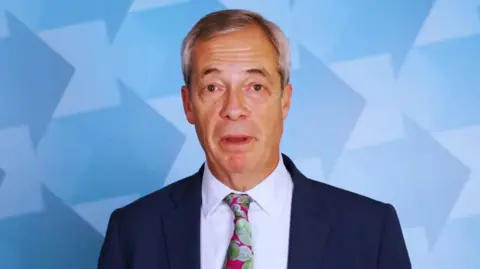
Speaking in a campaign video, the Reform UK leader highlighted how nearly one in three pupils in the city speak English as a second language, which he described as "cultural smashing of Glasgow".
He added it was unfair on taxpayers that "people like this should come into Britain illegally", adding that his party would make it a "really big issue" in next year's election.
Asked about the remarks, Swinney said they "demonstrate that Nigel Farage is a purveyor of racist views" while Prime Minister Sir Keir Starmer said Farage was a "toxic divisive disgrace".
Swinney told BBC News: "I think Nigel Farage's comments are quite simply racist. There's no other way to describe them.
"I don't know quite when we believed multilingualism was something of a problem in our society - it's not a view I take, I think it's a benefit and reflects the diversity of our country, and I think these comments demonstrate that Nigel Farage is a purveyor of racist views and people should think long and hard about that before they vote for his party."
Speaking about Farage's comments during a visit to a community hub in Glasgow, the prime minister told journalists "He's a disgrace. He's a toxic, divisive disgrace" and added that it was "particularly poor" that the Reform UK leader had used children "to start that divide".
Sir Keir added that he believed Farage had made the comments because he wanted to distract from pro-Russian elements in his party.
He also told the BBC that Farage was "only interested in the politics of grievance" and "pulling communities and societies apart".
Sir Keir added: "I'm very proud that in Scotland we have communities that are compassionate, reasonable, diverse of course, and I'm very proud to serve all of the communities in Scotland and I don't look to pull those communities apart."
Scottish Labour leader Anas Sarwar said: "How dare [Farage] use Glasgow's kids to spread his poison."
BBC News has contacted Farage for comment.
Is the Farage figure right?
The headline figure Farage used in his video came from Scottish government data and is accurate. But the data set also includes information about levels of competency which the Reform UK leader did not highlight.
Pupils are recorded as having English as a "first language", or as an "additional language" in a number of other categories - including being "competent" or "fluent".
Current statistics for the Glasgow City area show:
- there were 71,957 school-age children in Glasgow last year, and the majority (70%) were native English speakers.
- 29% of pupils had English as a second language with the other1% marked as "unknown".
- and of that 29%, 19% were competent or fluent in English, and the remaining 81% were either new to English, early acquisition or developing competence.
What about other Scottish cities?
Edinburgh, by comparison, had a similar rate of pupils who had English as a first language (76%) - but had a much higher rate of competent or fluent English speakers out of those who spoke English as a second language (53%).
Similarly, 76% of pupils in Aberdeen had English as their first language, and out of those who spoke English as a second language, 43% were competent or fluent.
The number of children new to English in Glasgow increased by 27% between 2020 and 2024, but Glasgow City Council said this was partly because it had made improvements to the way it recorded the data.
Fluent English speakers increased by 32% during the same time period.
The number of children from overseas being enrolled in Glasgow's schools is also falling, down from 3,917 in 2012/22 to 2,527 last year.
A total of 147 languages are spoken by Glasgow's schoolchildren.
A council spokeswoman said: "Glasgow thrives as a city enriched by many different languages and cultures, and we proudly celebrate this diversity and the positive impact it brings to all our school communities."
The picture across Scotland is very different compared with cities like Glasgow or Edinburgh.
Only 10% of school-age children in Scotland do not have English as a first language.
Of those, 41% are either competent or fluent in English, while 59% are either new to English, in early acquisition or developing competence in the language.
Farage's campaign video insisted that the Glasgow figures were a result of "housing and better facilities" being offered to migrants.
He referenced "those that come on the back of lorries or across the English Channel by boat".
Farage has recently come under fire from his former classmates who say he displayed racist and antisemitic behaviour while at Dulwich College in London.
One Jewish classmate, Peter Ettedgui, said the Reform leader repeatedly told him "Hitler was right" and "gas them" when they were teenagers.
Last week in response, Farage said he had "never directly racially abused anybody".
And at a press conference on Thursday afternoon, the politician continued to deny he ever made racist remarks in a "malicious or nasty way".
Nigel Farage says his party plans to make immigration a "big issue" at next year's Holyrood election.
Now technically, given this a policy area reserved to Westminster, none of the MSPs elected next May will actually be able to legislate on immigration.
But given the debate among the public and politicians at the moment, it still seems likely to feature fairly prominently – particularly if Reform UK is involved.
It kind of suits both sides at the moment, in that Swinney is very keen to go up against Farage at the ballot box, and pitch his SNP as being the anti-Reform vote in a bid to squeeze Labour out of the conversation.
Meanwhile, Farage is quite comfortable straying onto what most would consider controversial territory, if it gets a rise out his opponents and gets his party into the headlines.
In truth he won't much mind being attacked by the first minister if it draws attention to the issues he wants to talk about, and lets him burnish his anti-establishment credentials.

