Government wins legacy case at UK Supreme Court

 BBC
BBCThe UK Supreme Court has allowed a government appeal in a major Troubles legacy case, in a decision which victims' campaigners have branded "a bitter blow".
Judges in London ruled parts of the 2023 Legacy Act did not lead to victims' rights being diminished.
A Northern Ireland Office (NIO) spokesman welcomed the decision.
The 2023 Legacy Act was introduced by the previous Conservative government and offered conditional immunity for perpetrators of some Troubles crimes in exchange for co-operation with a new body, the Independent Commission for Reconciliation and Information Recovery (ICRIR).
The Labour government has since introduced a new bill in parliament, with MPs already having voted to repeal the conditional immunity provision.
Northern Ireland's High Court and the Northern Ireland Court of Appeal (NICA) had both previously found that parts of the Act were incompatible with human rights and also undermined the rights of victims in breach of the Windsor Framework, which was signed following the UK's leaving the EU.
In 2024, the NICA ruled the government had too much veto power over the disclosure of material by the ICRIR to bereaved families.
But the five Supreme Court judges said the Northern Ireland Secretary's power to decide whether disclosure would pose a risk to national security was "not unrestrained, nor is it the 'final say'."
They went on: "The Secretary of State's powers do not mean that the Commission will lack independence in disclosing sensitive information to the next of kin, victims and the public".
Despite plans to change the law, the Northern Ireland Office still took the case to the Supreme Court over the application of the Windsor Framework, telling a hearing last October that the issue was "constitutionally profound".
'We welcome the clarity provided today'
In a 77-page ruling on Thursday, judges unanimously allowed the government's challenge.
In a statement, the NIO said: "We welcome the clarity provided today by the Supreme Court, which has confirmed that the ICRIR is fully equipped to deliver human rights-compliant investigations, and reaffirms the government's position on the interpretation and application of Article 2 of the Windsor Framework.
"Today's judgment also shows that the government was right to address the main flaw in the Legacy Act - namely conditional immunity.
"The scheme, which never came into force, was wrong in principle, lacked public confidence, and has been repeatedly rejected by the courts.
"While the question of immunity was not before the Supreme Court, the Court went out of its way to refute the main argument put forward for it.
"It is clear that the Troubles Bill is now the only viable way to generate confidence across communities, enable information sharing by the Irish authorities and put in place the necessary safeguards for our former service personnel."
Condemnation of the ruling
 PA Media
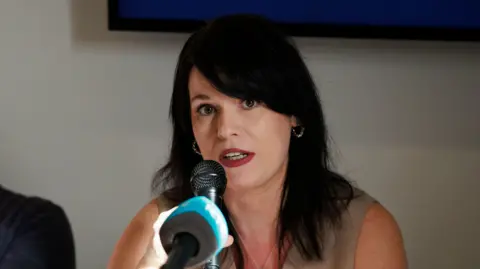
Amnesty International "condemned" the ruling.
It said it is "deeply concerned" the government has a veto over information disclosure.
"The decision to uphold the government's appeal is a bitter blow to victims and condemns them to further delays for the truth," said its Northern Ireland deputy director, Gráinne Teggart.
"The judgement must not be used by government to give cover to a system which shields wrongdoing rather than exposing it."
Democratic Unionist Party (DUP) leader Gavin Robinson has welcomed the ruling, saying it has "implications not just in terms of legacy, but for those who had set out to undermine the previous Supreme Court ruling in relation to gender and its application in Northern Ireland".
Sinn Féin MP John Finucane said Thursday's judgement will cause "genuine concern among families who believed protections contained within the post-Brexit arrangements would safeguard their rights".
"Families will be particularly disappointed that the Supreme Court has overturned the earlier Court of Appeal ruling, which had upheld important protections relating to legacy and the rights of victims," Finucane said.
TUV leader Jim Allister said he welcomed the ruling as it "restrains" the effect of the Windsor Framework.
"While it checks the absurd contention that rights in Northern Ireland should be those evolving in the EU, not of the UK, it does not curb the continuing and pernicious reach of the Protocol/Windsor Framework into the constitutional and economic operation of Northern Ireland as a part of the UK.
"Nor does it deliver us from the oppressive requirements of the European Convention on Human Rights, which must come on a UK wide basis under a future government."
SDLP leader Claire Hanna said: "Today's judgement does not remove the concerns consistently raised by victims and survivors, particularly around disclosure.
"The SDLP has been clear that until these issues are properly addressed, any new legacy mechanism will continue to see only partial participation and will fail to command the confidence of most victims and survivors."
The Taoiseach (Irish PM) Micheál Martin said the Irish government will be examining the judgement "very carefully".
The Ulster Unionist Party (UUP) chair Lord Elliott said the party "welcomes" the ruling and it is a "significant constitutional correction, but it also raises questions on this Labour government's handling of legacy from the moment it took office".
