As a fellow Puerto Rican, Bad Bunny's Super Bowl show was personal

 Getty Images
Like Bad Bunny, I have also heard people say that my Puerto Rican Spanish is unintelligible.
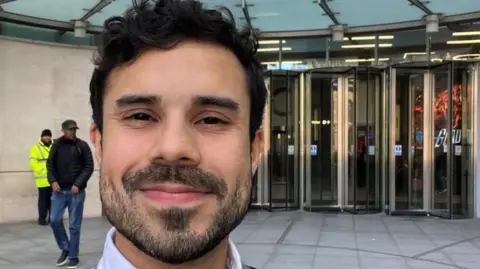
As a fellow Puerto Rican, whenever someone asks why I identify with Bad Bunny, the first thing that comes to mind is that, at some point in our lives, we've both worked in supermarkets packing customers' groceries.
Many people I know have done the same - we share a common past with the Latin rapper and singer who headlined Sunday's Super Bowl half-time show.
And of course, I'm talking about our origins, not just the experience of packing groceries or pushing shopping carts under the Caribbean sun.
 Ronald Alexander Ávila-Claudio
A lot has happened to Bad Bunny, real name Benito Martínez Ocasio, since then.
Now at the peak of his career, after a decade of milestones and record-breaking achievements, he performed on Sunday almost entirely in Spanish at Santa Clara's Levi's Stadium for an audience of 125 million viewers.
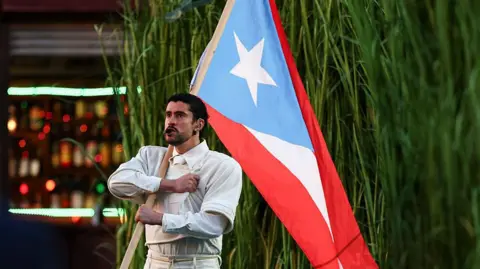
As he sang hits like Tití Me Preguntó and Baile Inolvidable, he moved through a set designed to evoke the sugarcane fields that once powered Puerto Rico's economy; a small rural home; and El Morro, the iconic colonial fort in Old San Juan.
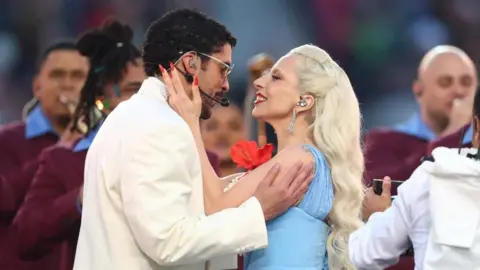
Salsa, reggaeton, bomba, and plena rang out during the 14-minute set, which included guest performances from Lady Gaga and Ricky Martin, along with cameos from the likes of Pedro Pascal, Cardi B and Jessica Alba,
Although the show carried a message of unity and vindication of Latinos in general, the artist sang from and for Puerto Rico.
As scholars Vanessa Díaz and Petra R. Rivera Rideau note in the book P FKN R: How Bad Bunny Became the Global Voice of Puerto Rican Resistance, his success stems from the "intimate connection he maintains with the island".
He remains a controversial figure and doesn't resonate with all Puerto Ricans equally.
But many of us see in his lyrics, rhythms, and image a reflection of our reality and of the tensions around growing up in a place with its own identity that nonetheless exists legally within the most powerful country in the world.
What connects me to Bad Bunny
Like Martínez Ocasio, I grew up in a small town: he in Vega Baja in the north of Puerto Rico, I in San Lorenzo in the south-east.
His mother was a schoolteacher and his father was a truck driver with no connections in the music industry. My mother, far removed from the media world, worked in a factory.
My childhood, like his - as the artist once described in an interview with The New York Times Magazine - felt "far away" from the bustle of San Juan, even though the capital was only a 45-minute drive.
Each trip to the so-called metropolitan area was quite an event: waking up early, dressing nicely, deciding what we might eat for lunch.
Most often, those trips centred around Plaza Las Américas, a massive shopping mall where, as Martínez Ocasio once said, "you didn't even know where you were standing".
Like him, I learned English as an adult and speak it with a non-native accent, despite being a US citizen, as all people born in Puerto Rico are.
For many of us, mastering another language often depends on whether we can afford private classes.
It's no small detail that, according to the latest US census data, only 22% of the island territory's population feels it can speak English "very well".
Disconnected by limited public transportation, without tourists or major events, daily life in our towns moved slowly, all while shaped by a public debt crisis and a subsequent bankruptcy that caused profound political, social, and economic turmoil.
Over the past three decades, fiscal hardship has left us with a fragile electrical grid vulnerable to hurricanes, mass migration, violence, school closures, and a diminished public university.
Back in 2018, in the song Ser Bichote, from his debut album, the artist sang: "Schools are closing while puntos open. So what do I do? Tell me, I'm asking you."
The "punto" is what we call the places where illegal drugs are sold, the ones our parents always warned us about.
Perhaps only we, Puerto Ricans, understood the reference, and the rest were content to just dance to it.
 IMAGN IMAGES/Reuters Connect
Music filled with symbolism
Even Puerto Ricans who don't share the singer's background feel proud of how his music denounces our struggles while symbolising our culture and identity.
On Sunday, before tens of millions, he recreated and criticised our battered electrical grid while performing the song El Apagón.
He also used symbols like the "pava", the traditional farmer's hat, and the endangered Puerto Rican crested toad.
His songs, such as BOKeTE, blend romance with commentary on the island's deteriorating roads or the historical persecution of the independence movement, like LA MuDANZA.
In the latter, he sings: "People were killed here for waving the flag, that's why I carry it everywhere" - including the Super Bowl.
Puerto Rico has limited influence over US national policy: island residents cannot vote in presidential elections, and their congressional representative has no voting power.
Without sovereignty, bilateral relations, or participation in international bodies, culture remains our primary doorway to the world, and Bad Bunny has opened it wider than ever.
A cross-genre artist
With Bad Bunny, reggaeton has reached unimaginable places. Just last week he made Grammy history by winning Album of the Year with his entirely Spanish album Debí Tirar Más Fotos.
Though the genre has roots in Panama and New York, Puerto Rican artists globalised it.
For years, reggaeton was persecuted on the island. It was mostly young people of Afro-Caribbean descent living in poor communities who sang and listened to it in underground clubs that were often raided by the police.
Over time, artists like Daddy Yankee, Tego Calderón and Don Omar - who Martínez Ocasio honoured during the Super Bowl - helped turn reggaeton into a mainstream genre many of us grew up with.
As Prof Albert Laguna told BBC Mundo last year, Bad Bunny has also become an artist appreciated beyond the reggaeton audience.
His unexpected blends of reggaeton and trap with salsa, merengue, bomba, plena, and other Latin American genres create "an opportunity for conversation across generations", Prof Laguna said.
Another one of his most significant contributions, and a triumph of reggaeton, is the affirmation of Puerto Rican Spanish.
While in the past Latin artists have sung in English to reach the English-speaking market, Bad Bunny has done so with our words and our way of speaking.
It's the same Spanish we've fought to preserve for decades, even amid US efforts to impose English as the primary language.
I've heard more than once that my Spanish is unintelligible, the same criticism some people level at Bad Bunny's songs.
In fact, US President Donald Trump wrote on Sunday on his Truth Social platform: "Nobody understands a word this guy is saying".
Yet others, drawn by the beauty of the music, try to get closer to our Spanish, learning words like "pichear" (to ignore) or "janguear" (to hang out).
Producer MAG, a long-time Bad Bunny collaborator, said in the book P FKN R that the Grammy-winning album Debí Tirar Más Fotos sparked a "cultural movement".
"It feels like the world is embracing us, and Puerto Rico, in such a beautiful way," he was quoted as saying.
This Sunday, we saw that embrace live.
