Lawyers appeal to UN over men jailed in alleged power struggle in UAE

 Reuters
Lawyers acting for two Jordanian citizens who have been detained in the United Arab Emirates (UAE) since 2014 have lodged petitions with the UN claiming they are victims of an internal power struggle within the emirate of Ras al-Khaimah.
Jihad Quzmar and Karam al-Sadeq are serving lengthy prison sentences there after being convicted of offences including the unlawful seizure of public funds, money laundering, bribery and corruption. Both men have denied wrongdoing.
The petitions to the UN claim that they are the victims of arbitrary arrest and mistreatment in prison, and call for their immediate release.
The BBC has approached Ras al-Khaimah's authorities for comment.
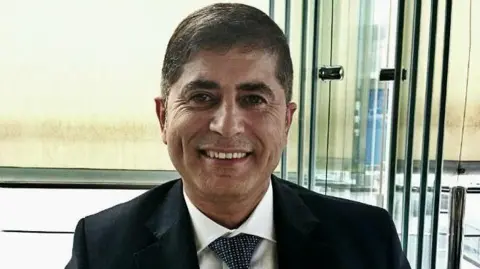
The son of Jihad Quzmar has told the BBC of the emotional toll on his family of the long years of his father's incarceration.
"My dad missed all of our graduations," said Mo Quzmar, speaking from Toronto, Canada. "He missed my wedding and he missed my sister's wedding. He missed the birth of my son."
Mo remembers vividly the day on which his father was arrested, early in the morning of 7 September 2014.
Mo was 21 at the time and not in the UAE, but his mother and younger brother were at the family home in Ras al-Khaimah when there was aggressive knocking on the door.
Jihad Quzmar had only just returned home from a family trip to Toronto. He had received a call from an official telling him to cut short his holiday and come back for business reasons.
While he was away, Karam al-Sadaq - with whom he had worked at the Ras al-Khaimah investment authority, Rakia - had been arrested.
As well as his business interests, Jihad Quzmar is a lawyer who had acted as a legal adviser to the rulers of Ras al-Khaimah.
The men at the door were plain-clothes officers and had arrived in several 4x4 cars.
Jihad Quzmar was first taken to the General Headquarters of State Security in Ras al-Khaimah.
His son said: "I believe he was there for 30 days or so. His cell was extremely cold. He was held by himself. He was unable to communicate with anyone outside."
The family did not know what was happening to him for several months, according to Mo.
Jihad Quzmar was then moved to a camp, Al-Barirat, where the personal security force of the ruler of Ras al-Khaimah is located.
"The conditions there were even worse," Mo said.
"His window was blocked so that sunlight couldn't get in. He didn't have a watch. He didn't know what the time was. The guards weren't allowed to tell him. He wasn't allowed a Quran. He wasn't allowed phone privileges."
In diary entries and letters, Jihad Quzmar gave his own account of what he experienced: "I am in a cell that is 2m by 2m. I sleep sporadically... no more than two hours in every 24... I was in a state of total collapse due to solitary confinement and lack of sleep."
In all, Jihad Quzmar was held in solitary confinement for 466 days, according to his lawyers' petition to the UN Working Group on Arbitrary Detention, a panel of human rights experts which investigates cases of arbitrary deprivation of liberty.
 Quzmar family
The petition says that both Jihad Quzmar and al-Sadeq - who experienced similar conditions in prison - were detained in connection with alleged fraud amounting to around $1.5bn (£1.1bn; €1.3bn) by the former CEO of Rakia, Dr Khater Massaad.
In 2016, Massaad himself was convicted in absentia of fraud by a criminal court in Ras al-Khaimah. The UAE has since tried to have him arrested and extradited. He continues to live outside the country and maintains his innocence.
The petitions to the UN on behalf of Jihad Quzmar and al-Sadeq also allege that their detention is due to the current ruler of Ras al-Khaimah, Sheikh Saud bin Saqr Al Qasimi, believing they were involved in a plot to overthrow him.
Jihad Quzmar refused to make a confession or implicate anyone else in the fraud case. He is currently serving a prison sentence of 24 years.
Al-Sadeq did make a confession, but his lawyers say that he only did so as he was pressured to do so and under the belief it was in exchange for his freedom. But he has remained in jail, serving a sentence of more than 20 years.
Both men are being held in the central prison in Ras al-Khaimah, the fourth biggest of the seven emirates that make up the UAE.
The emirate is a monarchy, with its legal and administrative branches operating within the UAE's federal framework.
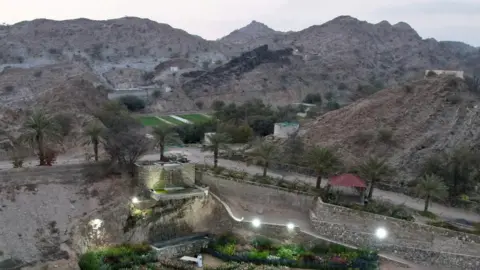
Tourism is an increasingly important part of its economy, with Ras al-Khaimah known for its mountains and coastal landscapes, offering destinations focused on nature and the environment in contrast to the glitzy, ultra-modern experience of Dubai.
The men's lawyers have also filed petitions to the UN Special Rapporteur on Torture.
Mo Quzmar says that direct appeals to the authorities not just in Ras al-Khaimah but in the wider UAE have fallen on deaf ears.
His father is now 63 years old, while al-Sadeq is 43.
Mo says that the years of incarceration have affected his father's health.
At one point he had a lung infection his family says was life-threatening.
Jihad Quzmar is only allowed to speak to a member of his family for 15 minutes per day. Only Mo, his mother and a cousin are permitted to speak to him. He is not allowed contact with his lawyers.
Al-Sadeq is also only allowed to speak to three members of his family, for up to five minutes and not every day.
Mo has not seen his father in person since 2019. He says that Jihad Quzmar has never seen a picture of his grandson.
"I think he's strong," Mo says, "in the way that he's never agreed to implicate anyone.
"Under all these tough circumstances, he stuck to his beliefs, he never thought that any of them did wrong... but at the same time, I feel like he's at a point in his life now, 11 years later, where he just doesn't see a way out."
But Mo says the family has not given up. "We hope the UAE will recognise the severity of the UN complaints which have been filed. We hope this action will finally open the door that has been closed to us for so long and allow my dad to come home."
