Key section of assisted dying bill must be cut, MSPs told

 PA Media
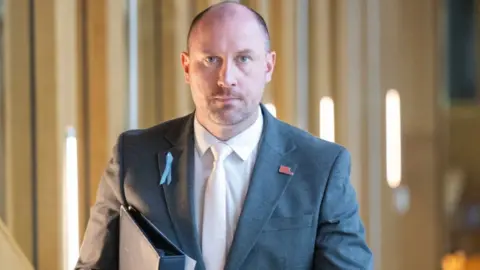
Employment protections for medics who conscientiously object to assisted dying will have to be removed from a landmark Holyrood bill before a final vote, Health Secretary Neil Gray has said.
The minister said those parts of the proposed legislation were beyond Holyrood's powers, and suggested they would have to be added retrospectively if the bill passed.
The Assisted Dying for Terminally Ill Adults (Scotland) Bill would allow terminally-ill, mentally competent adults to seek medical help to end their lives.
The proposals, tabled by Liberal Democrat MSP Liam McArthur, are being scrutinised by MSPs after they passed a vote on its general principles.
McArthur said the issue over devolved powers was " fairly routine", and that he was taking a "belts and braces approach" to reassure MSPs "that the law they wish to see will be the law they get".
A bill to legalise assisted dying in England and Wales has also passed an initial vote at Westminster.
The Scottish bill says no-one would be legally required to participate in the assisted dying process, and that those with conscientious objections must "not be subject to any detriment" as a result.
Such individuals must not be at "any risk of discrimination in the place of their employment" or see an "adverse impact on their current or future employment, training or development" as a result of their objections, the bill adds.
However, Gray told Holyrood's health committee that provisions relating to the regulation of health professionals and protections for those who refused to participate in assisted dying were beyond Holyrood's powers.
He said that hurdle could be overcome if the UK government issued a section 104 order, which would allow Holyrood ministers to change reserved laws to bring them into line with devolved legislation.
However, MSPs heard this could only happen after the bill become law. The health secretary said parts of the bill spelling out protections for workers would have to be removed from the bill before MSPs voted on it and added retrospectively if it passed.
Gray recognised that this would pose "challenges" for MSPs voting on the bill, but said the parliament had a duty to ensure that any bill it passed fell within its legislative competence.
He said failing to do so would leave the "strong possibility" of the legislation being challenged in the Supreme Court.
 Getty Images
Gray - who abstained from the stage one vote - had also warned that powers governing the use of lethal drugs were reserved to Westminster.
However, the UK government has granted a Section 30 order – which would temporarily grant Holyrood ministers powers normally reserved to Westminster – to resolve that issue.
Gray said the UK government granted the order on the proviso that it must sign off on the selection and regulation of substances and devices used in assisted dying.
The health secretary said the "unusual" move would ensure regulatory consistency across the UK.
He added that the Section 30 order had been laid before the final vote "so that members are free to make their considerations based on their own convictions and those of their constituents rather than on whether or not the bill is outside of [Holyrood's] competence".
UK-wide approach 'hugely beneficial'
Asked by Conservative MSP Sandesh Gulhane if the UK government had guaranteed that it would grant a Section 104 order if the bill passed, Gray said negotiations were ongoing.
Gerald Byrne, the government's head of constitutional policy, said section 104 orders were not an "unusual" method of resolving issues arising from devolved legislation, while McArthur described them as "fairly routine".
He told BBC Radio Scotland's Drivetime that he had always been "clear" that issues over medicines and employment protections would need to be addressed for assisted dying to be introduced in Scotland.
The LibDem MSP credited ministers at Holyrood and Westminster for working "constructively" and "at pace".
He added that it would be "hugely beneficial" to have a consistent approach across the UK.
The parliament agreed the general principles of the bill by 70 votes to 56 in May.
MSPs were allowed a free vote on the bill, meaning they were not told how to vote by their parties or the government.
At stage two the bill was considered by the health committee, with MSPs able to table amendments.
To become law, it will need to pass a final parliament-wide vote in March before Holyrood is dissolved for May's Scottish election.
Meanwhile the Terminally Ill Adults (End of Life) Bill – tabled in the House of Commons by Labour MP Kim Leadbeater – is being considered by the House of Lords, with more than 1000 amendments tabled.
Despite peers being given extra time to debate the proposals the bill could fall if it is not passed in both the Lords and the Commons by the spring, when the current UK parliamentary session ends.
