Searching for the artistic legacy of the 1986 National Garden Festival

 BBC
BBCThere were "probably too many" sculptures at the National Garden Festival when it was held in Stoke-on-Trent in 1986.
That is the surprising admission of the woman in charge of looking after the more than 100 public artworks for the event, Vivien Lovell.
Many of the sculptures were forgotten, one was damaged (and subsequently rebuilt) and some have disappeared altogether – but a handful of them can still be found dotted across Stoke-on-Trent, offering a lasting memory of the summer when the city welcomed the biggest spectacle it had ever seen.
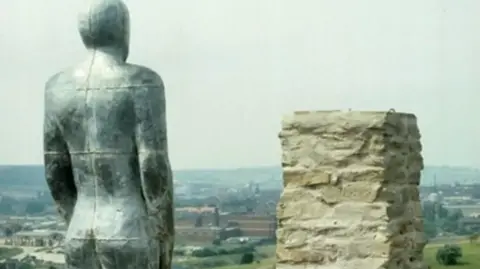
One of the most prominent was Antony Gormley's A View, A Place:
 Dave Ball / Sheffield Hallam University
It was positioned alongside a triangulation pillar at the highest point on the site, overlooking a place where industry and nature met.
"For me, industrial heritage and the memory of the industrial revolution is just as important as Stonehenge," Gormley said.
The artist subsequently went on to create The Angel of the North and Another Place which comprises a series of cast-iron, life-size figures spread out along Crosby Beach.
A View, A Place was a mould of Gormley's own body, with his arms placed in front of his thighs.
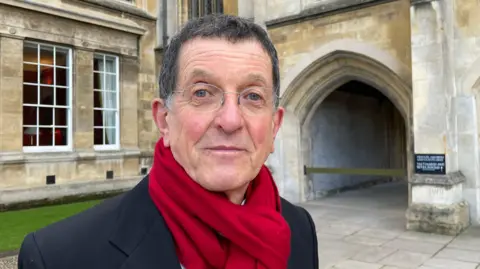
The lead body case had openings where its eyes would be - so people could see inside its dark interior, he told me.
However the figure had to be removed before the end of the festival because people would poke their fingers into the eye sockets.
According to Lovell, they became enlarged and ultimately distorted the aesthetic of Gormley's work.
However, it was more curiosity than vandalism, she added.
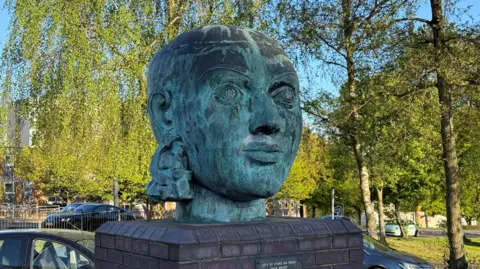
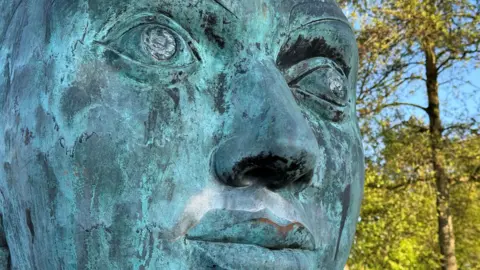
Other sculptures, such as Dhruva Mistry's sculpture Her Head, have become permanent public artworks in the city.
The piece was given to the city by the Henry Moore Foundation and moved to its current location on Potteries Way in 1988.
The work is now among 24 heritage landmarks across Stoke-on-Trent that were set to share a £240,000 pot of money from The National Lottery Heritage Fund tp restore and protect them.
"These landmarks matter to local communities," said council leader Jane Ashworth.
"They help tell the story of our city and the people who shaped it."
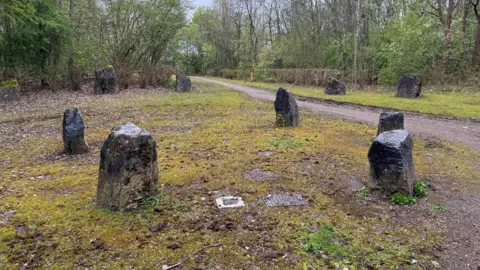
Other artworks created for the festival were more ethereal – including an audio piece set up by British Telecom.
The firm arranged for a free-to-call phone number to operate for the entire summer, for people to call where they could listen to individuals speaking about their own experiences of gardening.
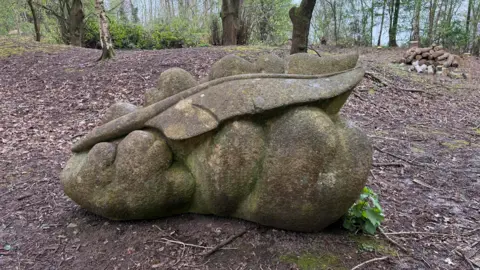
But perhaps the artwork created for the festival that has become most infamous was Vincent Woropay's sculpture of Josiah Wedgwood.
It was inadvertently demolished during construction of a new road, leading to the resignation of the council's deputy leader at the time.
The brick-built head, known as Capo, was rebuilt and installed at Etruria Hall which was later the headquarters for the 1986 edition of the National Garden Festival.
Chloe Chard, Woropay's widow, said he would have been "so delighted, and touched, and relieved" to see his work restored.
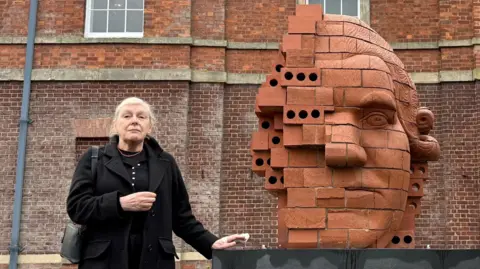
"It was not envisaged by the festival that sculpture would be a really major component but that's what happened," Lovell said.
She added that it had been particularly good for enabling younger artists to try their craft.
"It was really giving very young artists their first opportunity," she said.
"They weren't always successful, they didn't have to be, but it was a way of testing out ideas in public.
"Watching the public interact with the works was an absolutely brilliant experience."
She added the idea was to use art as part of regeneration.
"I think it achieved its aims," she said.
"It's now widely accepted that art is an essential element in that process."
Follow BBC Stoke & Staffordshire on BBC Sounds, Facebook, X and Instagram.
