How a Birmingham firm is building an electric lorry charging network

 BBC
BBCAs fuel prices drift up while the war in Iran continues, one side effect is more haulage and logistics companies are considering adding electric lorries to their fleets.
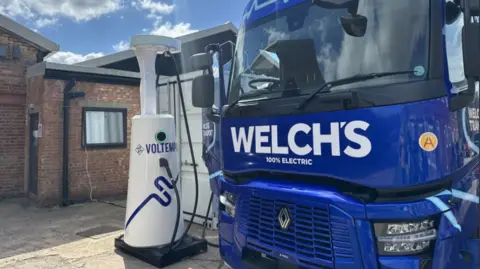
In the Tysley area of Birmingham there is a company that is responsible for building the national lorry charging network, Voltempo.
In a few years this company has gone from a handful of employees to more than 50.
They design, build and install the massive chargers that electric lorries need, creating the network the vehicles will depend on.
The CEO of Voltempo, Simon Smith, told me they already have 35 sites and more are on the way.
"They are all in prime locations. Easy to get to and accessible," he said.
"That allows fleets and hauliers to be confident the charging will be in place when they are on the move."
All around me in the factory, people are busy building charging stations ready to go out for installation.
An HGV charger is similar to one an electric car owner might use - it just provides a lot more power.
You also can not just drive up to one and hope it is free.
Instead, when a company installs a group of six chargers at their depot they have the option to earn some money and allow other companies to use the chargers when they are available.
All booked through an online system.
It is a clever approach that is rapidly expanding the national network.
But is an electric HGV really cost effective?
"They do cost more, although the prices are coming down," said Chris Welch of Welch's Transport.
"But when a third of my cost base is fuel, switching to electric could reduce that to a 10th of my cost base."

Currently, Welch's have six electric HGVs in a fleet of 70 vehicles, but the firm is looking to get more, especially as fuel prices keep climbing.
An electric lorry can potentially make money when it is not out on the roads, because they can be used as batteries, storing energy from the grid when it is cheap to buy and releasing it when demand and the price are higher.
Beyond that, these vehicles have no exhaust and fumes and they are exceptionally quiet.
Driver Liam Ely told me he noticed how quiet they were to drive when he realised he wasn't blasting the radio in his cab to drown out the engine noise.
The chargers built in Birmingham by Voltempo will be the driving force behind electric HGVs.
Follow BBC Birmingham on BBC Sounds, Facebook, X and Instagram.
