Warning of long airport queues under new EU border control system

 Getty Images
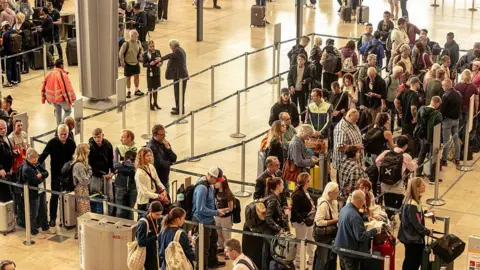
There are warnings of queues at passport control at airports in Europe over upcoming holiday periods, as the rollout of a new biometric border system continues.
Passengers have already reported hours-long waits at some destinations, at busy times, due to the new systems.
A group representing airports said there was a risk of five-to-six-hour queues over the summer.
However, the European Commission said it would be possible to suspend the new system at peak times until September.
Allow TikTok content?
Videos posted on social media in the past week describe three-hour queues at Geneva airport's passport control.
Geneva always gets busy during winter as skiers, Brits among them, head for the slopes.
But the airport is blaming the new Entry-Exit System (EES) at border control for "congestion... particularly on Saturdays during the busy ski season".
A spokesperson said implementing EES had been a "major challenge for Swiss customs and Geneva Airport".
The spokesman said measures to try and make the process smoother included putting on more staff.
 Getty Images
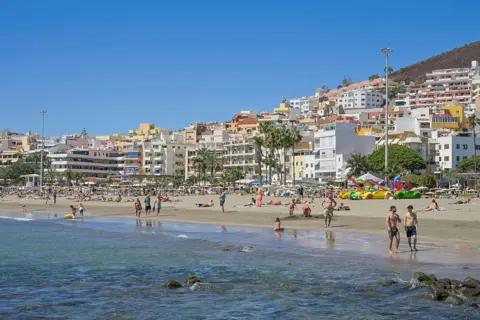
Long waits have been reported at Tenerife, in the Canary Islands, too.
Andrew Knight runs Sanasty Car Hire at Tenerife airport. Most of his customers are from the UK. Many of those arriving for winter sunshine have got stuck in long lines of passengers trying to get through the border kiosks.
Those who have arrived at quieter times have progressed through passport control quickly, butwhen when multiple aircraft have landed in short succession, queues have built up.
Some passengers have been getting through passport control "in about 20 minutes, other people are experiencing one and a half, two-hour delays waiting to use the systems. A few times the systems have gone down, so it's really hit and miss."
 Getty Images
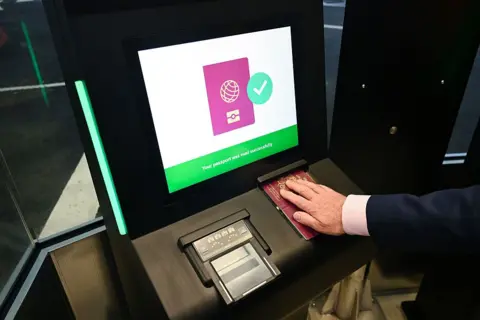
The digital Entry Exit System will eventually replace ink stamps on passports.
It requires non-EU citizens to register fingerprints and a photo alongside having their passport scanned the first time they cross a border of the Schengen free-movement zone. This registration lasts three years.
Air travellers do it upon arrival at European airports, usually with an automated machine or kiosk. The details are verified on future entries.
The system is part-way through a gradual introduction period which began in October.
At the moment, half of border points are meant to be operating EES, with at least a third of non-EU passengers using it.
Julia Lo Bue-Said, who runs travel agent network Advantage Partnership, said "without question, the new system has created even more bottlenecks and pinch points [in places] that were already challenged."
Border process takes longer
Olivier Jankovec is director general of Airports Council International Europe, which represents more than 600 airports.
He told the BBC the passenger processing time at border control had increased by "four to five times" under EES, with people typically waiting up to two hours.
Jankovec said problems included not enough border staff, and some machines not working.
He fears the situation will worsen when large numbers of holidaymakers register over Easter and summer.
Markus Lammert, European Commission Spokesperson for Internal Affairs, says 23m entries and exits have already been registered under EES, and there have been 12,000 refusals of entry.
He insisted the system has operated "largely without issues", but said member states would continue to work on improvements.
From 10 April, EES is meant to be in use at every border point, for every eligible passenger.
However, countries can partially suspend EES operations where necessary over the summer, until September.
Jankovec said this would be necessary to cope if "the situation becomes unsustainable at border control".
Without it, and if issues around the equipment and border guard numbers didn't improve, he warned of five-to-six-hour waiting times.
The group said close coordination was needed with border control authorities to make sure they could suspend the system "in a timely manner".
On Thursday, travel association ABTA said border authorities were under-using their ability to reduce checks when necessary, and said this had led to passengers being "caught up in lengthy delays".
ABTA said that as well applying the contingency measures, destinations and border authorities need to do more to plan for peak travel periods.
Julia Lo Bue-Said advised people to come prepared for long waits over the February half term and beyond.
"Plan for the worst", she advises, especially at peak times. "Make sure you've got some refreshments, make sure you've got something to keep [small children] occupied".
Correction 5 February 2026: The story has been updated to correct the name of Andrew Knight's business, which is Sanasty Car Hire.
