Asia governments to cap fuel prices as oil costs jump

 Getty Images
Some countries across Asia have announced measures to deal with the impact of soaring global energy costs caused by the US-Israel war with Iran, including capping petrol prices.
On Monday, crude oil surged above $100 a barrel on concerns about potential shortages due to prolonged disruption to Middle East energy supplies.
At the weekend, Iran named Mojtaba Khamenei as its new Supreme Leader - a sign that hardliners remain in charge of the country - while some Gulf countries halted oil production and there were fresh airstrikes in the region.
East Asian nations have been hit especially hard by the conflict due to their reliance on energy that comes through the key Strait of Hormuz sea route.
Authorities in South Korea and Thailand said they would set limits on fuel prices.
South Korean president Lee Jae Myung said his government would "swiftly implement" a price cap on petrol products.
The Iran conflict has created a "significant burden" on the country's economy, which is highly dependent on the region's energy, Lee said during an emergency cabinet meeting.
He added that Seoul is ready to step in with additional measures and expand the country's 100tn won (£50bn; $67bn) financial markets stabilisation programme if necessary.
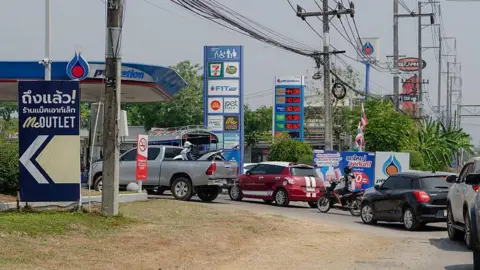
In Thailand, Prime Minister Anutin Charnvirakul urged people to not stockpile fuel and announced plans to cap the price of diesel for 15 days. Long queues formed at petrol stations around the country in recent days, with supplies running low at some outlets.
South Korea's trade ministry also warned oil firms that any attempt to take advantage of the crisis will be dealt with, calling for "transparent and fair" pricing after the cost of petrol rose in recent days.
Vietnam's finance ministry said it is are preparing to temporarily remove taxes on fuel imports.
In the Philippines, new measures aimed at saving energy came into effect.
President Ferdinand Marcos Jr on Friday announced plans for a four-day working week for most public offices, with the exemption of critical services like fire stations and hospitals.
Universities in Bangladesh are also shut from Monday to save energy, according to state media.
US President Donald Trump has said on Sunday that a short-term jump in oil prices was a "small price to pay" for removing Iran's nuclear threat.
Energy Secretary Chris Wright said oil and gas prices will fall when the US destroys Iran's capability to strike tankers in the Strait of Hormuz, a critical waterway for around 20% of the world's oil.
Shipments through the strait have come to a standstill after Iran threatened to attack vessels that try to pass through the channel as a response to the US and Israeli airstrikes.
Reopening the strait to shipping is key to easing energy prices for Asia as many major economies in the region are reliant on energy from the Middle East, said Roc Shi from the University of Technology Sydney.
The effective closure of the waterway is a "supply chain crisis, not just a price spike" especially for Japan and South Korea, both of which source the majority of their energy from Gulf states, he added.
Plans to set fuel price caps are "politically attractive" as they offer "visible relief", but risk backfiring if the move leads to panic buying and a shortage of petrol, Shi said.
How long the surge in oil prices lasts depends on the conflict's duration and how severely supply is disrupted, said OCBC bank strategist Christopher Wong.
Oil prices could unwind "relatively quickly" if tensions in the region ease, but they could continue climbing if there is any disruption to production or shipments, Wong said.
