How gritters work and risk to drivers explained

 Getty Images
With snow, ice, wind and rain warnings in force across the UK, many motorists are worrying about their journeys.
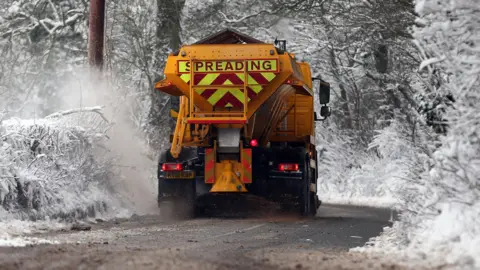
Highways teams across the country will be heading out to help lessen the hazards on the roads by spreading salt, not grit, as it is commonly called.
The rock salt used reacts with rainwater or snow to form a brine solution, lowering the freezing point of the water.
But Martyn Midgley, area highways manager for Gloucestershire County Council at the Stroudwater Depot, said drivers should not assume the roads will be "ice free" just because salt has been spread, with black ice posing a risk to motorists.
Midgley said the solution created by the weather reacting with the salt is similar to the composition of sea water, which "doesn't freeze unless it's exceptionally cold".
"Science also tells us that our salt is really effective down to -7°C (19.4F)," he said.
"After that, it's less effective, but still effective down to about -15°C (5F); after that, things will freeze."
Midgley added the crew's "sophisticated lorries" can spread the salt by a certain rate, which can be adjusted according to the width of the road.
Gloucestershire Highways covers the county's strategic network, meaning its A and B-roads, along with routes to fire stations, police stations, hospitals, and major bus routes.
One salt dome, of which there are four in Gloucestershire, can hold 4,500 tonnes of salt.
In a typical winter, without a "big snowfall event", Midgley said that was enough salt to last Gloucestershire the whole of the winter, although they "don't chance it" and order resupplies.
"For a colder night, we can spread more but it's still got to dissolve into the water, and we need cars to actually help us crush that salt and make it dissolve," he said.

"We always say to drivers, even if we've been out salting, don't assume it's going to be ice free - it could still have black ice, which you can't see.
"Just drive that little bit slower, brake more gently, leave a bit more distance to the car in front and all those good, sensible things."
Follow BBC Gloucestershire on Facebook, X and Instagram. Send your story ideas to us on email or via WhatsApp on 0800 313 4630.
