Why is it so hard to build eco-friendly homes?

 West Oxfordshire District Council
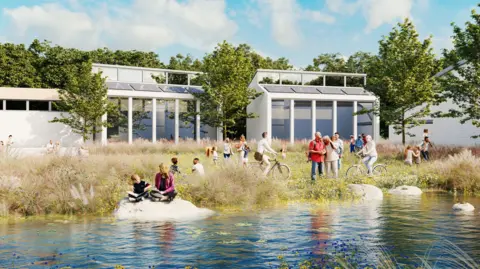
Nine years ago, plans for a garden village for West Oxfordshire were announced by the government.
But if you visit the Salt Cross site, near Eynsham, hedgerows and fields still dominate the landscape where 2,200 homes should be.
In the same time frame, a garden village in Welborne, Hampshire, is getting ready to welcome its first residents.
So why the delay? The main difference between the two developments is the ambitions for the Salt Cross site to be zero carbon. But why does it take so long for new homes, with high environmental standards, to be built?
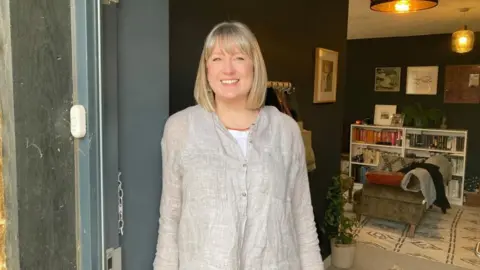
In Hook Norton, to the north of Oxfordshire, a community of 12 low carbon, affordable homes has been built in the time since the Salt Cross development was first announced.
For Rachel Cronin, who was one of the first to move in, the thick walls, triple glazing and smart insulation has led to a significant reduction in running costs.
"The costs of my bills vary, but I think at their most expensive, in high winter, it's £100. But in the summer it's about £50," she said.
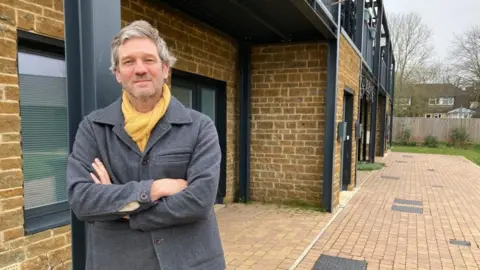
Architectural designer, Charlie Luxton, helped form the plans for the Hook Norton development. He says the government's 1.5 million house building target can be achieved to high environmental standards.
"There's no challenge about speed and sustainability, you need to think a bit harder, but that doesn't mean it has to take a lot longer.
"It might cost a little bit more to build them. We're only talking five to ten percent maximum, but then the running costs of these buildings can be a third or a quarter of what any other house is, so over 30, 40, 60 or 100 years, they are so much cheaper than a standard build," he said.
At Salt Cross, the environmental targets have been described as a "noose around the neck" for developers.
The zero carbon ambitions for the site have been supported by the council and local community but challenged by land owners and central government, as too high to be "viable" and guarantee an acceptable financial return.
Grosvenor represents the interests of landowners of the site and argued having lower environmental targets would ensure a minimum financial return.
The group said the site needed "significant upfront investment" and would be exposed to "multiple market cycles" with "viability depending on finely balanced assumptions about build costs, sales values, and finance rates".
So if the potential building costs go up, on a site of the scale of Salt Cross, the risk could be "magnified considerably."
The decision went as far as the high court, which ultimately backed the zero carbon ambitions for Salt Cross and planning applications are due to come forward later in the year.
For Councillor Andy Graham, leader of West Oxfordshire District Council, sustainable, affordable housing is at the heart of the area's plans for 18,000 new homes by 2043.
"It is a challenge, but once you start moving in this direction it gathers a momentum of its own," he said.
"This is legacy - it's leaving behind something that will make a significant difference in this county, by building this kind of high spec. People want to have good value for money and this one of those things," he said.
A spokesperson for the Ministry of Housing, Communities and Local Government, said, "our planning reforms are designed to help developers get building – making it easier and quicker to get planning permission for much needed homes – including environmentally friendly developments."
