Stormont to investigate rise in 'pimping websites'

 Getty
GettyA Stormont inquiry is to investigate a rise in "pimping websites" in Northern Ireland, amid growing concerns about the exploitation of trafficked and vulnerable women on online platforms.
The inquiry will be carried out by the Assembly's newly formed All-Party Group (APG) on Human Trafficking and Commercial Sexual Exploitation.
It plans to gather evidence from frontline organisations, law-enforcement bodies and survivors, as it examines how these sites operate and what legislative or regulatory changes may be needed to curb exploitation.
The inquiry comes 11 years after the Human Trafficking and Exploitation (Northern Ireland) Act, which criminalised paying for sexual services, passed into law.
An event will be held at Parliament Buildings later on Monday.
It is hosted by the APG and charity Care NI, to mark the start of the inquiry.
Christian Action, Research and Education (CARE NI), has said that since the law received royal assent in 2015, pimping websites "have become the most common way for criminal gangs to profit from the sale of vulnerable women and girls".
What is the law in NI?
The legislation making it a criminal offence to pay, either directly or through another person, for sexual services came into effect in Northern Ireland in 2015.
However, it is not illegal to sell sexual services in Northern Ireland, and it is also not a crime to loiter or solicit for the purpose of offering to sell sexual services.
It is, however, a crime to keep or manage a brothel or to control prostitution for profit.
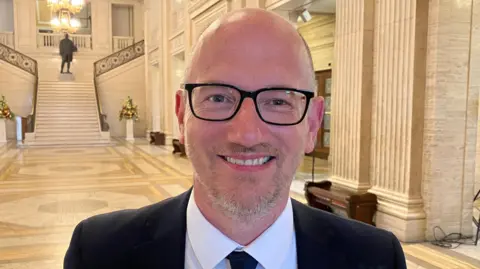
Speaking to BBC Radio Ulster's Good Morning Ulster on Monday, Democratic Unionist Party assembly member for North Down, Peter Martin, who chairs the all-party group (APG), said the inquiry aimed to expose those online platforms which exploit vulnerable women.
"We are clearly concerned about the commercial sexual exploitation of women, particularly where it intersects with modern slavery," Mr Martin said.
He said platforms had hidden behind a narrative of empowerment and safety.
Also speaking on the programme on Monday, Jessica McDowell, a policy officer with CARE NI, said stronger action was needed against criminal gangs profiting from the online exploitation of women.
McDowell said she hoped the work of the All-Party Group would "focus minds on what more can be done" to strengthen existing legislation and better protect vulnerable women and girls.
'More than 800 women advertised'
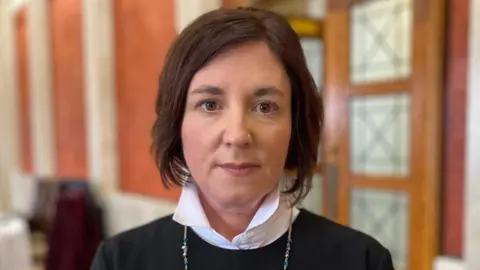
Ruth Breslin, director of the Sexual Exploitation Research and Policy (SERP) Institute, said websites advertising prostitution were "very prevalent".
She said the sex trade "couldn't really operate without it", describing the site as where sex buyers go and where organisers and traffickers advertise "often very vulnerable women, many of whom have been sexually exploited and trafficked".
Breslin said that while it was illegal to purchase sex in both Northern Ireland and the Republic of Ireland, it was not illegal to sell sex, meaning women involved were not breaking the law.
However, she said there had been "serious problems with the implementation" of the legislation and called for "much stronger action against sex buyers".
"After all, they are the reason this trade exists - they create the demand that draws vulnerable women into prostitution," she said.
She said more than 800 women were being advertised on the one particular site on Monday morning.
Adult services websites 'already regulated'
Lucy Smith, the founder of the sex worker safety scheme Ugly Mugs, told BBC Radio Ulster's Talkback programme that websites now play a central role in how many sex workers operate.
"Sex workers commonly use the internet now, on what they call adult services websites," Smith said.
"That's where they advertise and engage with clients, specify what they do and don't provide, and negotiate safety."
Smith explained that these platforms are already subject to regulation under the Online Safety Act 2023.
"That legislation places an onus on websites, wherever they are based in the world, to take a wide range of measures to detect, report and remove potential trafficking, and to proactively report any cases of trafficking to the police."
Smith added: "Those websites are currently regulated by Ofcom, but there is a question about whether there needs to be further regulation."
While she said they would "cautiously welcome" the inquiry, Smith stressed that its approach would be crucial.
"Obviously, anything that can be done to prevent trafficking and support victims of trafficking is important," she said.
However, she warned they would take issue if the inquiry sought the introduction of "legislation based on Christian lobby groups' feelings about sex work," adding that "we want to see policies based on evidence."
PSNI working 'tirelessly to identify offenders'
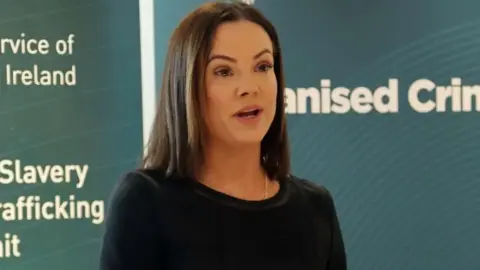
In a statement, Det Insp Rachel Miskelly from the Police Service of Northern Ireland's organised crime branch said sexual exploitation was often an unseen crime, but stressed that detectives were working tirelessly to identify offenders.
She said protecting vulnerable people, disrupting organised crime and safeguarding communities "remained a priority", adding that officers would "follow all available evidence and take firm and proportionate action where offences are identified".
 Pacemaker
Miskelly said that some victims may be "too frightened to speak out" or may not realise they are being exploited, and emphasised that tackling sexual exploitation "cannot be done by policing alone".
She urged anyone with concerns about sexual exploitation to come forward.
