Dyspraxic teen says VR has improved co-ordination

 BBC
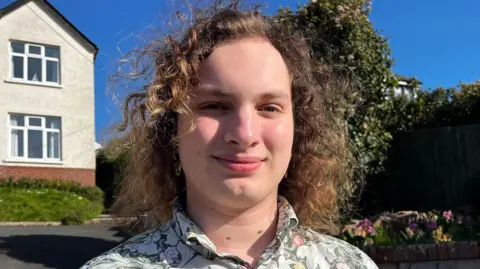
BBCA teenager living with dyspraxia says his movement and spatial awareness is improving thanks to virtual reality (VR).
Sixteen-year-old Frankie Farrow, from Crediton, Devon, was diagnosed with the neurological condition that affects physical co-ordination at the age of eight.
Frankie took part in a study at the University of Exeter that showed playing a VR game improved hand-eye coordination and reactions.
Academics at the university said the technology might be "an effective way to improve motor control in children and adolescents with dyspraxia".
 Family handout
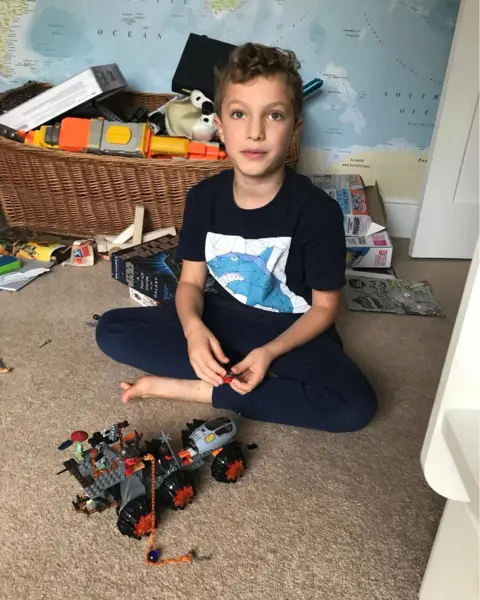
"I've definitely adapted my life around it [dyspraxia], but there's certain things... that can be tricky," Frankie explained.
"I have a poor sense of coordination and I can't do certain things as easily with my hands, and I'm just not very aware of my surroundings."
Frankie, who is studying at a local college, said his movement was "pretty normal" but he did bump into things "quite a lot" and "sometimes I'll drop things".
Dyspraxia - also known as Developmental Coordination Disorder, according to the the NHS - affects movement and co-ordination.
It is believed to impact about 5% of children and adults, including at least two pupils out of every class of 30 in the UK.
Every individual is different, but people living with it can struggle to do things such as grasp, kick or throw, as well as walk, run and jump.
This, in turn, could affect confidence and quality of life, experts said.
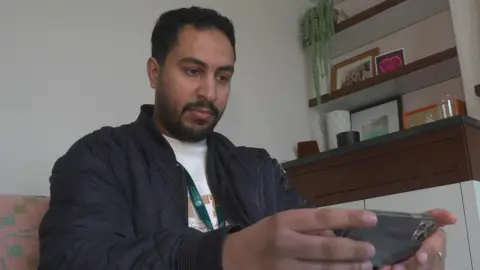
Mohammed Alharbi, a PhD student at the University of Exeter, has been spearheading the research.
He said: "The VR game gives the children in the study confidence and motivation to participate, especially in schools or in the community.
"But I think the most important thing that children report is that using the VR is more fun and they're more motivated to play it, rather than, say, do repetitive exercises that physios often suggest for dyspraxia."
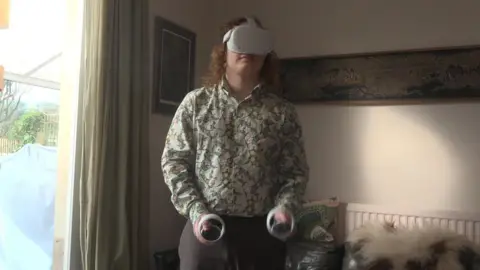
The study involves a virtual reality game called Beatsaber.
In it, they wear a VR headset and see blocks fly towards them which they must hit back to the beat of music.
Frankie is one of 27 young people aged 10 to 16 currently working with the university to find out what impact immersive virtual reality can have on dyspraxia.
Researchers said it was the first study of its kind involving children and young people with the condition and virtual reality.
They claimed that those using the VR for 30 minutes a day for a week showed improvements, particularly in upper body dexterity.
Dr Gavin Buckingham is a cognitive psychologist in the Department of Public Health and Sports Science at the University of Exeter, and the project supervisor.
He said: "These findings provide some promising early evidence that virtual reality games like Beatsaber might be an effective way to improve motor control in children and adolescents with dyspraxia.
"The next step would be to investigate whether virtual reality can help children enjoy a broader range of sporting activities at a young age."
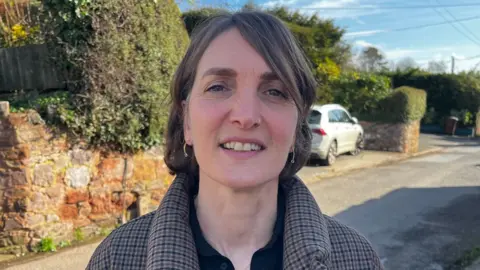
Frankie's mum Beccy Farrow said her son's condition had improved as he had got older - a common trait of dyspraxia.
But she added that she hoped virtual reality would be another tool to help him overcome obstacles.
She said: "I think the most important thing for me, especially as a mum, when he was little... his behaviour wasn't a choice, and it wasn't behaviour because of an emotional thing.
"This was just literally a processing, a planning issue that was causing him to dysregulate [not be able to control his emotions].
"Sometimes it's just your physicality that's the underlying cause."
Follow BBC Devon on X, Facebook and Instagram. Send your story ideas to spotlight@bbc.co.uk.
