2025 one of the lowest yielding years, says farmer

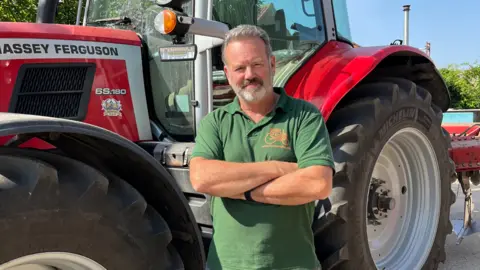 Richard Bramley
A North Yorkshire farmer has said 2025 has been "one of the lowest yielding years" for certain crops in recent memory.
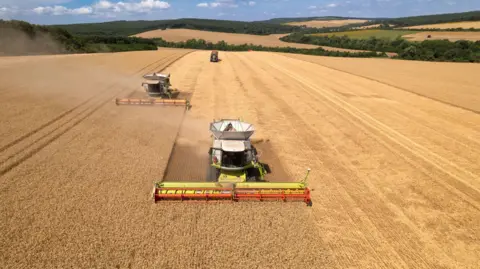
Richard Bramley, an arable farmer from Kelfield, near Selby, estimates his yield for crops such as cereal and oilseed was down 20-25% this year due to the drought that affected Yorkshire in the summer.
Mr Bramley said while there was always going to be challenges in farming, ending on "the right side of things financially" was growing increasingly difficult in recent years, due to unpredictable weather patterns.
This month the Met Office said that 2025 was on course to be the UK's hottest year since records began, with climate change driving higher temperatures.
"The issue we had is that you need more than sunshine; you need moisture," he said.
"While things started off looking full of promise, what happened subsequently is we didn't get the moisture for crops to really capitalise on that."
The year "started off really well," Mr Bramley said, due to the dry weather and sunshine but "as the season progressed, it gradually got more challenging".
Springtime was reportedly the UK's sixth driest since 1836, and the temperature for March to August was more than 2C above the long-term average between 1961 and 1990.
Droughts were declared in Yorkshire, the North West and the East and West Midlands, and as of December water levels are still below average in some places.
The BBC previously spoke to farmers in North Yorkshire who expressed their concern for the consequences that the dry weather would have on their harvest.
Mr Bramley said he was "acutely aware" that the wet weather of the previous two years had also "had a significant impact".
"As a grower of crops here in the UK, I've just had my third challenging year in a row," he said.
He added while root vegetables such as potatoes and sugar beet had established well and produced a good quality yield, it had been a "very poor quality" harvest for other crops.
 Getty Images
Consumers might not notice the difference due to any shortfall being filled by imports, but farmers were feeling the squeeze "at the farm gate", he said.
He attributed this to a number of factors including financial and political pressures, as well as climate change.
"The challenges, climatically for growing food, are global, and a lot of the countries that we rely on for our imports have considerably bigger challenges when it comes to the climate," he explained.
"If we rely too much on those, at the expense of home production, we are setting ourselves up for difficult years to come."
Looking ahead to next year, Mr Bramley said it was a farmer's job to "manage volatility" as much as possible, but that a certain amount of luck was involved.
"The rule of thumb is the most important day of a crop's life is when the seed goes into the ground - that's our starting point," he explained.
"We have to rely a little bit on luck, but it's always the case in farming, you know you're always going to have good years and bad years.
"You just hope you end up a bit more on the right side of things financially, and that's certainly something that's getting a lot more challenging in the last few years."
Listen to highlights from North Yorkshire on BBC Sounds, catch up with the latest episode of Look North.