'Wildly unaffordable': The harsh reality of shared ownership

 BBC
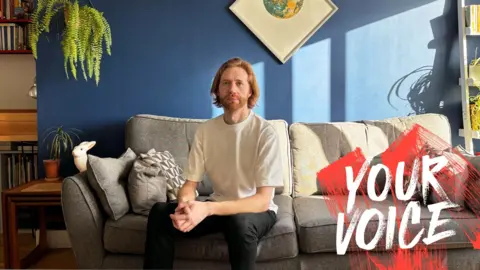
BBCWhen twin brothers Riccardo and Simone Bertagna bought a share of a three-bedroom flat in Seven Sisters, north London, they told me they felt "proud".
"It felt good. I felt I achieved something," says 35‑year‑old Riccardo.
They bought a 25% stake in the property, which had a total value of £440,000, through a housing association. It meant paying a mortgage, rent on 75% of the property, and a service charge of around £90 a month.

The brothers saw it as a good investment and "more stable" than renting in the capital. It also worked out at £50 a month cheaper than when they were tenants.
But a few years ago the flat was devastated by an external leak. Rising service costs and disputes about who was responsible have left the brothers feeling "trapped" in an "unsellable" home.
They say that despite the leaks, a broken lift, "dirty" communal areas and "no visible improvement to the property or complex", the monthly service charge has continued to rise to just under £300.
Their housing association told us their concerns are being investigated and that shared ownership responsibilities are clearly set out before purchase.
Riccardo and Simone are among a hundred or so people who have contacted BBC Your Voice about issues they face in shared ownership properties.
Shared ownership is a government‑backed affordable housing scheme that allows eligible buyers - those who cannot afford a full deposit and mortgage and whose household income is below £80,000 (or £90,000 in London) - to purchase a property in portions over time to help them move into home ownership.
The homes are usually sold through a social landlord, often a housing association.
A report out today from the National Audit Office (NAO) says complexities within shared ownership mean customers can be caught out by issues such as increasing service charges, and many who take up the scheme don't fully understand the longer-term financial risks.
There are forms of shared ownership in Northern Ireland, Scotland and Wales. In England, it is the largest affordable housing scheme for home ownership.
'It's just not sustainable'
But Jamie, who acquired her home through the scheme, says: "I don't think it's affordable at all."
Jamie is a single parent and bought a 25% share of a three‑bedroom flat in north London to share with her child and disabled mother. She says she is struggling to afford her home after service charges rose to more than £8,000 per year - an increase of nearly 50% in under four years.
From April, she faces paying £683 per month in service charges on top of her rent and mortgage payments. Housing costs, before bills, now take up more than half of her income.
"My net income is about £2,998 a month, and my housing costs are now over 50% of that. It's just not sustainable."
"I knew there would be service charges," she says, "but shared ownership was advertised as affordable housing."
Jamie's housing association said it understood her concerns about rising costs, and would contact her to provide clarity on charges.
There are around 250,000 shared ownership homes in England.
The NAO investigation found that service charge increases could create affordability pressures over time for shared owners. Shared owners are also leaseholders and, while they may only own a small share of the property, they are obliged to pay 100% of the service charges.
Service charges cover the costs of buildings insurance, repairs and maintenance to the exterior of the properties, such as the cleaning of shared spaces or upkeep of communal gardens. There is no official cap on charges, but they are supposed to be "reasonable".
George Andain says shared ownership was his "only chance of getting a foot on the property ladder".
He bought a 45% share of a flat worth £340,000 in central Brighton in 2021. He says his mum and brother "explicitly asked the question about service charges", but they were reassured that they were unlikely to increase drastically.
The service charge for his one‑bedroom "affordable" flat was around £120.

Purchasers through the scheme must pass strict affordability checks, and for Andain, the mortgage, rent and service charges put him at the "limit" of what was manageable.
So when he received a "shocking" letter 18 months later saying his monthly service charge was going up to £327 - a sum he "absolutely just could not afford" - he was stunned.
In the same year, he also received notification that the housing association had underestimated the previous year's service charge, and he and other homeowners received an extra bill for more than £2,000.
The NAO says that the uncertain nature of service charge increases "poses the greatest risk to households whose initial affordability assessments leave them with limited financial headroom".
While the issue of service charges is being consulted on through the Leasehold and Freehold Reform Act 2024, George believes these charges should be regulated in a similar way to how social rents are capped.
Andain's housing association told us that a managing agent, appointed by a freeholder, sets the service charge and it had challenged increases and requested justifications.
Sir Geoffrey Clifton‑Brown, Chair of the Committee of Public Accounts, said that while the scheme offers a "pathway" to homeownership, it is "wholly unsatisfactory" that people who have bought through shared ownership "have been faced with cost pressures and complexities".
Unable to sell
The report also looks at the "barriers" to staircasing, where people can buy an additional share of their property. The investigation found that each time a shared owner did this, they were required not only to fund the additional equity purchase but also pay for a Royal Institution of Chartered Surveyors (RICS) property valuation, additional legal fees, and a landlord administration fee.
Increases in service charge costs can also act as a barrier to staircasing, as they reduce the income available to fund greater home equity, the report found.
Some shared owners we have spoken to say their service charge is so large that mortgage companies won't lend to them – leaving them stuck with the percentage they originally bought and unable to sell.
That's the position George says he is now in. "I feel trapped here," he says.
"If we wanted to start a family, we're going to be in a one‑bed flat until there's some kind of resolution."
Patrick Duffy and his NHS‑worker partner, Lewis, managed to staircase from a 40% share to a 60% share of their east London flat.
But the process is "messy and complicated", says Patrick. The couple pay rent on 40% of the home, have two separate mortgages at two different interest rates, and face a service charge of £602 per month. Patrick says the system is "supposed to be affordable housing, but it's wildly unaffordable".
Patrick says he has friends who have "successfully" staircased and ended up as full homeowners through the scheme, but believes that in his case "there are too many elements that are unregulated".
The NAO report found that shared ownership is forecast to be cheaper than private renting in 93% of areas across England over 10 years.
The study suggests that over that period, shared owners are, on average, £29,000 better off - rising to £42,000 in London.
The Shared Owners' Network said: "We are calling on the NAO to build on this report and launch a Value for Money investigation to determine whether the shared ownership scheme truly provides affordable homes, meets its policy objectives, and makes effective use of public funds."
The National Housing Federation said shared ownership had successfully helped hundreds of thousands of people onto the housing ladder and encourages housing associations to adopt its code of "best practice" which ensures a fair system.
Both it and the government acknowledge challenges faced by some. A government spokesperson said: "We have already strengthened shared owners' rights, made sure there is greater transparency and fairness of costs, and enhanced data collection.
"We continue to explore what more can be done to improve the experience of shared owners."
There were 20,353 shared‑ownership homes built using grant funding in 2024–25, more than in any other year in the past decade and making up 11% of the supply of all new-build homes.
Many more homes are being planned as part of the government's plans to build 1.5 million homes. But the NAO warns that the government needs to "make this scheme work better" to give people truly affordable housing.

Sign up for our morning newsletter and get BBC News in your inbox.

