Rows over flags, football and censoring Christmas cards - inside the first executive

 Getty Images
Newly-released state papers reveal more details about a row over flags within the first power-sharing executive after the Good Friday Agreement.
The refusal by Sinn Féin ministers in 1999 to fly the union flag at their departments on Christmas Day infuriated unionists.
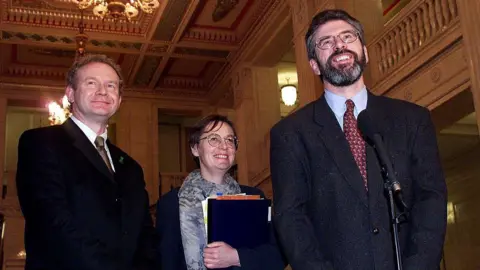
At the time, Martin McGuinness had just been appointed Education Minister and Bairbre de Brún was Health Minister.
Files released by the Public Record Office of Northern Ireland (PRONI) show how unionist ministers complained in one of the first arguments within the new executive.
 Getty Images
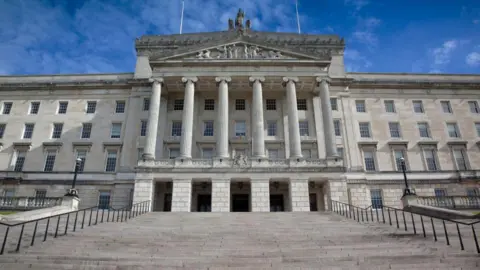
The Good Friday Agreement brought unionists and Sinn Féin together in government at Stormont for the first time.
When the newly-established Northern Ireland Executive re-convened after Christmas on 11 January 2000, the Ulster Unionist Party's Environment Minister Sam Foster referred to "the lack of consistency in flying the union flag on government offices on Christmas Day".
Then DUP Social Development Minister, Nigel Dodds, registered "in the strongest terms" his opposition to "any minister who refuses to abide by the schedule for days for hoisting flags on government buildings".
He was clearly referring, though not by name, to the two Sinn Féin ministers.
This view was communicated in writing because DUP ministers refused to sit in the executive alongside Sinn Féin.
 PA Media
Legal advice concluded that the royal prerogative which commanded when the flag should be flown in Great Britain was "without legal authority in Northern Ireland".
Under the provisions of the 1998 Northern Ireland Act, regulations governing the flag had become "a transferred prerogative matter", precluding Her Majesty's "command on flags … having any legal effect in Northern Ireland".
Therefore, "the issue of the flying of the Union flag from government buildings is for individual ministerial discretion".
The dispute resulted in the then Secretary of State Peter Mandelson introducing regulations governing the flying of the union flag in Northern Ireland.
This was done at Westminster later in 2000 while devolution was suspended.
Football shirts
Two years later, as the Republic of Ireland and England prepared to play in the 2002 FIFA World Cup, there was a query from the Department of Finance and Personnel as to whether asking staff not to wear "football shirts which clearly display the country and emblem of the team they are supporting" was "infringing on their human rights".
The Social Security Agency differentiated between "aggressive" football shirts and "non-aggressive" symbols such as poppies and fáinnes (a badge worn by speakers of the Irish language).
This demarcation was based on the possibility that "a Roman Catholic may choose to cross … the road if being approached by several men wearing Rangers shirts but would be unlikely to take this action if approached by … people wearing poppies".
Sinn Féin Christmas card
Also in the newly-released papers a row over a Christmas card is revealed.
In December 2004, a Christmas card sent by Sinn Féin's Kilrea branch to staff at Coleraine's Social Security Office was put on display alongside similar seasonal greetings from the PSNI and other voluntary and government bodies.
The office manager refused a request from some staff "who felt offended by the card" to remove it.
The manager felt '"it was only a display of gratitude from an elected representative and offence should not be taken".
According to legal advice "the manager acted correctly", as it was "simply a Christmas card", as opposed to a "Sinn Féin poster or a Sinn Féin calendar", and it would be "a step too far to require office managers to censor Christmas cards".
A compromise was suggested whereby office managers "may wish to consider holding cards which are addressed to the branch' and which could alternatively be 'displayed in the manager[']s office so that staff could see them if they wished".
 Getty Images
Disaster Planning
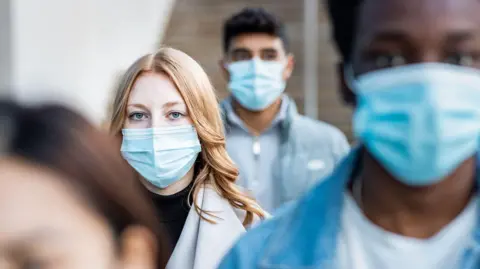
Files dating from 2003, show how the outbreak of SARS (Severe Acute Respiratory Syndrome) in Asia prompted an examination of emergency planning within the Northern Ireland Civil Service to prepare for the possibility of "a major civil disaster, disease/epidemic, or chemical/nuclear incident".
In the event of a SARS-like incident examples of "swift executive action required" could entail a need to "quarantine contacts", "close schools" and possibly "close borders".
The containment of SARS negated the need for these measures in Northern Ireland, but some would be implemented 17 years later in response to Covid-19.
Census computer
A file from the 1960s details the plans for collecting the censuses of population in Northern Ireland in both 1961 and 1966.
The former was the first census in which a computer was used to tabulate the data.
Much to the disappointment of the Northern Ireland Ministry of Finance, use of the computer was not supplied to them free of charge as it was to the General Register Offices in London and Edinburgh.
The estimated cost of conducting the 1961 census was £73,000, but that relied on enumeration being undertaken by the police force at the time, the Royal Ulster Constabulary (RUC).
However, as the IRA was undertaking a border campaign this was not feasible in some areas "where the police are regarded as 'fair game' by the IRA".
This required the employment of 100 additional civilian enumerators at an estimated cost of £3,000.
Five years later, the 1966 Northern Ireland census date had to be moved from April to October because the former date coincided with the 50th anniversary commemorations of the Easter Rising, ruling out the availability of the RUC to act as enumerators.
Professor Marie Coleman is Professor of 20th Century Irish History at Queen's University Belfast
