NI beauty spots share in £16m peatland repair fund

 Getty Images
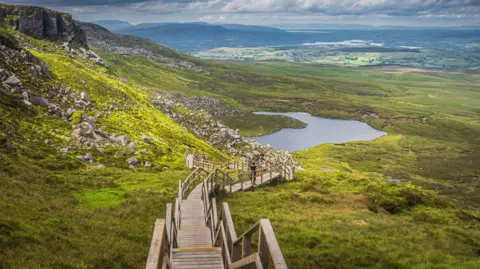
Some of Northern Ireland's "most iconic landscapes" are to benefit from a major peatland restoration project led by the conservation charity, Ulster Wildlife.
The Mourne Mountains, the Sperrin Mountains and Cuilcagh Bog in County Fermanagh are among "19 priority sites" included in the cross-border scheme.
Conservationists will repair and rewet damaged peat bogs on both sides of Irish border, funded by a €19.2m (£16.6m) package from Peaceplus, a programme managed by the Special EU Programmes Body.
Ulster Wildlife's chief executive Dawn Miskelly said they were "delighted" by the scale of the funding which will create 20 jobs and support a further 20 existing jobs.
"Investment in nature recovery on this scale isn't that common but it is exactly what we need if we are serious about halting and reversing biodiversity loss," she told BBC News NI.
 Ulster Wildlife
Miskelly described peatlands as "real powerhouses" of nature which not only support rare and threatened species, but also have the potential to reduce flood risks and tackle climate change.
However, about 80% of peatland on the island of Ireland is "in a degraded state" which adds to carbon emissions rather than reducing them, according to the charity.
Known as the Peat+ Project, Ulster Wildlife will work with local councils, landowners, environmental organisations, academics and Ireland's National Parks and Wildlife Service to restore these special habitats over a three-year period.
Why are peatlands important?
Peatlands are areas of spongy, waterlogged ground where the high volume of water in the soil prevents dead plants from decomposing fully.
Over a very long period of time, the partially decayed plants and other organic material merge together to form peat.
Although peatlands only cover about 3% of the Earth's land surface, they are the planet's biggest natural store of carbon, in the form of decomposing organisms.
Keeping this carbon locked in the ground - as opposed to releasing it into the atmosphere - helps to slow climate change.
Peatlands can also help with flood alleviation because they slow the flow of water through the landscape, according to Miskelly.
"They are good for water quality because they trap sediment," she explained.
"They're also really important habitats for nature and some really specialised species that are only found on peatlands."
 Butterfly Conservation / Jim Asher
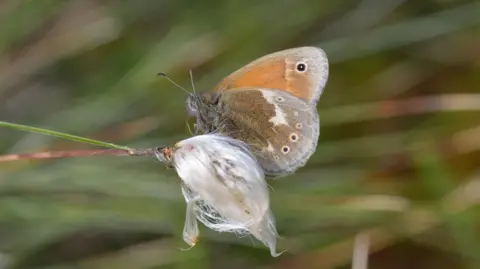
Among the species which have made their home on County Antrim peatland is an insect which is in decline in some parts of the UK.
Miskelly said conservationists "very recently discovered a population of Large Heath butterfly" at Springmount Bog near Clough.
"So what we want to do there is to improve the quality of that bog so that it can remain a home for that population... which is a Northern Ireland priority species."
How do you repair a damaged bog?
It can take thousands of years for peat to form, but before its environmental value was realised, many bogs were damaged when they were drained to grow crops.
Drainage can leave bogs vulnerable to wildfires, and the creation of ditches to enable drainage can increase the risk of flooding downstream.
"So generally what has happened over centuries is that the bogs have dried out and whenever they dry out, that's when they start to release carbon," Miskelly said.
Ulster Wildlife, working with partners and local contractors, plans to increase the water level in the bogs to "bring them into a more healthy state".
"So that can involve things like putting in peat dams or other types of dams to stop the water flowing out of the bog and to allow it to become that big sponge that it wants to be in terms of holding water within the bog," she explained.
 Ulster Wildlife
The Republic of Ireland's Ireland's National Parks and Wildlife Service is among the partners who will be working on the project, with Glenveagh National Park in County Donegal listed among the sites where bog restoration is planned.
Miskelly said the participants represent a "real broad partnership brought together to deliver the benefits".
Stormont's Environment Minister Andrew Muir said his department was very pleased to support the project, which he said would "deliver on multiple strategic objectives".
