Israel says 'limited' ground operations under way in Lebanon

 Reuters
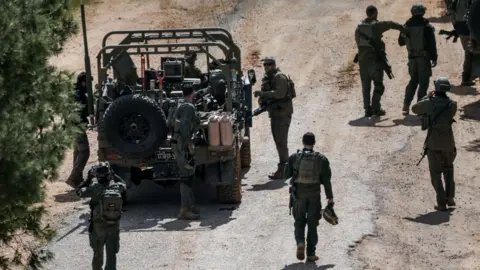
Israel's military says its troops have begun "limited and targeted ground operations" against the Iran-backed armed group Hezbollah in southern Lebanon.
The military said operations had targeted "key Hezbollah strongholds" in recent days with the aim of strengthening the defence of Israeli border communities.
Israeli fighter jets have continued to strike towns and villages across southern Lebanon. State media said nine people, including three paramedics, were killed on Monday.
In Israel, one man was wounded in a Hezbollah rocket attack on the northern city of Nahariya, paramedics said.
Lebanon was pulled into the conflict between Israel, the US and Iran two weeks ago when Hezbollah launched rockets and drones into Israel in retaliation for the assassination of Iran's supreme leader and repeated Israeli strikes since a ceasefire ended their last war in 2024.
Israel said Hezbollah's attack justified launching a new offensive against the group that would continue until it was disarmed.
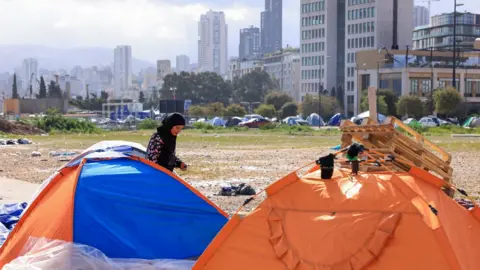
At least 886 people, including 111 children, have been killed in Israeli attacks in Lebanon since then and one million others have been displaced, according to Lebanese authorities.
Two Israeli soldiers have been killed in southern Lebanon, according to the Israeli military.
On Monday morning, the Israel Defense Forces (IDF) put out a statement saying that troops from its 91st Division had begun operating in Lebanon.
"This activity is part of broader defensive efforts to establish and strengthen a forward defensive posture, which includes the dismantling of terrorist infrastructure and the elimination of terrorists operating in the area, in order to remove threats and create an additional layer of security for residents of northern Israel," it added.
IDF spokesman Lt Col Nadav Shoshani said Hezbollah - a Shia Islamist political and military group which is designated as a terrorist organisation by countries including the UK and US - was "intending to expand their operations" in southern Lebanon. It was sending hundreds of fighters from its elite Radwan Force and firing hundreds of rockets a day, he added.
Israeli media reported that three Israeli divisions - amounting to thousands of troops - were now operating in southern Lebanon, with two more due to join them in the next few days.
The ground operations are a new blow to Lebanese sovereignty and will stoke fears of a prolonged Israeli occupation.
On Saturday, US news site Axios reported that Israel was "aiming to seize the entire area south of the Litani river", which is about 30km (20 miles) from the Israeli border.
On the third day of the conflict, the IDF issued a blanket evacuation order for the area south of the Litani, telling all residents to leave immediately as it targeted what it said were Hezbollah positions and fighters. It almost doubled the size of the evacuation zone last Thursday, moving the limit north to the Zahrani river, 40km from the border.
Israeli Defence Minister Israel Katz warned at a meeting with military commanders on Monday that displaced Lebanese Shia residents would "not return to their homes south of the Litani area until the safety of residents in the north [of Israel] is guaranteed".
 EPA
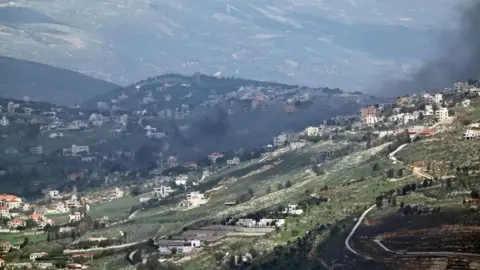
EPAHezbollah said on Monday that it had launched rockets and drones at the Israeli border town of Kiryat Shmona and the northern Israeli city of Nahariya.
Israel's Magen David Adom ambulance service said it had treated a man in Nahariya for blast injuries who was in a mild to moderate condition after a rocket landed between two buildings and sparked a large fire. Six other people were treated for smoke inhalation.
Overnight, Hezbollah said it had shelled an Israeli military position in the Lebanese border town of Aitaroun, and launched rockets at gatherings of Israeli troops in the Israeli border towns of Margaliot and Yuval.
Lebanese media also reported clashes between Hezbollah fighters and Israeli troops around the Lebanese border towns of Khiam, Aadaysit Marjayoun and Taybeh on Monday.
The state-run National News Agency (NNA) meanwhile cited the Lebanese health ministry as saying that Israeli air strikes had killed four people, including two children, in the town of Qantara, just west of Taybeh.
Another three people were reportedly killed in two separate strikes in the village of Kfar Sir, just north of the Litani.
NNA said the first strike had hit a house, killing one person. When an ambulance from the Hezbollah-linked Islamic Health Society (IHS) arrived at the site, there was another strike, killing two paramedics, it added.
A third paramedic was killed in a strike on a civil defence centre belonging to the IHS in Yater, to the south-west, according to NNA.
Following an attack that killed 12 doctors, paramedics and nurses at an IHS-run primary healthcare centre on Friday night, the Lebanese health ministry accused Israel of violating international law by repeatedly targeting ambulance crews while they performed their duties.
The Israeli military said Hezbollah was using ambulances for military purposes - an allegation the health ministry denied.
 Reuters
The leaders of the UK, France, Germany, Italy and Canada released a joint statement warning that a significant Israeli ground offensive would have "devastating humanitarian consequences" and that it "must be averted".
The UN's Secretary General, António Guterres, has appealed for an immediate ceasefire to end "the horrible suffering of the Lebanese people".
Over the weekend, the Reuters news agency and Israeli newspaper Haaretz quoted Israeli officials saying Israel and Lebanon were preparing to hold peace talks in the coming days.
France's President Emmanuel Macron said his country was ready to host the talks in Paris.
Axios reported that there was a detailed French plan for negotiations on a ceasefire and disarming Hezbollah which would require the Lebanese government to formally recognise Israel. Israel and the US were studying the proposal, it said.
However, Haaretz cited a source as saying on Monday that the talks had been postponed after Israel pulled back from the plan.
Israeli cabinet minister Zeev Elkin told Army Radio that Israel would not compromise on disarming Hezbollah. "Lebanon has to choose: will it remain hostage to Iranian interests or will it disarm Hezbollah?" he said.
Lebanon's foreign ministry reiterated that the cabinet had banned Hezbollah's military activities and made clear that "no armed group operating outside the authority of the state" would be allowed to plunge the country into chaos in the service of "suspicious agendas".
Hezbollah has refused to disarm in full and vowed to carry on its fight against Israel.
In a separate development on Monday, UK Foreign Secretary Yvette Cooper said she was mobilising £5m ($6.65m) in emergency funding to help vulnerable and displaced Lebanese civilians meet their basic needs, including with food and shelter.
