'Mind boggles' at doubts over legality of Iran war, Israeli president says
Israel's President Isaac Herzog has told the BBC his "mind boggles" at questions over the legality of the war on Iran, saying it was necessary for self-defence in the face of Tehran's nuclear and military ambitions.
Iran's leaders had not adhered to international law themselves, he told the Sunday with Laura Kuenssberg programme, adding that the joint offensive with the US would make the region and Europe safer.
Herzog also defended Israel's ongoing offensive against Hezbollah in Lebanon, saying it was "doing [the Lebanese government's] work for them" to dismantle the armed group.
Last week, senior ministers reportedly raised concerns about the legal basis for the war when debating UK involvement.
Britain has not participated in offensive operations but has allowed the US to use its air bases to carry out "defensive" strikes against weapons being used in retaliatory attacks across the Middle East.
Pressed on doubts over the legality of the war, Herzog said it was "quite amazing" to question it "when you think about the fact that Iran did not adhere to any rule of international law", and given concerns in the UK over Iranian-backed domestic security threats.
In October, MI5 said it had identified 20 "potentially lethal" Iran-backed plots since January 2022.

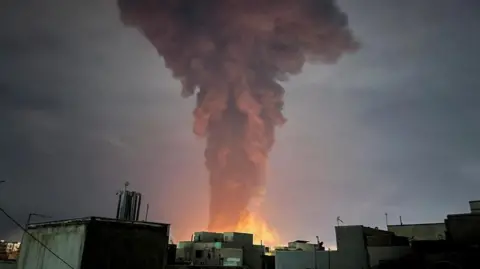 Reuters
The Israeli president pointed to the killing of Iranian protesters earlier this year, its backing of armed proxies in the region, and a drone attack against a British air base in Cyprus as evidence of the threat posed by Iran.
He continued: "It mind boggles me that [legality] is the focus rather than on the future of the Middle East and doing peace in the Middle East."
Herzog said the war is "clearly self-defence, which is not only self-defence for us but self-defence for Europe, for Britain, for the entire region - look how they are bombarding all their neighbours".
Israel also launched a new offensive against Hezbollah after the Iran-allied group fired missiles over the border in response to the killing of Iran's Supreme Leader Ali Khamenei.
Israel has hit targets in southern Lebanon and southern suburbs of the capital Beirut, where the group has a strong presence, while its troops have pushed further over the border into the country.
Herzog told the BBC that Israel had been "attacked vehemently by missiles" launched by Hezbollah, and that the government in Lebanon "object to it totally" but "don't have the power" to disarm them.
On Sunday, Lebanon's health minister said the death toll in the country had risen to 400, while the Israel Defense Forces said two soldiers had been killed in southern Lebanon.
Meanwhile, Seyed Ali Mousavi, the Iranian ambassador to the UK, said Iran wouldact in its own "self-defence" if the UK joined offensive operations.
On Saturday, US President Donald Trump strongly criticised Sir Keir Starmer, accusing him of seeking to "join wars after we've already won" and signalling he would reject an offer of further military assistance from Britain, which he described as "our once great ally".
Foreign Secretary Yvette Cooper told the BBC that Starmer had been "right to stand up for Britain's interests" in his position on the war, adding that the UK government would not agree with Trump "on every issue".
Starmer and Trump spoke on the phone on Sunday, their first direct conversation in over a week.
