Jacinda Ardern's move to Australia renews spotlight on New Zealand's brain drain problem

 Getty Images
For a people nicknamed after a flightless bird, taking off overseas has somewhat ironically become a rite of passage for many New Zealanders.
In recent years, the number of Kiwis deserting the nation has reached record levels, a large chunk of them moving "across the ditch" to Australia.
Former Prime Minister Jacinda Ardern has become the latest to join the exodus, with her office last week confirming she and her family have moved to Sydney, after they were spotted house hunting in the city's affluent northern beaches.
Ardern's move has renewed a spotlight on New Zealand's battle to retain its best and brightest, as the country struggles with a lagging economy, a cost of living crisis and housing shortages.
"Ardern's move is likely to be seen as symbolic of this broader pattern. To some it will read as desertion," Alan Gamlen, director of the Australian National University's migration hub, told the BBC.
Last year, more than 66,000 Kiwis packed up and moved away - the equivalent of 180 every single day.
That flow is partially offset by New Zealanders returning to their homeland. But for a nation with a population of only 5.3 million, the number of citizens it is haemorrhaging is significant.
It's a relatively safe country, globally famous for its stunning landscapes, and people living there enjoy a high life expectancy.
So what is driving hordes to leave?
 Getty Images
There is no question this is a long term trend, especially for young people, who often want overseas experience - known as "an OE" - before returning to set down roots.
Since the 1970s - when Britain ended trading agreements that had shored up New Zealand's economy and Australia introduced loosened work and travel restrictions - the outflow of people has surged sporadically.
But "the trend has re-emerged noticeably over the past five years", says Gamlen.
And increasingly, many young New Zealanders are making more permanent moves, reticent to come back to a country they feel no longer offers a prosperous future for them.
The nation is dealing with high unemployment - with levels not seen for a decade outside the Covid-19 pandemic - and wage growth has failed to keep up with inflation.
That's driven the cost of living through the roof. Grocery prices, for example, are among the highest in the developed world.
Dwindling housing affordability has pinched pockets further, with a shortage of homes driving up both rents and house prices.
And there are broad health and education inequalities too.
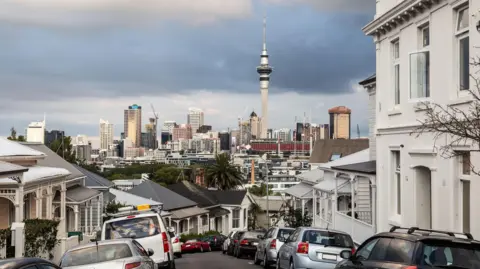
Ten years ago, Nicole Ballantyne swapped Auckland's eastern suburbs for Sydney's.
The 27-year-old was initially drawn by better post-high school study opportunities, but now finds it hard to imagine a life back home.
"Sydney is a better version of Auckland," she told the BBC.
"It has a lot more going on, the career opportunities are really good and it's also just that little bit more connected to the rest of the world."
Her brother has since moved over too. Not a single member of her tight-knit friend group from high school remains in New Zealand.
 Getty Images
Ballantyne stresses she's a proud Kiwi - "I will always support the All Blacks," she jokes - but says she's been able to build a life in Australia which she couldn't back home.
"If Auckland could offer that, I would have stayed."
She's far from alone. Though the UK and America are popular destinations, an estimated half of New Zealand's expats have flocked to Australia's shores, where they have for over half a century enjoyed essentially equal work rights.
Times are tough in Australia too, but it offers better job, pay and housing prospects.
"There is some movement the other way, but these days it's much smaller," says Gamlen.
'Deep unease' about state of country
The exodus is causing anguish amongst New Zealand's lawmakers - on both personal and policy fronts.
"My oldest son has moved to Melbourne, because he can't find work here," opposition Labor MP Ginny Anderson told the BBC World Service recently.
"My own brother, who is a trained school teacher, now works in China because the wages are better there."
"This is a reality for many New Zealand families who have been divided... and that's heartbreaking for me."
With the country heading to a general election in November, many politicians are trying to convince voters they have solutions.
All agree New Zealand must turn its economy around, but have different visions on how to do that.
They range from relieving pressure on the employment market and infrastructure through immigration cuts, to creating more jobs through an investment boost for housing construction.
MPs from the governing coalition stress any "brain drain" is not a new problem for the country, and say its recent deeper woes are a hangover from the Covid-19 pandemic.
 Getty Images
But some experts point out emigration isn't all bad for New Zealand. Those who do return make the country richer for their experience and could drive innovation.
"Every departure represents new connections and an expanding network," Merryn Tawhai, from the Auckland Bioengineering Institute, told the University of Auckland's Ingenio magazine last year.
Housing Minister Chris Bishop told the BBC's World Questions programme his government is achieving "good progress" in making the country a place its citizens want to stay.
"But I don't pretend for a moment that everything is perfect in New Zealand. Clearly it isn't," he said.
"There is a deep unease amongst many New Zealanders about the state of [the country]."
Ballantyne says she suspects the former prime minister's decision to move to Australia is more nuanced than that.
"There's probably a level of harassment out and about still, she's a public figure... [and in] Australia, she might be able to lay a little bit lower."
Ardern left New Zealand shortly after quitting politics in January 2023, and took on a fellowship at Harvard University.
Her office says her family had been travelling for a few years and have now decided to base themselves out of Australia "for the moment".
"They have work there, and it brings the added bonus of more time back home in New Zealand," a spokesperson told local media.
