'We're counting the cost of soul-destroying flood'

 BBC
BBCLandowners and farmers are calling on the Environment Agency (EA) to provide better protection for their businesses as they count the cost of recent flooding.
Leven in East Yorkshire flooded on 1 December when dozens of homes narrowly avoided being inundated as water from Holderness Drain entered the village.
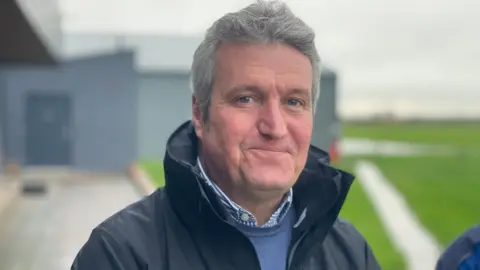
Farmer Jon Sharp, who is among those with land still affected more than two weeks on, said: "We put all our investment for next year's harvest into this land and to see it rotting under water is soul-destroying."
At the time, the EA confirmed there had been an "operational issue with the pumping station at Holderness Drain" but a spokesperson said it had now been resolved.

Although the floodwater has now receded from nearby streets, local landowners continue to be impacted.
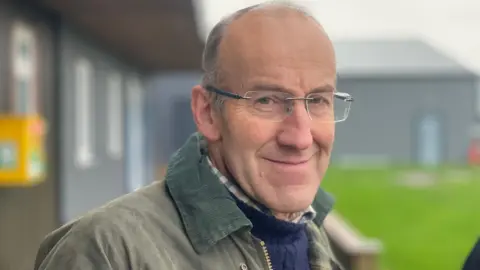
Colin Hazell, co-owner of Hull Aero Club, said the EA had failed to pump away flood water despite the "obvious risk" to his business.
He said: "There are pumps that are either non-operational or not used and so we are given away to the water every single year."
To cope with the issue, he said the airfield had been using pumps in wheelbarrows as "improvised flood defences".
"It's costing us thousands of pounds every week as a business because we can't fly. It's critical that we get the situation resolved," he said.
The Environment Agency is now running pumps "24 hours a day", according to Mr Hazell, but he said it was "too little, too late".
"In the last 24 months, the club has lost over £170k of turnover due directly to flooding of this catchment," Mr Hazell added.
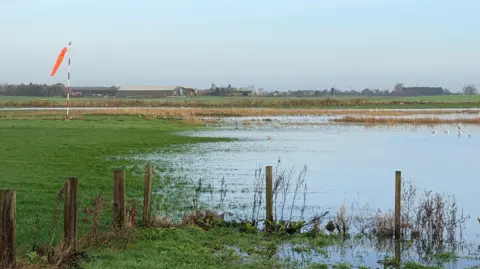
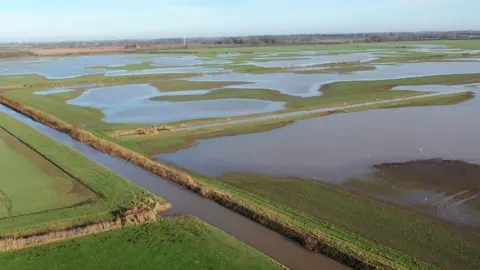
The farmland surrounding Leven is some of the lowest-lying in the region with parts of the area below sea level.
Farmers rely heavily on pumping stations but have had long-running concerns about the level of protection they receive from flooding.
In 2020, work started on a new pumping station for Holderness Drain, which was part of a £28m scheme to better protect the area.
Farmer Rob Byass, who has "thousands of acres of valuable farmland" under water, said the station "failed catastrophically" at the beginning of December and the EA had to take responsibility.
"We have had no explanation from the Environment Agency," he said.
"We don't know the reasons for this failure, but there has been a lot of flooding in Leven and a lot of farmland flooded.
"All the ditches and drains were already at high levels before the heavy rainfall of a few weeks ago. We wouldn't be in this situation if the water in them had pumped away."
The EA said the low-lying land in the River Hull and Holderness Drain catchment in East Yorkshire is heavily reliant on a system of artificially created drains and pumping stations and that these systems are operated by several organisations.
The spokesperson added: "We understand local farmers' concerns following exceptionally high rainfall in the River Hull area this November - a 278% increase on what we would expect to see at this time of year.
"We work closely with our partners, including the Internal Drainage Boards, to mitigate flood risk in these complex areas. This includes our £20m investment in the new Holderness Drain pumping station, demonstrating a firm commitment to protecting local communities."
 Peter Allwood
Listen to highlights fromHull and East Yorkshire on BBC Sounds, watch the latest episode of Look Northor tell us about a story you think we should be coveringhere.
Download the BBC News app from the App Store for iPhone and iPad or Google Play for Android devices
