'Without Oxford University, we don't get Dr. Seuss'

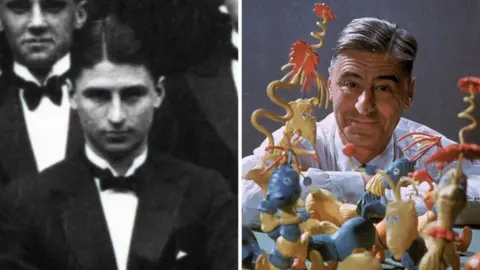 UC San Diego/Getty Images
When he waved away the dreaming spires where the students all stay, young Ted Geisel went zipping away.
The boy who left Oxford all whimsy and loose, would become someone wondrous... the marvellous Dr. Seuss.
It has been 100 years since the author who wrote The Grinch and The Cat in the Hat left Oxford.
In 1926, the man whose real name is Theodor 'Ted' Geisel, dropped out of his doctorate course in English Literature at the University of Oxford and shelved a future in academia to pursue a passion for drawing and cartoons.
By the time of his death 65 years later, he was known around the globe as one of its most beloved and iconic authors - Dr. Seuss.
Every year Dr. Seuss Day is celebrated on 2 March, the date the incomparable icon of literature was born in 1904.
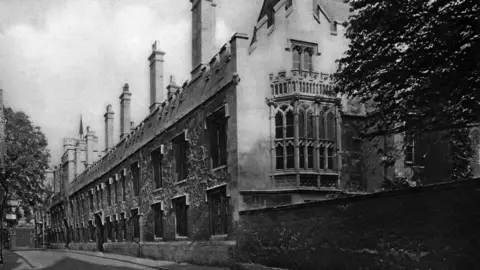
During his brief time studying at Lincoln College, the "academic side of it probably didn't rub off on" Geisel, his biographer Brian Jay Jones tells me.
"But I don't think that you get Dr. Seuss without having that stop at Oxford," he adds.
 Getty Images
It was in 1925 that a 21-year-old Ted Geisel graduated from Dartmouth College and first set his sights on the world-famous University of Oxford.
"At that time, he wanted to become Dr Geisel at that point, not Dr. Seuss," Jones says.
Current Lincoln College fellow Dr Perry Gauci says Geisel was "following in quite a long line of American students coming over" to Oxford, although it was "still rare".
"Lincoln really was quite a small college, and maybe that's what he was looking for - something that is more homely and welcoming," Gauci suggests.
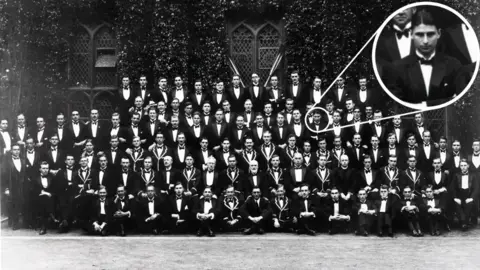 UC San Diego
Once in Oxford, Jones says Geisel "was not a fantastic student" and tried to "attach himself" to the notorious Rhodes Scholars.
"But that didn't really last, because they were much more serious about their studies than he was."
Whilst looking for an academic mentor in Oxford, Geisel was paired with the Scottish essayist Alexander Carlisle.
Later in his life, Geisel said of this partnership: "I was surprised to see him alive. He was surprised to see me in any form."
"He was the oldest man I'd ever seen riding a bicycle, I was the only man he'd ever seen who should never have come to Oxford."
 UC San Diego
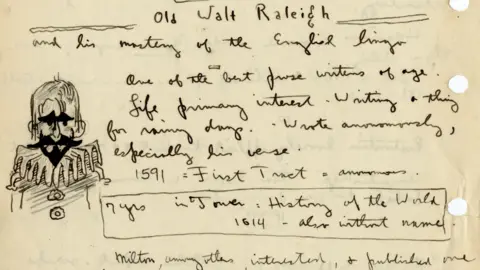
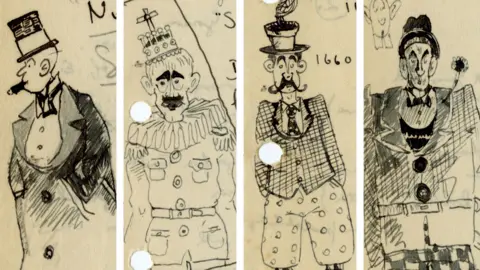
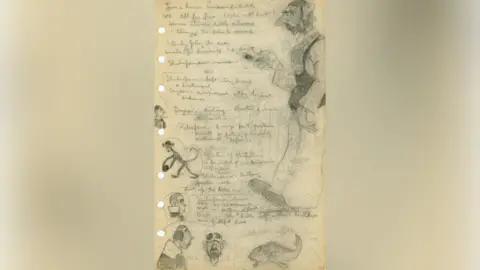
The Geisel Library at the University of California, San Diego is home to artefacts from throughout Seuss's life - including a notebook from his time at Lincoln.
Gauci suggests the "quite remarkable" notebook suggests Geisel had been "studious" and was doing "diligent work".
"But the amazing thing about this notebook is that throughout it, it's just full of illustrations and cartoons," he says.
"It's very much Seuss on his way."
Jones suggests that, although the 80-page notebook suggests that "he starts off really trying hard", as you keep turning the pages Geisel's doodles "start to take up more and more of the notebook".
"You can see his mind is clearly elsewhere."
 UC San Diego
It was those drawings that caught the eye of Geisel's classmate, and fellow American, Helen Palmer.
"He falls in love with her very quickly, and he starts spending most of his time with her," Jones explains.
"She looks in his notebook and says: 'You know, those are really interesting drawings. What are you doing here to be an English professor. You should be doing that for a living, not teaching English'."
"That spurs him to realise that maybe he's on the wrong path here."
Years later, Palmer recalled: "Ted's notebooks were always filled with these fabulous animals."
"So, I set to work diverting him; here was a man who could draw such pictures; he should be earning a living doing that."
Geisel himself admitted he was "naturally flattered" by Helen's praise.
"In a short time, the horses were taking up the middle of my notebook, and my Shakespeare notes - such as they were - were in the margins," he explained.
Geisel lasted less than a year in Oxford, but Jones says "once he's hooked up with Helen" he spent his time "travelling, goofing off and kind of really doing anything but his studies".
"He is clearly already punched out."
 UC San Diego
The then-22-year-old Geisel followed Helen's advice in mid-1926 and dropped out of his course at Lincoln.
He spent the next year travelling Europe, before returning to the US to pursue his art dream - where he soon began drawing under the pseudonym Dr. Seuss.
"He'd been signing cartoon Seuss for a while - he had done it even when he was at Dartmouth working for the humour magazine there," Jones explains.
"But that doctor in there to him was very funny because it gave it this air of authority that he thought that he clearly did not have - especially because he was busted at Oxford."
"I think his experience at Oxford and in academia influenced the way he chose that nickname," Jones says.
 Getty Images
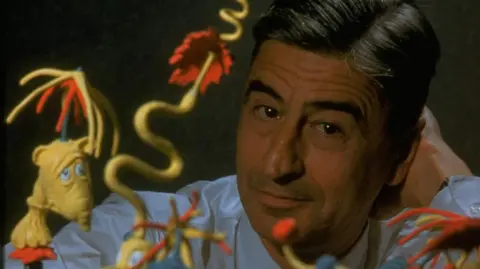
Fast forward decades, and Dr. Seuss would go on to become one of the world's favourite authors - with irreverent hits such as Horton Hears a Who! and How the Grinch Stole Christmas taking pride of place on children's bookshelves across the globe.
Jones explains that most of Geisel's reflections in later life about his time in Oxford are "him talking about just what a terrible student he was".
"He's very self-effacing about it - I think that he just knew he was not cut out for it," he says.
"But I think he looks back on it with no regrets - I don't think he would change a thing about it."
Although he never returned to Oxford after his brief spell in the city, Gauci says Geisel is still inspiring students today.
"I've shown one or two students some of the things that they (The Seuss Library) have online, and they are so interested to learn about it because Seuss is still so popular," he says.
"Seuss has left an incalculable legacy to the world, and his story is an encouragement for everyone to follow their passion."
 Getty Images
As for Oxford's impact on young Ted Geisel, Jones says: "The experience shaped him, and I really do think it informed the way he adopted that nickname."
"I don't think he would ever call himself Dr. Seuss had it not been for being at Oxford and having the literary and professorial aspirations when he was there."
"But had he gotten to Oxford and been a great student we also might never have gotten Dr. Seuss."
Without Oxford the world would not know what to do when the sun is not sunny, or how Geisel could make lots of good fun that is funny.
Nobody would ever give a damn about Cats in Hats or Green Eggs and Ham, and the world wouldn't have a golden goose - the madly magnificent Dr. Seuss.
Images of Geisel's notebook and him at Oxford full credit: Dr. Seuss Collection, University of California San Diego Library, with permission of Dr. Seuss Enterprises.
You can follow BBC Oxfordshire on Facebook, X, or Instagram.
