Zack Polanski's unusual path to becoming Green Party leader

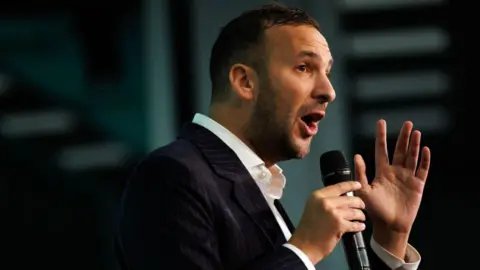 Getty Images
Zack Polanski has led the Green Party to its first Westminster by-election victory in Gorton and Denton.
The party's candidate, Hannah Spencer, won a majority of more than 4,000 and becomes the fifth Green MP.
It comes less than six months after Polanski won the party leadership by a landslide.
Since then the Greens say their membership has almost tripled from 68,500 to more than 190,000, while national opinion polls also suggest growing support for the party.
Polanski stood on a platform promising bold communication and "eco-populism", vowing to replace Labour.
While he made a name for himself as a feisty media performer among the party faithful, Polanski was previously little known outside the London Assembly, where he is an elected member.
Beating two of the party's four MPs to the leadership, the 43-year-old's pitch to the membership was to move away from the tried-and-tested, with a decisive shunt to the left and a more confrontational communication style.
Polanski has had an unconventional path to politics, previously working as an actor, hypnotherapist and mental health counsellor.
A 2013 article in the Sun that still dogs him involved a reporter, who posed as a client, claiming he helped her to boost her bust through the power of thought.
Asked about the piece following his win, Polanski said his time as a Harley Street hypnotherapist pre-dated any of his political ambitions and he had immediately apologised.
"We are all more than one mistake," he said, adding that Labour was "terrified" of his popularity if they were "rifling through stories from a long time ago where I was clearly misrepresented".
Born in 1982, Polanski grew up in Salford, heading to university in Aberystwyth, in Wales, before ending up in Hackney, east London.
He is gay and also Jewish, changing his name from David Paulden when he reached 18 in order to embrace the identity erased by his family's anglicised surname, as well as to differentiate himself from his stepdad, who had the same first name.
His first foray into politics was joining the Liberal Democrats, a party he now criticises as being insufficiently left-wing, and standing unsuccessfully for Camden Council and the London Assembly.
He joined the Greens in 2017, working as a local party chairman before getting elected to City Hall in 2021 and becoming the party's deputy leader in 2022.
As deputy leader, Polanski played a role in the party's growing electoral success.
In last year's general election, the Greens quadrupled their number of MPs to four, with his leadership rivals Adrian Ramsay and Ellie Chowns among those joining Parliament.
During his leadership campaign, Polanski promised a mass-membership "eco-populist" movement that connects with voters on an emotional level.
Key to that approach is Polanski's approval of Nigel Farage's "storytelling" skills, which he told BBC Newsnight could be harnessed to send a different message to a wider audience, including Reform UK supporters.
He said the Greens had to "connect with that anger and turn it to hope, turn it to possible solutions".
In his "eco-populism" leadership pitch he has linked the climate crisis to inequality and called for radical action, "not briefcase politics", to fix unfair systems.
He has promised to lower bills with green energy and nationalised water companies, while also taking the "fight" to Labour, particularly on inequality.
The battle on inequality includes his longstanding support for a Universal Basic Income, a small, non-means-tested payment for everyone that covers basic needs.
As a former property guardian and long-time renter, Polanski has also campaigned for decent, warm homes for everyone.
He has called for the government to take action on what he describes as the genocide in Gaza, as well as being arrested for his activism with environmental protest group Extinction Rebellion.
Polanski's leadership has marked a shift away from his predecessors, who saw the party win half its Westminster seats from the Conservatives in the South and East of England.
Because of the way the Green Party is structured, with a leadership election every two years, members will get a chance to give their verdict on Polanski's new direction well before the next general election, due in 2029.

Sign up for our Politics Essential newsletter to read top political analysis, gain insight from across the UK and stay up to speed with the big moments. It'll be delivered straight to your inbox every weekday.
