Rob Jetten becomes Netherlands' youngest ever PM

 Getty Images
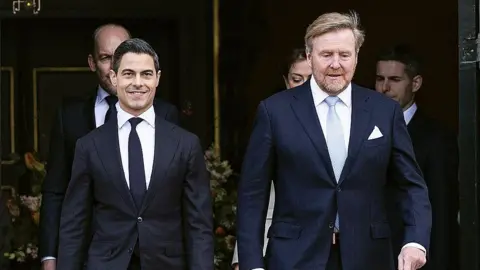
Rob Jetten has become the youngest and first openly gay prime minister of the Netherlands after his minority government was sworn in.
The 38-year-old claimed victory in October's election with his Democrats 66 party (D66) narrowly beating anti-Islam populist Geert Wilders in a nail-biting election.
Jetten formed a centre-right minority government with the People's Party for Freedom and Democracy (VVD) and the Christian Democratic Alliance (CDA).
It is a minority cabinet, meaning every major reform in the coalition deal - from an extra €19bn (£16.6bn) for defence to painful cuts in healthcare and benefits - will have to be negotiated vote by vote in the Netherlands' two parliamentary houses.
The coalition also wants fewer asylum seekers, with refugees having to apply for asylum outside Europe, not after they arrive.
Asylum migration has been a particularly sensitive issue in Dutch politics, contributing to the downfall of the country's last two coalition governments.
Jetten succeeds Dick Schoof as prime minister who oversaw one of the shortest-lived governments in Dutch history.
D66 will provide seven ministers, VVD will provide six, and CDA five, with three state secretaries each - junior members of cabinet.
Jetten was formally sworn in by King Willem-Alexander at the Huis ten Bosch Palace in The Hague on Monday.
Posting a selfie ahead of his swearing-in ceremony, Jetten wrote on X: "Proud to be doing this together. In a new phase, with great responsibility and, above all, a shared promise to work for everyone in the Netherlands.
"By not dwelling on what's wrong, but by building on what can be improved. That requires courage and collaboration."
'Let's get to work'
Slick, smiling and patient, Jetten has spent years shaking off the nickname "Robot Jetten", earned for his stiff, over‑rehearsed TV appearances.
The transformation was stark on election night. In a packed, sweaty music venue in Leiden (between Amsterdam and The Hague), he seemed effortlessly at ease, confident and groomed, as young supporters roared around him.
For many BBC News met there that night, the D66 leader was everything Wilders was not: relatively young, upbeat, pro‑EU and socially liberal - a fresh face pitched against an older, hard‑right establishment.
Standing beside the King on a red carpet spilling down the palace steps on Monday, Jetten gave the appearance of a well-polished premier.
After being confirmed as prime minister, he posted the official photo on Instagram with a brisk caption: "Let's get to work."
Wilders, who pulled the plug on his own right-wing coalition in June, has said he would oppose any initiative by Jetten's government, while other parties have raised concerns about the plans presented so far.
Jesse Klaver, leader of the GreenLeft-Labour coalition, the biggest alliance in opposition, posted on X on Friday about the government's financial plans: "Ordinary people will pay hundreds of Euros more, while the very richest won't be asked to pay anything extra.
"That's unfair and won't help the Netherlands move forward. We take responsibility for adjusting these plans. This has to change."
