Iran postpones Khamenei funeral as US and Israeli bombardment continues

 WANA/Via Reuters
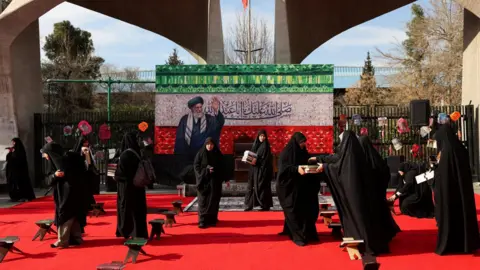
Authorities in Iran have postponed the funeral ceremony for the late Supreme Leader, Ayatollah Ali Khamenei, as US and Israeli forces continue intense strikes across the country.
An official said there had been many requests from people wanting to attend the three-day event at a Tehran prayer complex and that infrastructure needed to be prepared. It had been due to begin on Wednesday night.
A member of the Assembly of Experts meanwhile said the clerical body was "close" to choosing a successor to Khamenei, who was killed in a strike at the start of the US and Israeli assault on Saturday.
Iran has responded by launching missiles and drones at Israel and Gulf states with US bases.
Kuwait's health ministry said overnight that a girl had been killed by shrapnel that fell on a residential area during an Iranian attack.
Meanwhile, US Secretary of Defence Pete Hegseth said a US submarine sank an Iranian navy frigate in the Indian Ocean, off the coast of Sri Lanka.
"[The warship] thought it was safe in international waters. Instead, it was sunk by a torpedo. Quiet death," he told reporters.
Sri Lanka's Defence Secretary Air Vice Marshal Sampath Thuyyakontha said the bodies of 80 people on board the IRIS Dena had been recovered.
Another 32 people have been rescued, while dozens more are missing.
Hegseth also said that US and Israeli forces would have total aerial superiority over Iran within days and would "soon" control the country.
"This was never meant to be a fair fight, and it is not a fair fight. We are punching them while they're down," he declared.
The secretary of Iran's Supreme National Security Council, Ali Larijani, said US President Donald Trump had "dragged the American people into an unjust war".
Khamenei - who was Iran's spiritual leader and its highest authority - was killed at his compound in Tehran in the first wave of US and Israeli strikes, along with his wife, one of their adult sons, and several top officials.
The three-day funeral ceremony for the 86-year-old cleric had been due to start at 22:00 local time (18:30 GMT) on Wednesday, with mourners invited to pay their respects as he lay in state at the capital's Grand Mosalla prayer complex.
But on Wednesday morning the head of the Islamic Propaganda Co-ordination Council of Tehran province told the hardline Tasnim news agency that it had been decided to postpone the ceremony until "a more appropriate time".
Seyyed Mohsen Mahmoudi said this was because of "the high volume of requests to attend this ceremony and the need to provide appropriate facilities to host the people".
Following Khamenei's assassination, state media showed crowds of the Islamic Republic's supporters protesting in Tehran against the US and Israeli attacks. But social media videos also showed opponents celebrating on the streets in the capital and other cities.
Khamenei became supreme leader in 1989 after the death of the Islamic Republic's founding father, Ayatollah Ruhollah Khomeini. He maintained a firm grip on Iran's politics and its armed forces, and suppressed challenges to the ruling system, sometimes violently.
Many people called for his overthrow or his death during nationwide protests in late December and early January. Security forces under his command crushed the uprising with unprecedented force, killing at least 6,480 people, according to human rights groups.
Iran's new supreme leader is supposed to be chosen by the Assembly of Experts. The clerical body's 88 members are elected by Iranians every eight years, but Khamenei ensured they were conservatives who would follow his guidance on picking a successor.
One member, Ayatollah Ahmad Khatami, told state TV that the candidates had already been identified but did not name them.
"The supreme leader will be identified in the closest opportunity, we are close to a conclusion. However, the situation in the country is a war situation," he said.
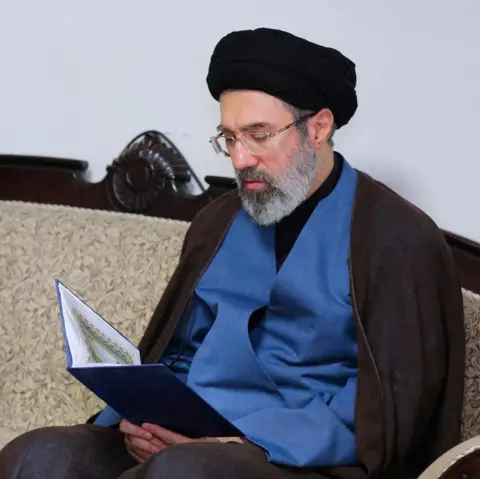
Two Iranian sources told Reuters news agency that another of Khamenei sons, Mojtaba, was considered the front-runner to succeed him.
Mojtaba, a 56-year-old cleric, is a shadowy figure said to have amassed significant power and wealth under his father's rule. He is close to conservatives and the powerful Islamic Revolutionary Guard Corps (IRGC), which is tasked with defending the country's Islamic system.
Israel's defence minister said any successor who continued to threaten Israel and the US would be "an unequivocal target for elimination".
 WANA/Handout via REUTERS
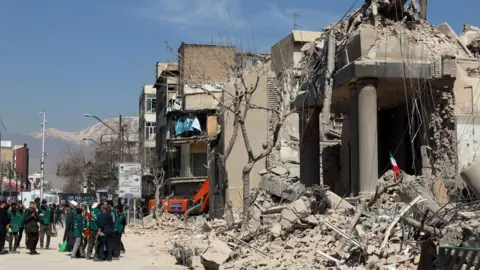
The Israel Defense Forces (IDF) meanwhile announced that its forces had carried several broad waves of strikes across Iran on Tuesday night and Wednesday.
The targets included ballistic missile arrays and air defence systems, it said, as well as a missile storage and production facility, command centres belonging to the paramilitary Basij and Internal Security forces, and "defence and detection systems" at Tehran's Mehrabad airport.
The IDF also said an Israeli F-35 fighter jet had shot down an Iranian Yak-130 over Tehran, which it described as "the first shootdown in history of a manned fighter aircraft by an F-35".
According to the IDF, more than 5,000 munitions have been dropped by Israeli aircraft on Iran and about 300 missile launchers had been "dismantled" since the start of the conflict.
On Tuesday night, the head of the US military's Central Command, Adm Brad Cooper, said the US-Israeli campaign was "ahead of our game plan".
"In simple terms, we're focused on shooting things that can shoot us," he added.
Iran's state news agency, Irna, reported on Wednesday that US and Israeli strikes had killed 1,045 military personnel and civilians since the start of the conflict.
It was not immediately possible to verify the figures, but the US-based Human Rights Activists News Agency (HRNA) said overnight that the number of reported civilian deaths had reached 1,097, including 181 children under the age of 10.
 EPA
EPAIran's armed forces have responded to the strikes by launching hundreds of missiles and drones at Israel and neighbouring Arab states which host US military installations.
Early on Wednesday, Kuwait's health ministry said an 11-year-old girl, who was a resident of the country, had died after being hit by falling shrapnel.
Nine other people - six US service personnel, two Kuwaiti army soldiers, and one other civilian - have been killed in Kuwait since the start of the conflict.
Authorities in Saudi Arabia said there had been an attempted drone attack on its largest oil refinery, Ras Tanura, on the Gulf coast. No damage or disruption had been reported, it added.
On Monday, the refinery was forced to halt some operations after a drone attack caused a fire.
Turkey's defence ministry also said an Iranian missile heading towards its airspace had been intercepted by Nato air and missile defence systems in the Eastern Mediterranean.
And in Qatar, the State Security Service announced the arrest of 10 members of two cells allegedly linked to the IRGC, which it said had been tasked with spying on infrastructure and carrying out "sabotage operations".
The IDF also said its defence systems had operated to intercept more salvos of Iranian missiles. There were no immediate reports of any casualties.
A total of 10 people have been killed in missile strikes in Israel over the past five days.
