'Cornea transplant means I can care for my husband'

 Supplied
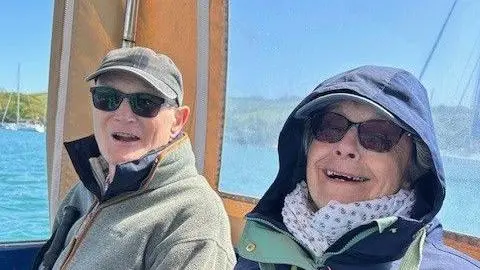
An 85-year-old woman who has a degenerative eye condition has said a vital cornea transplant now means she can care for her husband, who is living with dementia.
Ann Mallet, from Ashbourne in Derbyshire, was gradually losing her sight due to a condition called Fuch's dystrophy, which impacted her independence, ability to drive, and how she cared for her husband, Glyn, who also lives with sight loss.
Unable to see colour or watch the television any more, Ann was able to see a "different world" when she received corneal transplants in both of her eyes at the Royal Derby Hospital.
"I'm so thankful to the families who donated their loved ones' eyes to help people like me," she said.
'Vital procedure'
Ann said she noticed her eyesight starting to deteriorate when she was 60.
"I couldn't see colour and I couldn't see a few yards ahead. It affected everything really," she told the BBC.
"My husband can't see, he's completely blind in one eye and not much sight in the other."
After a visit to the opticians, Ann was referred to the hospital and was later told she had Fuch's dystrophy.
It is a genetic condition that affects the different layers of the cornea, which is the transparent front layer of the eye that focuses light on to the retina.
The condition means the cornea becomes filled with water, making vision seem blurry, cloudy, or lost altogether.
Ann said slowly losing her vision meant she was unable to drive her husband to his appointments or do their weekly shop.
The University of Derby and Burton NHS Foundation Trust said a corneal transplant was a "vital procedure" for Ann.
Unlike organs such as kidneys and lungs that need to be transplanted as soon as they are donated, corneas can be stored for 28 days until they are matched to a patient needing a cornea transplant.
NHS England said while the whole eye was donated, it was the cornea that was transplanted.
 Supplied
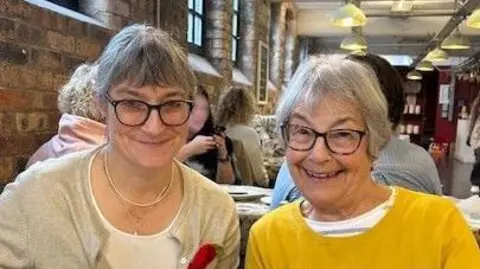
After waiting a year for her transplants, Ann had a few shocks when she was able to see the world like it was before her diagnosis.
"Within a few days it was a different world," she said.
"I remember looking around the house and thinking, 'there are cobwebs that I'd never seen before'.
"I've got a dress, which I thought was grey and white. When I had the operation, it turns out the dress was blue."
Ann's daughter Jo Hollick said: "I think without the operations being done, mum would not be independent now.
"That's the definition of life-changing."
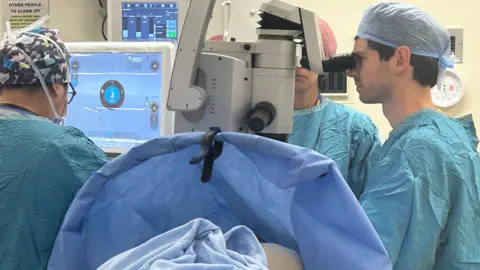
Dr Lana Faraj, who carried out Ann's transplants, said there was a "great shortage" of eye donors in the UK.
"Eye donation is essential to be able to do this amazing work and give more people the ability to live like Ann's story," she said.
NHS England said the number of donated corneas recorded in the UK by NHS Blood and Transplant (NHSBT) was down by 3% to 4,976 in 2024-25.
According to NHSBT, 18% of people on the Organ Donor Register have chosen not to donate all their organs, and almost two-thirds of them, about 3.3 million, said they did not want to donate their corneas.
The NHS has urged more people to agree to donate their eyes after death to "help the thousands of people not able to see properly, bringing down the waiting list and reducing waiting times".
NHSBT said it needed 70 donors a week (140 corneas) to ensure there were enough corneas continuously available.
"When you get the call and you are asked if you're willing to donate your loved ones' eyes, just remember how precious that is and how life-changing it will be for that other person that will receive it," said Faraj.
Ann added: "It [organ donation] must be a great decision to make, and if families are able to know that they've brought pleasure to other people from their deceased loved ones, then that's worth knowing."
Follow BBC Derby on Facebook, on X, or on Instagram. Send your story ideas to eastmidsnews@bbc.co.uk or via WhatsApp on 0808 100 2210.
