Top A-level grades in Wales see slight increase as thousands receive results

 BBC
BBCTop A-level grades in Wales have seen a slight increase compared with last year, with the number of exams taken in the country also going up.
In total, 10.7% of Welsh students achieved grades at A*, up from 10.5%, while the 32,633 A-level exams taken was a 2.6% increase compared with 2025.
Among the thousands of young people receiving their results on Thursday morning was 18-year-old firefighter Bobi Jones from Newcastle Emlyn in Carmarthenshire, who combined his studies with working as a firefighter.
He felt "quite relaxed" about his grades after having "plenty on my plate" responding to recent wildfires.
Results for AS-levels, BTec, the Advanced Skills Baccalaureate Wales and other vocational qualifications are also being published on Thursday.
The Welsh government said Wales had "once again" seen "strong" A-level results.
A-level grades could be shared with students from 08:00 BST, but arrangements vary depending on the school or college.
Many students will need confirmation of their grades to secure university offers and will be checking for updated information about their places.
 MAWWFRS
Bobi studied A-level business and sport, as well as the Welsh Baccalaureate qualification, and achieved two Bs and a C.
He said his school, Ysgol Bro Teifi, had been "very flexible", with teachers allowing him to leave class when his work alarm had gone off as long as he had caught up with schoolwork afterwards.
"The past few months have been very busy with exams and also the fire brigade. We've been really busy with fires and wildfires," he said.
He is now planning to take on an apprenticeship with a local electrician that he will combine with on-call shifts for Mid and West Wales Fire and Rescue Service.
But he wasn't able to spend much time dwelling on results on Thursday, as he was called out to respond to an incident.
Overall in Wales, there was a 0.1% point increase in A* and A grades and more passes overall, compared with 2025.
Girls outperformed boys at most grades, but boys were more likely to achieve the top A* grade.
 Rosa MacGowan
Rosa MacGowan, 18, from Swansea juggled studying four A-levels and the Welsh Baccalaureate alongside her part-time job in the hope of going on to be a doctor.
Having spent the summer travelling and spending time with friends, she was eager to find out what is next.
She woke up and checked her results to see she would be studying medicine at Glasgow University, after achieving an impressive set of results including two As and three A*s.
She said: "I am so relieved. I was so nervous logging on to Ucas, but when the green box came up saying I got a place I was really excited about the future.
"I can't believe that in less than a month I'll be on the way to Glasgow to study medicine. I can't wait for all the new opportunities that will come along with this."
Rosa said she felt "positive about the future and can't wait for the next chapter".
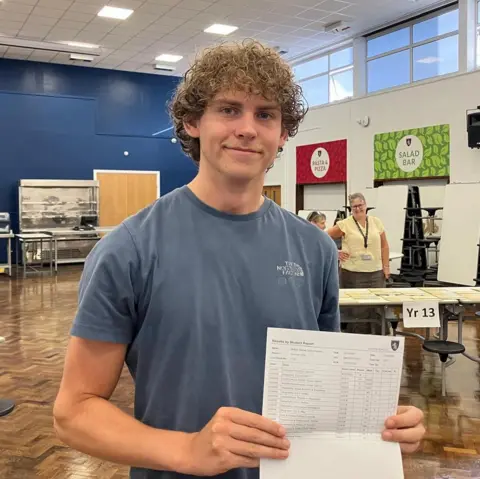
William Hopkins has been studying for a BTec in Uniformed Protective Services, alongside his A-levels and hopes to join the Army after results day.
"I've enjoyed it, but I've never been really academic and I never really enjoyed school that much," he said.
William achieved the 70 overall Ucas points he needed to follow in the footsteps of family members and friends by joining the armed forces.
"I'm looking to go into either the Army or Royal Marines as an officer," he said.
"They've all gone in younger, but I wanted to have a bit more experience living I guess.
"I've always enjoyed new things and testing my limits.
"Even if I don't get into the Army I know I will land on my feet somewhere else."
Aiming for a place studying criminology with psychology at the University of the West of England in Bristol, Caitlin Giffard, also from Swansea, needed three Bs.
She said she was "so happy" to achieve As in A drama, criminology and the Welsh Baccalaureate, as well as a B in psychology.
"It was a real eye-opener, really, the difference between GCSE and A-level, because I had a lot of friends who did quite well at GCSEs, but then had grades drop at A-level," she said.
"I'm so happy with my results and am very grateful for the support from loved ones, bring on the next chapter."
 Caitlin Giffard
The most popular A-level subjects this year were still mathematics, biology, chemistry and psychology.
According to provisional data for summer 2026, the largest proportional decreases in entries compared with 2025 were in computer science (-14.9%), Spanish (-12.9%) and drama and theatre (-8.2%).
English language and literature entries increased by 23.3%, Welsh language was up 42.7%, while German, from a small base, increased by 59.4%.
Fewer 16-year-olds in Wales have been going on to study A-levels in recent years according to data from Medr, the body that oversees and funds post-16 education.
Provisional data for 2025-26 suggested that fewer than half (49%) of Year 11 students who carry on in education now progress to AS courses, the first year of A-levels, compared with 60% in 2014-15.
Figures show a growing proportion are going on to study Level 2 courses, that are equivalent to GCSE, rather than a Level 3 course.

Cefin Campbell, the Welsh government's deputy minister for skills and tertiary education, said learners should be "incredibly proud of what you've achieved".
"If your results aren't quite what you hoped for, remember they don't define your future and it's not the end of the road," he said.
"There are lots of options open to you and support is available through Working Wales part of Careers Wales, your school or college, to help you find the path that's right for you."
Bethan Evans, executive director for regulation and analysis at Medr, said there had been a drop in the number of students progressing to study at A-level "particularly in the years since Covid".
Asked whether that was a concern, she said there were "more options available to our young people today than ever before".
"More and more people at the age of 16 are choosing to go to study vocational qualifications at further education colleges, for example," she said.
This year's results come after a major UK government report highlighted "shrinking" job and career opportunities for a "lost generation" of young people with high numbers not in education, employment and training (Neet).
Welsh government data suggests that 17% of Welsh young people aged 16 to 24 are Neet.
Evans said it was "a significant challenge for us" which had "an impact on people's life prospects".
She said Medr had worked across universities, colleges and apprenticeship providers to try to address the issue.
"I think we do see that there is a risk of losing some learners fairly early on in their [education] journey, and that's part of the reason why Medr has put in place an expansion of the junior apprenticeship scheme," she added.

