What we know about Spain's worst rail disaster in over a decade

 Reuters
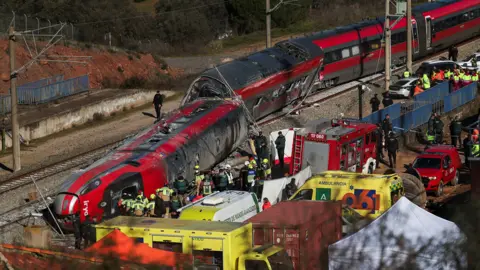
At least 45 people have died and dozens more have been injured after two high-speed trains collided in southern Spain, local authorities have said.
The crash at Adamuz, near the city of Córdoba, is Spain's worst rail disaster more than a decade.
Here's what we know about the incident so far.
Where did the crash happen?
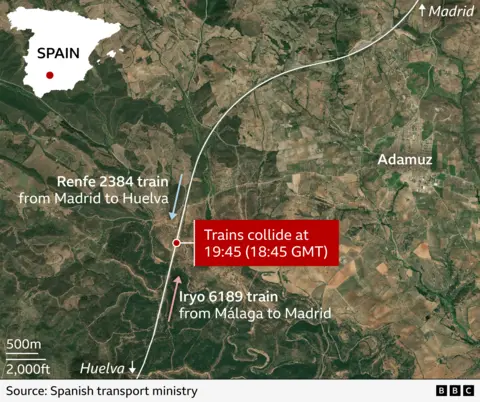
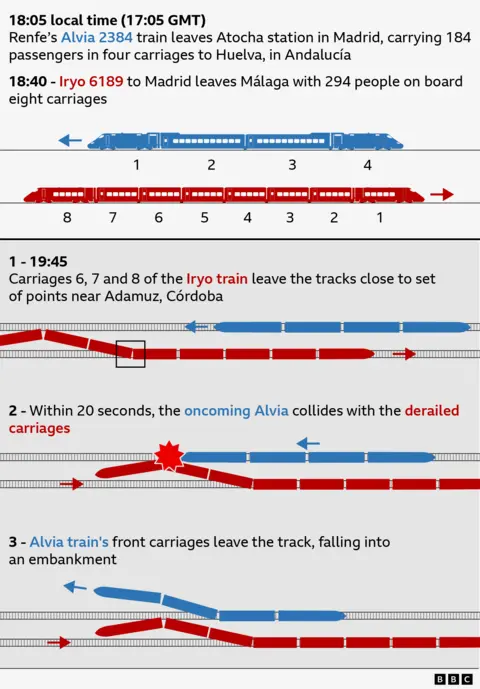
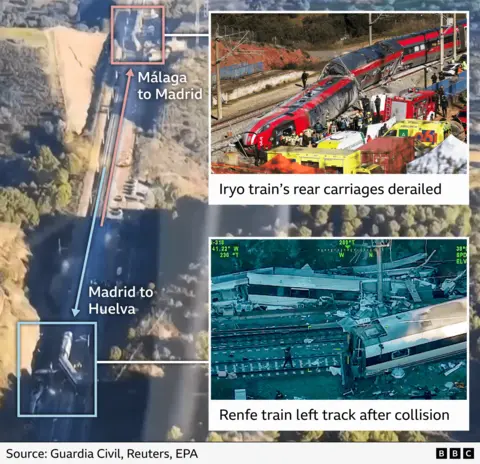
The crash occurred at around 19:45 local time (18:45 GMT) on Sunday, about an hour after a train run by private firm Iryo left Málaga for Madrid.
The last three carriages of the Iryo train - carriages six to eight - derailed on a straight stretch of track near Adamuz and crossed into the opposite track.
Those carriages collided with an oncoming train operated by state company Renfe travelling from south Madrid to Huelva, which was forced into an embankment running alongside the track, Spain's Transport Minister Óscar Puente said.
The majority of those killed and injured were in the front carriages of the Huelva-bound Renfe train.
There were around 400 passengers and staff on the two trains, according to Renfe.
What have survivors said?
Lucas Merayo, who was in the fifth car of the Madrid-bound Iryo train, told the BBC that about an hour into the journey, it became very bumpy. Passengers became scared and the carriage went silent, he said, "and then we heard a crash" and the train stopped.
Luggage fell and the lights went out. Then they started to hear noises of pain and screams from the three carriages behind them that had derailed, he said.
He and his girlfriend were uninjured, but people were in shock and crying, some experiencing panic attacks. A nurse beside him responded to a call for medical volunteers, and when she came back from the sixth carriage she told him someone had died.
Surviving passengers from the derailed carriages broke glass and went on the tracks to escape. Passengers helped one another get down, and he saw seriously injured people, with bleeding heads and improvised bandages.
The first on the scene were people from Adamuz, some in their pyjamas, who offered to transport the injured, Lucas Merayo said.
After two hours, they were evacuated by bus and Lucas eventually made it back home to Madrid on Monday morning, when he hugged his eight-year-old son and began to cry.
"It's really, really shocking and overwhelming to be alive when everyone else is not," said the actor and influencer, who is from Argentina.
He said the experience of the crash is "going to be with me all the time".
As it was dark, he had not realised the oncoming train had fallen into an embankment until he saw it on the news.
 Spanish Guardia Civil / Handout via Reuters
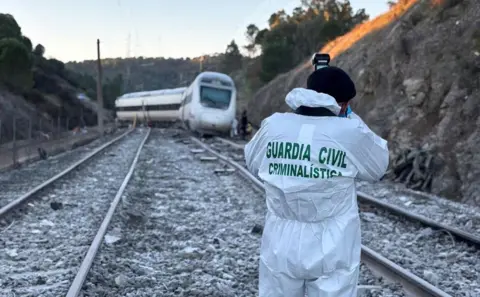
The president of the Andalusian regional government, Juanma Moreno, told local outlet Canal Sur they had to bring in "heavy machinery" to "practically lift" parts of the second train, which "has taken the worst part of this accident".
"The problem is that the carriages are twisted, so the metal is twisted with the people inside," Francisco Carmona, head of firefighters in Córdoba, told Spanish public broadcaster RTVE.
"We have even had to remove a dead person to be able to reach someone alive. It is hard, tricky work," he added.
Rescuers continued to search the wreckage until Wednesday when a 43rd victim was found.
What caused the crash?
The precise cause of the derailment remains under investigation, but a preliminary report suggests the rail was already damaged before the crash.
Spain's rail accident investigation body, the CIAF, said there is evidence that a fracture in the rail occured before the Iyro train derailed.
Investigators found notches on the wheels of several Iyro carriages, including some that did not derail, which were consistent with the wheels striking a broken section of the rail.
Earlier this week, transport minister Óscar Puente confirmed grooves the size of a coin were found on the wheels of the first five carriages of the Iryo train, which passed safely over the track before the final three carriages derailed. Two or three trains that had gone over the track shortly beforehand had similar notches, he added.
"These notches in the wheels and the deformation observed in the track are compatible with the fact that the track was cracked," CIAF's preliminary report said.
Similar damage was also found on trains that passed through the same stretch of track earlier on Sunday, indicating the fracture may have been present before the Iyro train reached the site.
The CIAF called its report a "working hypothesis", adding that it "must be corroborated by later detailed calculations and analysis".
Interior Minister Fernando Grande-Marlaska earlier ruled out sabotage but said all other hypotheses were being considered.
Meanwhile, a transcript has been published by daily El País of calls to the control centre in Madrid from the Iryo driver and from the conductor on the Renfe train.
The Iryo driver is initially unaware his train has been involved in a severe crash. The control centre is unable to reach the driver of the Renfe train so contacts the conductor who says "I have blood on my head. I don't know if I'll be able to reach the train driver".
Who are the victims?
The 43 people who died in the crash have not yet officially been identified.
One of the victims was María del Carmen Abril, a teacher, who was returning from her surprise 50th birthday party to Madrid, her friend told the BBC.
Jose Manuel Muñoz described Abril, as she was known, as a "lovely, generous, affectionate person who loved flowers and was always trying to solve other people's problems".
Victor Luis Terán, a Bolivian national, died on the train heading south to Huelva, after taking an earlier train because of a last-minute change in plans, his sister-in-law said.
A total of 123 people were injured. As of Wednesday morning, 37 people remained in hospital, including four children. Nine people were in intensive care.
