Whistleblowers 'intimidated' by animal charity boss

 Platform Home Ownership
Former volunteers have accused a high-profile animal rescue charity of exaggerating how many dogs it finds in an attempt to increase donations and sponsorship.
Drone to Home's CEO, Phil James, has also been accused of intimidating two of the volunteers after they raised concerns.
The women were sent cease and desist letters threatening them with legal action for defamation - but the BBC has established one of the letters is fake.
The BBC asked both Drone to Home and Mr James to comment on the allegations or take part in an interview, but Mr James responded by disputing the claims and threatening the corporation with legal action.
Drone to Home also announced its intention to close in April in a Facebook post on 22 November, and claimed that it and its staff had been the victims of "sustained and severe abuse" and "physical attacks and intimidation" on the same platform the following day.
The BBC asked the charity and Mr James for evidence of these claims but none has been provided, and the Drone to Home Facebook page was shut down on 24 November.
The BBC has spoken to four former Drone to Home volunteers about their concerns, but these are not the only people who claim the charity has been misleading about its pet-finding successes.
Volunteers from other animal search and rescue (SAR) organisations have told the BBC they think the charity had been using Facebook posts to falsely give the impression it was responsible for finding lost dogs shown as missing on its Facebook page.
Numerous people have also raised concerns about the behaviour of Mr James.
Four women - including one of the former volunteers - told the BBC they felt intimidated when Mr James followed them around and filmed them as they helped in the search for a lost dog in Long Clawson in Leicestershire.
Mr James had previously contacted the former volunteer's employer and accused her of "harassing our customers".
In another incident, Mr James contacted a volunteer drone pilot's employer and left a voicemail falsely accusing him of "abusing my staff on social media".
Some of the incidents have been reported to police, and some female dog rescue volunteers told the BBC they are now investing in bodyworn cameras for peace of mind while they are out looking for animals.
What is Drone to Home?
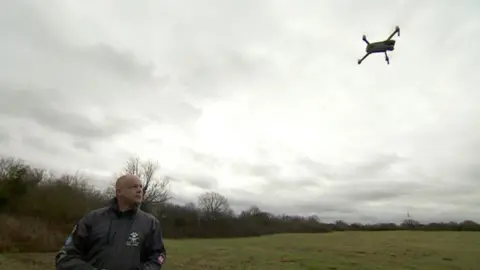
Drone to Home was registered as a charity in April 2022.
It was founded by Mr James, who lives in Nottinghamshire and previously told the BBC he used to be a police officer.
According to its website, Drone to Home is "the first dedicated dog drone searching registered charity in the UK".
Drone to Home received £58,882 in donations and legacies in its first year as a registered charity, according to accounts submitted to the Charity Commission.
The charity had 154,000 Facebook followers before the page was closed.
Its work has been widely reported by the BBC and other media.
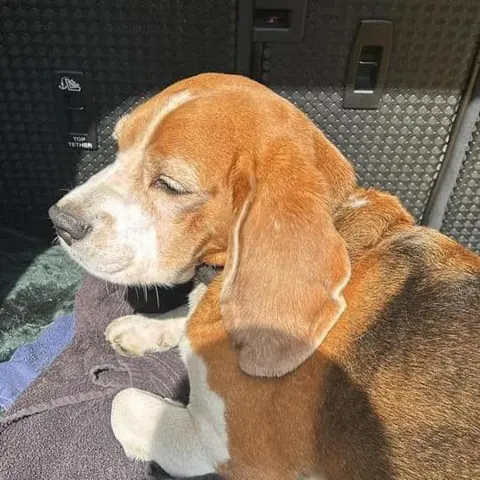
Successful high-profile lost dog searches include Malcolm, a beagle belonging to Shaun Ryder from the Happy Mondays.
 Shaun Ryder
How many pets have been reunited?
 Kim Jefcott
Drone to Home publicly claims to have reunited thousands of pets with their owners.
In an interview conducted towards the end of February 2023, Mr James told the BBC he and the charity had reunited almost 1,400 dogs in three years.
In its annual trustees' report for the period ending 30 April 2023, it claimed: "Throughout this past year, we have successfully reunited 747 dogs with their families, bringing our total to an impressive 2,348 dogs in the last four years."
Its trustees' report for the period ending 30 April 2024 claimed: "Throughout this past year, we have successfully reunited 2,878 dogs with their families, bringing our total to an impressive 5,668 dogs in the last four years."
On its website, Drone to Home claims to have "helped reunite over 10,000 lost pets with their families" in six years - which is more than four and a half a day.
However, former volunteers have told the BBC they think these figures have been inflated.
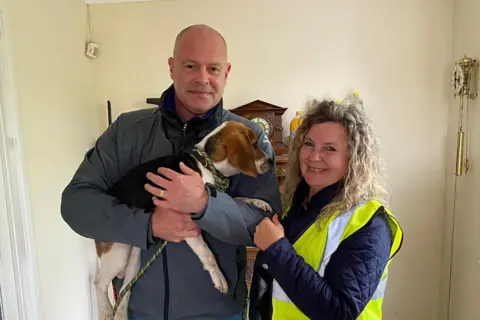
Kim Jefcott said she took the majority of calls for the charity until she left in May 2023, and showed the BBC her records from 12 December 2022 to 21 May 2023.
Out of the 155 reports of lost dogs, her records suggest Mr James attended only 20, and the majority of dogs either returned on their own, were found by their owners, or were found by other people.
A volunteer we are calling Kate because she asked to be anonymous - who volunteered between July 2024 to January 2025 - claimed Drone to Home "massively inflate their figures and statistics".
She said dogs would be included in the charity's "reunited" statistics even if they had not helped in any way.
"Even a two-minute phone call - they would add to the tally," said Kate.
"The way they inflate it is, let's say somebody rang me and I was in the middle of the phone call, and while we were on the phone somebody goes, 'oh my god, they're here', and I've got most of the details... they would make you put that down on their system as a reunite."
All four of the former volunteers told the BBC they believe the figures were inflated so the charity could receive more money.
Kate said supporters donated money "based on the fact they were told Drone to Home had these huge reunited figures".
Are Facebook 'reunited' posts misleading?
Before closing its Facebook page, Drone to Home used to post "missing" posters for dogs and update these to say "reunited" with heart emojis whenever a dog was found.
However, it did this regardless of whether or not it had helped with the searches, with or without a drone.
The BBC examined the "reunited" posts over a period of one month and tried to trace the dogs' owners.
We were able to speak to 17 owners, who all said the charity had not sent anyone to help with the searches.
The dogs had either been found by other SAR groups, members of the public, the owners themselves, or the dogs had returned on their own.
One of the "reunited" dogs was found with the help of squirrels.
Volunteers from other SAR groups believe Drone to Home's Facebook posts were misleading, because some people assumed the charity had reunited the dogs.
Sadie, who volunteers with another dog search and rescue team, gave the example of a dog called Pickle, which went missing near Lutterworth in Leicestershire in April.
Sadie said she and volunteers from other groups found and caught Pickle, but Drone to Home updated its Facebook post about Pickle to say "reunited".
"People think they've reunited that dog, that they got the dog safe," said Sadie.
Sadie said the charity used to delete comments from anyone pointing out dogs had been found by other groups, and also block people from commenting.
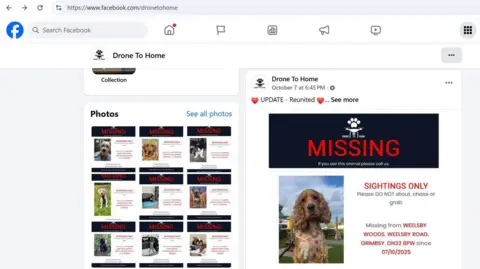
Another example found by the BBC involved a dog called Olive, which went missing in Grimsby on 7 October.
Olive's owner and her friend asked Drone to Home for someone to come out, but the owner said nobody came, and her friend was told in a Facebook message, seen by the BBC: "We do not have a volunteer drone operator on every street corner."
However, Drone to Home put a missing poster on its Facebook page and updated the post to say "reunited" after the dog was found by a member of the public, and after a Lincolnshire-based dog rescue group helped.
Drone to Home also sent a Facebook message asking for a donation.
Lisa Taylor, who is a Facebook administrator for about 20 different animal charities and rescue groups, has been collecting similar examples.
"They ambiguously update their own information as 'reunited' but do not give any further details," she said.
Messages seen by the BBC show Drone to Home volunteers have also raised concerns about this.
In a group chat from November 2024, one volunteer suggested they should "give a clearer outcome re our involvement to our followers", saying this was "about transparency to our followers".
How has the charity used legal threats?
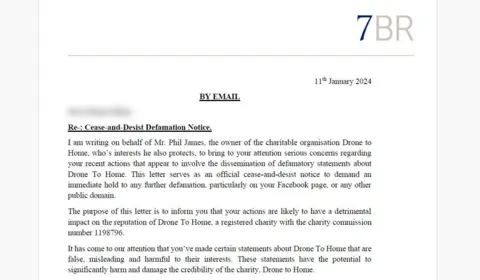
A former volunteer, who has asked to remain anonymous, received a "cease-and-desist defamation notice" from Drone to Home, dated 11 January 2024.
It purported to be from a barristers' chambers called 7BR, but the BBC examined the letter and established it was fake.
It was sent from the following email address:
"Phil." hr@dronetohome.org.uk
The letter warned: "Defamation, in any form, is unlawful and can lead to severe legal consequences."
The former volunteer thinks the letter was sent in response to a conversation they had with a friend who runs a kennels, who had been considering sponsoring Drone to Home.
Harry Charlton, chief executive of 7BR chambers, told the BBC: "No member of staff or barrister at 7BR was involved in or authorised the formulation or writing of this letter.
"We have reported this incident to the police on the basis that someone appears to have fraudulently misused the 7BR letterhead."
Ms Jefcott also received a "cease-and desist defamation" notice on behalf of Drone to Home in August 2023, but this was sent by a real barrister from 7BR.
She told the BBC it was in response to a message she posted on her Facebook page on 2 August 2023, in which she raised some of her concerns about the charity and Mr James.
How have employers been contacted?
Drone to Home and Mr James sent three emails to Ms Jefcott's employer - although she nor the BBC have seen the first email.
The second email, sent on 19 September 2023, accused Ms Jefcott of "harassing our customers by messaging and contacting people on work's time".
The third email, sent on 13 January 2024, purportedly came from an "HR manager" called "Jenny".
It claimed Ms Jefcott had "relentlessly verbally abused, harassed and caused pain and suffering to one of our charity staff members" over two years.
Another former volunteer has told the BBC that Jenny was an alias frequently used by Mr James. The BBC asked him about this claim but he did not comment.
Ms Jefcott told the BBC she had not abused or harassed anyone, and claimed the emails were evidence of Mr James harassing her.
Mr James also contacted the employer of a drone pilot called Kevin Gunn, and left a voicemail accusing him of "abusing my staff on social media".
Mr Gunn said this accusation was completely untrue.
The voicemail was left shortly after Mr Gunn replied to a Facebook post that a Drone to Home volunteer put on a local page for the Castle Donington area asking for sponsorship.
Mr Gunn told the BBC: "Literally within an hour, the CEO of Drone to Home contacted my employer.
"For me it became a burden. What if he continued to contact my work? I have to think about my family.
"It did affect me mentally for about six months... it was a shock."
Why did Mr James follow volunteers?
 Kim Jefcott
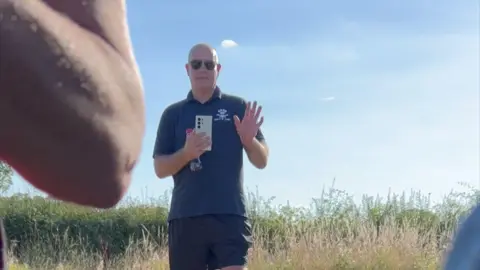
Four women and two men from two rescue groups went to a field near Long Clawson on 25 August this year, as part of their search for a lost dog called Kimmy.
The owner had also asked Drone to Home to help, and Mr James was parked further down the road when the volunteers and dog owner arrived.
Four of the volunteers have spoken to the BBC about what happened, including Ms Jefcott, but three asked to remain anonymous.
One of the volunteers, who we are calling Mandy, said she arrived at about 16:00.
"As soon as the owner arrived, Phil turned up behind and then immediately got out with his phone and started filming us," said Mandy.
Another volunteer, who we are calling Meg, told the BBC: "Phil came up to each individual volunteer and stuck the camera in their face.
"He kept putting his head close to our ears when he was behind us and saying vile comments in our ears to try and get us to react. We ignored him and then he left us alone because Kim turned up."
Another volunteer, who we are calling May, sent their location to another volunteer who was not at the scene.
Meg told the BBC: "I'd messaged her about the same time saying 'can you ring the police?'"
The volunteers said a police officer arrived and spoke to Mr James, but he did not leave. The officer then stayed at the scene until the volunteers left at about 19:00.
"We just couldn't believe his behaviour," said May.
May added she had bought a bodycam because she was afraid of Mr James.
What did police say?
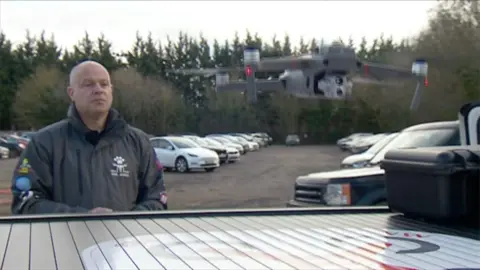
Leicestershire Police confirmed it was called to an allegation of harassment in Long Clawson, but said "no threats had been made, and no offences were disclosed".
7BR said it had reported the fraudulent letter to the Metropolitan Police, which told the BBC it could not comment as the matter had been passed to Nottinghamshire Police.
Nottinghamshire Police's press office said it could not find any report relating to the 7BR chambers, so could not comment.
Ms Jefcott also said she reported Mr James to Nottinghamshire Police in 2024, and was told in an email from them seen by the BBC: "The letters being sent to your employer is classed as harassment and is a police matter."
However, Ms Jefcott said an officer later visited her and told her there was not enough evidence to investigate further.
The BBC asked the force what action was taken in relation to Ms Jefcott's report, but it has not commented.
What has Mr James said?
The BBC contacted Mr James and Drone to Home's trustees on 21 November and asked them to respond to the allegations in writing or in an interview.
The following day, a post appeared on Drone to Home's Facebook page announcing "the closure of Drone To Home in April 2026", without giving any explanation.
A series of posts then appeared over the following days, in which the charity claimed to be the victim of "sustained and severe abuse" and "physical attacks and intimidation".
The posts contained claims from the charity that "six hate campaigns" had been set up by seven people it named - including three who contributed to this article.
On the evening of 24 November, the Drone to Home Facebook page was shut down.
The BBC asked Mr James and the trustees for evidence of the charity's claims, and Mr James responded by threatening the BBC with legal action.
In his email, he said the "prospective publication" of our story contained "allegations that are demonstrably false, deeply misleading, and inherently defamatory in nature concerning both my personal integrity and the operations, financial standing, and reputation of Drone To Home".
We wrote to Mr James, asking why the allegations were "demonstrably false" and "deeply misleading", and asked him to provide any relevant evidence in support.
The BBC has not received a response.
Some of those whose names were published by Drone to Home on Facebook said the posts had caused them distress, and that they had incited some of the charity's followers to contact them with abusive messages.
Messages received by Ms Jefcott, which the BBC has seen, included calling her "scum" and "a disgusting human". We cannot repeat some of the other messages due to the strong language used.
"I felt sick," said Ms Jefcott. "It's quite scary because you don't know if somebody's going to turn up on your doorstep, or you might see them out on the street.
"He's manipulated and brainwashed his followers to believe that I and others have brought down a fantastic charity."
Drone to Home's account also posted an image of Ms Jefcott sitting in her car during the incident in Long Clawson, and her phone number was printed on the side of the car.
It was posted on Facebook on 23 November, and Ms Jefcott said she received a call late that evening from someone saying words to the effect of "we are coming to get you", or "I am coming to get you".
She and some of the others named have contacted Nottinghamshire Police, which told the BBC it could not confirm whether or not it was investigating.
Send your story ideas to caroline.lowbridge@bbc.co.uk or via WhatsApp on 0808 100 2210.
