Hong Kong jailed my dad to stop me speaking out, says activist

 Reuters
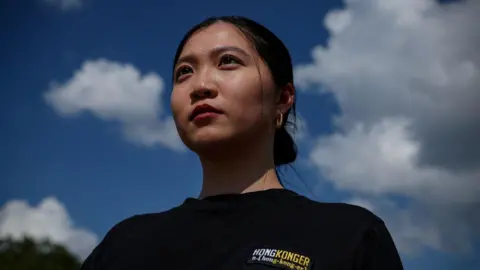
When Anna Kwok found out that her father had been arrested in Hong Kong for a national security offence, it came as a shock - but, she says, "there's also this feeling of knowing it would come one day".
Kwok, a 29-year-old pro-democracy activist, left the city in 2020. But she is still wanted by authorities who have put a HK$1m ($127,000; £94,300) bounty on her.
On Thursday, a Hong Kong court sentenced her father, Kwok Yin-sang, to eight months in prison for a national security violation - the first involving the family member of a wanted activist abroad.
The 69-year-old was found guilty earlier this month of attempting to handle the financial assets of a fugitive, after he tried to withdraw around $11,000 from an insurance policy he had bought for his daughter when she was two years old.
Critics say the conviction and sentencing of Kwok's father marks an expansion of the Hong Kong government's pressure campaign on political activists abroad, which increasingly resembles mainland China-style repression.
The Hong Kong government denied this. In response to queries from the BBC, a spokesperson said actions taken by law enforcement and the court against individuals "have nothing to do with their political stance, background or occupation".
Kwok is one of 34 activists wanted by Hong Kong's national security police. She is accused of colluding with foreign forces and breaching Hong Kong's national security laws after participating in the huge pro-democracy protests that engulfed the city in 2019.
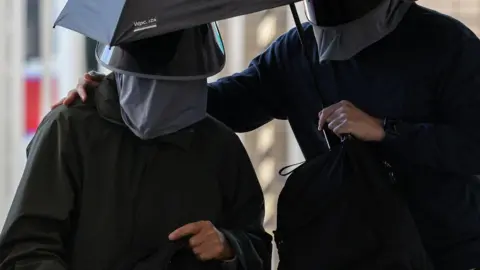
Kwok's father and brother were arrested last year on suspicion of dealing with her financial assets. Her brother was released but her father was charged under Article 23, a homegrown law that expands on the Beijing-imposed national security law. He pleaded not guilty.
Authorities say the laws, which target acts like treason and secession, are necessary for stability - but critics say they are tools to quash dissent.
 Reuters
According to Kwok, her father's prosecution was aimed at silencing her advocacy abroad. She is the executive director of the Washington-based Hong Kong Democracy Council, which has lobbied the US Congress to reconsider the operations of Hong Kong's trade offices in the US.
"My father's case really shows how political freedom is reaching a new low in Hong Kong," Kwok said. "And how the Hong Kong government, learning from Beijing, is committed to repress any sort of freedoms or any sort of campaign Hong Kongers dare to wage."
The Hong Kong police told the BBC they have acted "in accordance with the law" and "condemn any malicious attempts to smear the Force and stir up public panic".
Beijing's playbook?
Kwok is not the only overseas activist whose families have been summoned by the police.
A tally based on media reports shows that since 2023, police have questioned at least 50 family members of 19 "absconders" - the term Hong Kong authorities use for people wanted for national security offences.
Those summoned range from immediate family to cousins and in-laws.
Even figures deemed friendly to Beijing are on the list. In 2023, Eunice Yung, then a pro-Beijing lawmaker, was questioned by police about her father-in-law Elmer Yuen, a US-based activist wanted for national security offences. Yung, who had publicly severed ties with her father-in-law, said at the time that she co-operated with the police and supported their actions.
In February last year, the aunts and uncle of Carmen Lau - another pro-democracy activist living in the UK - were reportedly taken by Hong Kong's national security police to assist with investigation. At the time, police told AFP news agency that it was normal to collect intelligence from people linked to fugitives.
But Lau said what happened to her relatives was likely an attempt to intimidate her for protesting against China's plan to build a mega-embassy in London.
Around that time, Lau's neighbours in the UK also received letters offering a bounty payment of £95,000 to anyone who would hand her over to the Chinese embassy - similar to what had been sent to at least one other Hong Kong activist in the UK.
The US and UK governments have condemned these bounties as a form of "transnational repression".
But the Hong Kong government told the BBC that it "has the responsibility to pursue those who are suspected to have committed offences endangering national security, even if they have absconded overseas".
 Getty Images
In December, Lau said her neighbours received fake, sexualised images of her - the latest type of intimidation she has faced since leaving Hong Kong.
"It's for sure wanting us to self-censor, to shut up, and also emotionally blackmail us," Lau told the BBC.
"The police often say that they want us to go back to Hong Kong to face justice. So I think that's what they wanted to do."
Activists say these tactics come right out of Beijing's playbook. Rights groups have long accused Chinese authorities of intimidating or detaining families of dissidents who have fled the country.
This has had a chilling effect on the community of Hong Kongers abroad, said Lau, a former Hong Kong district councillor. Some have chosen to stay away from events organised by exiled pro-democracy activists, out of worry for their families back home, she added.
'They want me to stop speaking out'
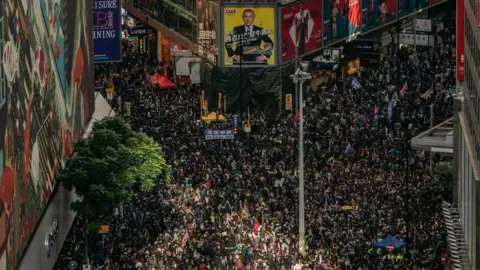
In 2019, hundreds of thousands of HongKongers took to the streets to protest against a proposal which would allow extradition from Hong Kong to mainland China.
It erupted into a pro-democracy movement, becoming the most serious challenge to the government since Hong Kong returned to Chinese rule in 1997.
Beijing responded by introducing a national security law (NSL) in 2020, arguing that it was essential to keep Hong Kong stable. Critics and rights groups said it criminalised activism and criticism of the government, creating a climate of fear and stifling the city's vibrant civil society.
Where many protesters had in the past been charged with illegal assembly or public nuisance, under the NSL they faced harsher punishments, including life in prison.
Hundreds have been arrested for national security offences, including former lawmakers and prominent pro-democracy figures, such as media mogul Jimmy Lai, who was sentenced to 20 years in jail earlier this month.
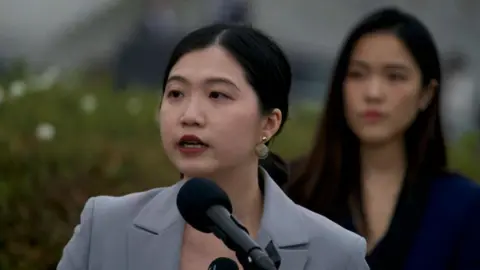
"In the past few years, the international community has recognised that the Hong Kong government has been weaponising the courts and the laws of Hong Kong for political suppressions," Eric Lai, senior fellow at the Georgetown Center for Asian Law, told the BBC.
 AFP via Getty Images
The case of Anna Kwok's father is just the latest example, he said.
"The fundamental issue in this case is, this absconder should not be seen as a criminal at all," Lai said, adding that the bounty warrants issued on "non-violent advocates" exercising their right to free speech abroad "do not conform to international human rights standards".
The Hong Kong government said in its statement that "everyone charged with a criminal offence has the right to a fair hearing".
It added that "absconders" were wanted "not because they have 'exercised freedom of expression', but because they continue to blatantly engage in activities endangering national security there, including requesting foreign countries to impose 'sanctions'" against Hong Kong and mainland China.
Kwok, however, said Hong Kong authorities were trying to make an example out of her and her family with Thursday's sentencing.
"There's definitely guilt to grapple with", she added, but also a bigger mission: "What I'm trying to show is simple. It's telling people that even if this happens to you, you have to continue."
"Hong Kong's government definitely wants to silence me. They want me to stop speaking out," she said. "And of course they have failed. I'm speaking to you now."
Additional reporting from BBC Chinese
