Will divisive landmark be missed as demolition looms?

 Owen Sennitt
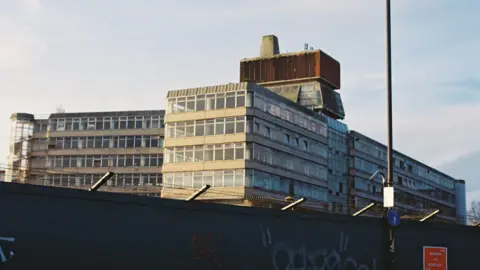
It has dominated a city's skyline for decades - but soon this brutalist office block will be no more.
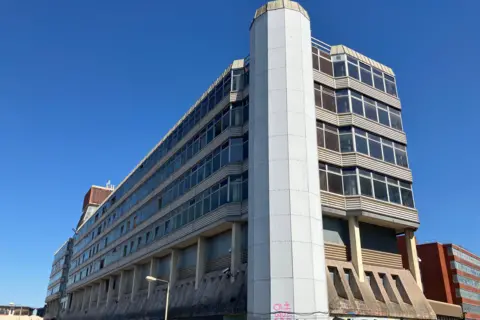
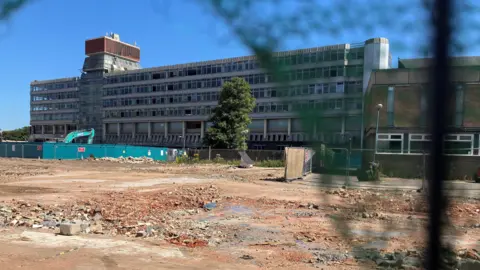
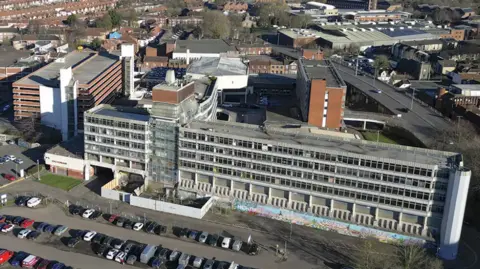
Sovereign House has stood in the north of Norwich since the late 1960s but for nearly 30 years, it has been derelict.
The seven-storey building is due to be razed to the ground as part of a £350m project to regenerate the wider Anglia Square complex into 1,100 homes.
While some revile it, others see it as a striking piece of architecture that has inspired art projects and drawn photographers admiring its design, likened by some to a spaceship or cruise liner. So will it be missed?
 Owen Sennitt/BBC
When will it be demolished?
Norwich City Council said it could not give an exact timeline for when work would start.
But it will begin once the neighbouring QD building is cleared of asbestos, which was identified following additional planned checks of the structure.
The spokesperson added: "The demolition of Sovereign House and Gildengate will be carried out once this work has been completed.
"We would like to reassure the public that all necessary health and safety procedures continue to be followed, as they have been throughout the demolition programme."
 Owen Sennitt/BBC
What is its history?
Sovereign House was purpose built for Her Majesty's Stationery Office (HMSO), with construction beginning in 1966.
It was designed by Alan Cooke Associates and was the first building the firm constructed as part of the Anglia Square shopping complex.
The design is characteristic of brutalist architecture, a minimalist style that emerged in the 1950s in the UK, known for its angular, geometric concrete structures that looked futuristic in their time.
When it opened in 1968, hundreds of HMSO staff moved from an office in London to start working there until it was shuttered in the late 1990s.
Unlike neighbouring Gildengate House, which became art studios, the building was never repurposed and was left to decay, becoming a target for urban explorers.
Both buildings are due to be demolished in the coming weeks or months.
 Martin Barber/BBC
Loved and loathed
 Owen Sennitt/BBC
Speaking to people on Magdalen Street, some people were eager to see Sovereign House razed to the ground.
Sharon Hovell, 61, said: "I think it's really ugly. I can understand that some people would want to keep it, but the brutalist thing was never attractive.
"It is going to sound great when all that glass comes down though."
Tom, from Norwich, said: "It's always been here since I moved to the city and people were always saying it's going to come down at some point."
 Owen Sennitt/BBC
Others called it a "bittersweet" moment.
George Moore, who said he used to pass it everyday when working as a cleaner in his teens along Magdalen Street, said: "I always thought it was a bit spaceship-like. I'm going to miss it.
"There's definitely a nostalgia factor when its gone but it needs something done with it and it was prohibitively expensive to do anything else. It is bittersweet."
Alice Smith added: "I think it is sad as it is a recognised place but depending on what they do with it, it could look quite nice and they are trying to modernise he area."
Brutalist Norwich
Sovereign House is not the only example of brutalist architecture in the city.
At the University of East Anglia, there are a number of buildings from this era but the most well-known structures are the Ziggurats.
They were designed by architect Sir Denys Lasdun and completed between 1967 and 1969 to provide student accommodation.
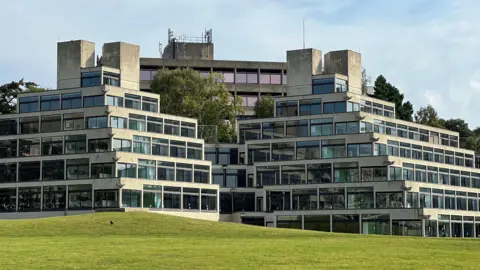
Since 2023, the Grade II* listed buildings have been empty due to concerns about Reinforced Autoclaved Aerated Concrete posing a safety risk as the materials have reached the end of their lifespan.
Other brutalist buildings include Norfolk Tower in Surrey Street, which is one of the tallest buildings in the city and Prospect House in Rouen Road, which has been home to the Eastern Daily Press offices since the 1960s.
But some buildings have already faced a similar fate to the one awaiting Sovereign House, such as nearby St Crispins House, which has ben demolished and rebuilt as student accommodation.
Do you have a story suggestion for Norfolk? Contact us below.
Follow Norfolk news on BBC Sounds, Facebook, Instagram and X.
