Volunteer firefighter on battling summer heatwave wildfires

 Josh Bailey
Fire crews have been stretched to breaking point this summer as wildfires spread across parts of the UK. Countryside professionals have also been in action fighting the flames, with their expert knowledge proving a valuable tool in tackling the blazes.
Gamekeeper Josh Bailey loves his job but he has barely done it this summer - instead spending weeks battling the raging wildfires that have ignited around the country.
As well as his 'normal' role the 33-year-old is also a trained firefighter and is one of many volunteers across the country who have been called on to help tackle the blazes.
After putting himself at risk for weeks he says he is in disbelief about people who continue to ignore safety warnings.
"There are some very responsible people but the other half are not and when the prime minister set the alarm off last Friday night I'm afraid it was too little, too late. We've been concerned about wildfires for years," he says.
Millions of mobile phones bleeped with a "severe alert" notification on 14 August, stating there was a "very high risk of wildfires nationally".
The lack of advance warning for the alert was criticised by charities and domestic abuse survivors, who said there was little chance to protect those hiding secret phones.
However a spokesperson for Prime Minister Andy Burnham said the alert had been sent "after a direct request from fire and rescue services on the front line".
"The government alert was a relief but we want the news channels and social media to broadcast alerts as I still don't think some people are aware," Josh explains.
"I truly think some people aren't aware that making a campfire or taking a camp stove onto the moorlands could potentially burn the Peak District down."
 Josh Bailey
Josh, who lives and works in Strines on the border of South Yorkshire and Greater Manchester, is one of dozens of firefighters who are called in by the government's Department of Environment, Food and Rural Affairs (Defra) to help when wildfires break out.
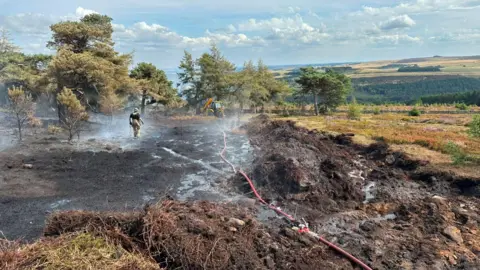
Most recently he joined crews after a moorland fire ignited near Mortimer Road in Bradfield, South Yorkshire.
Gamekeepers turned up within 20 minutes of being called to action. Local farmers also joined the fight, without being asked, and brought slurry tanks of water to help douse the flames.
"We started fighting the fire back on 24 July, it was a campfire that had burned into the ground," says Josh.
"We had put it out once, then the fire service put it out again. On 12 August, when the grouse shooting season started, we should have been shooting the grouse but we were actually fighting the wildfire above Bradfield as it had been burning nearly a month."
Tackling fires on moorland is not just about putting out the flames above ground.
"We had to dig it out because it had burnt into the peat layer, below the vegetation and above the mineral soil, it was going underground.
"We are trying to protect the moorlands and peatlands as these wildfires are devastating," Josh says.
He has spent the summer helping crews nationwide as dozens of fires tore across swathes of the country during recent heatwaves.
 Ryan Jenkinson/Getty
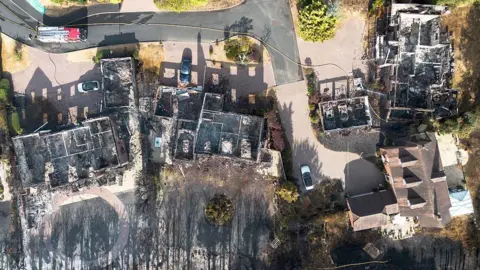
The prime minister described the country as a "tinderbox" when he visited the scene of the fires in Stourbridge in the West Midlands, which destroyed or damaged dozens of homes.
Closer to his home, Josh says a fire on the Stalybridge Estate reached 6,178 acres (2,500 ha) was stopped before it reached Manchester.
"There was another at Croydon where we went out at 03:00 BST driving on all terrain vehicles in the dark.
"There's no extra pay that comes with this, we are simply doing this out the love for the moorlands try to protect them."
Richard Bailey works with the Regional Moorland Group which supports landowners and has helped coordinate the response from gamekeepers.
He calculates members and their staff have contributed more than 2,000 hours in recent weeks.
Richard says their detailed knowledge of the terrain is invaluable.
"We know when to fight a fire and when to let it go, because it's coming into a natural break.
"The fire service have had better kit now from 2018 but it's that knowledge of how to get from A to B which we have, because we're on it [the land] every day."
Josh wants the government to look at 'cool burning' in winter.
The term refers to a controlled fire technique which aims to removes excess surface vegetation and flammable fuel like old heather or dry grass, while leaving the peat unharmed.
The technique is not without critics, with some opponents suggesting it can damage the peat and also contribute to fire risk.
He also wants more roads in remote areas for better access and to act as fire breaks to stop blazes spreading.
"I couldn't be happier for winter to come - but we are going to have to get used to this.
"It was the worst wildfire summer on record last summer and now this one has surpassed it.
"We are never going to stop wildfires but we need to make the public more aware and we need better fire mitigation in the UK."
Listen to highlights from South Yorkshire on BBC Sounds, catch up with the latest episode of Look North
