Wheelchair space rules 'not enforced' on buses
Transport for London (TfL) says that it needs to do more to ensure both "customers and drivers" understand the rules over designated wheelchair spaces.
It comes after a father said his four-year-old son was left feeling "like it was his fault" after being refused on to a London bus because the priority space was occupied by buggies.
By law wheelchair users have priority to designated wheelchair spaces, but campaigners say a lack of awareness is leaving disabled people behind.
Chris, who was taking his son Phoenix to a hospital appointment, says he is refused on to buses on an "almost daily" basis, leaving him worried about his son's future.
Under the Equality Act 2010, bus operators must make "reasonable adjustments" for disabled passengers.
This includes making sure ramps are in working order, providing priority spaces and seats for disabled passengers, and ensuring all passengers know, or can easily find out, where they are on their journey and when to get off.
Enforcing the rules
Rosie Trew, TfL's head of bus delivery, said that while passengers can use the priority space when it is free, it is "primarily for wheelchair mobility aid users".
"If someone in a wheelchair does want to get on, then they either need to share the space if possible, fold up their buggy, use the priority seating, or wait for the next service," she said.
If non-disabled passengers do not make room in priority spaces, drivers are required by law to ask them, more than once, to move or share the space.
However, drivers cannot force them to move and if they do refuse, TfL says that the driver should apologise to the affected passenger and advise them to wait for the next bus.
In the video, Chris asks the driver to call their depot, which they refuse to do despite the fact drivers are required to report incidents before "closing the doors and moving off".
The footage also shows the driver failing to intervene as other passengers directed abuse at the father.

A spokesperson for TfL said that the events in the video fell "way below" their expected standard and they "appreciate the upset it must have caused them".
"As soon as we became aware of this incident, we followed up with Transport UK, the bus operator, who investigated as a matter of urgency, speaking to the bus driver and reissuing guidance to all its drivers."
Chris says while some drivers are "very good", he believes others either do not know the rules or are unwilling to deal with the "fuss" of enforcing them.
He says that he does not want parents to be "chucked off the bus".
"It's simply folding the buggies down or moving them," he says.
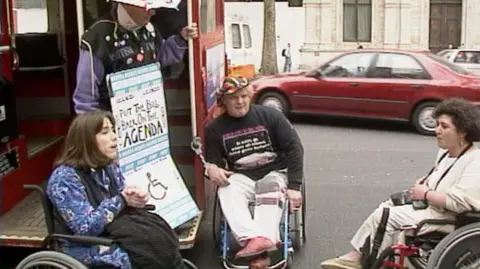
"It took years and years of protests and disabled people chaining themselves to buses, to even get that bay."
But he says he also appreciates that some buggies function as a wheelchair, or a parent themselves could be disabled and unable to fold a buggy.
More than 1,500 complaints have made been to TfL about buses being inaccessible to wheelchair users in the past three years.
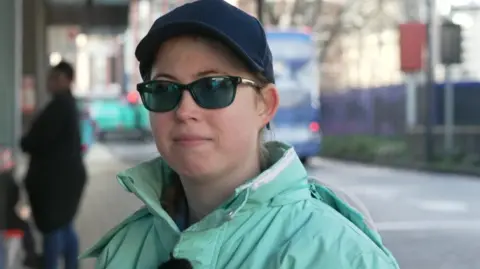
Rebecca Clarke, a youth board member for the disability charity Whizz Kids, told BBC London that she often expects the designated wheelchair space to be occupied when she needs to travel by bus and fears the possibility of "confrontation".
"It makes you want to not travel, which then obviously restricts your social life and your work life and opportunities," Clarke said.
"It's quite vulnerable as a wheelchair user if it's just you versus them.
"Having someone with a position of authority to state what the rules are can really help."
TfL says the London bus network is "one of the most accessible in the world", but Trew acknowledged it is not always well known what the priority space is for.
She says TfL is providing training to the capital's 25,000 bus drivers, which is designed to ensure they are "aware of their legal obligations".
The training will include testimony from customers with disabilities about their lived experiences "including both positive and challenging moments" on the bus network.
TfL's bus driver handbook is also being updated and will be released later in the year, which will be "another opportunity to reinforce the correct procedures and guidance drivers are expected to follow".
Last year, Sir Sadiq Khan said that introducing a second wheelchair space on buses in the capital was an "aspiration" but would not be possible without "significant compromises".
The London mayor said these would include reducing the amount of step-free seating and increasing the number of passengers who have to stand.
It would also, he says, "require priority seating to be located towards the rear of the bus", meaning passengers with reduced mobility would have to move further through the bus, making boarding more difficult.
Chris says while he and no disabled person "should have to do it", he is recording his experiences and speaking out so that in the future his son will not face the same barriers.
"I want him to be able to freely travel."
Additional reporting by Tom Edwards
Listen to the best of BBC Radio London on Sounds and follow BBC London on Facebook, X and Instagram. Send your story ideas to hello.bbclondon@bbc.co.uk
