The musician looking to record the confessions of Glaswegians

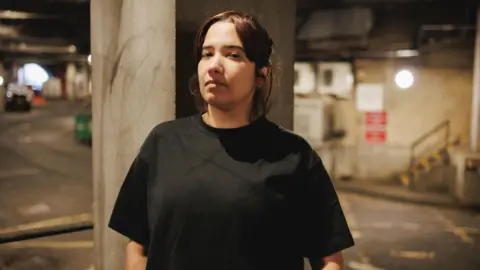 Eysa
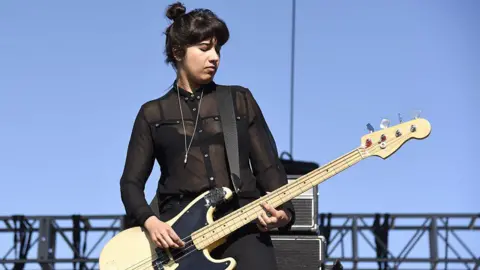
EysaAyse Hassan had already started playing in bands when she actually started to learn the bass guitar.
Now the musician is hoping that DIY spirit can be transferred to others, thanks to a new exhibition being held in Glasgow.
Ayse, who previously played with Mercury Music Prize nominated band Savages, is releasing her first solo album - under the stage name Eysa - next month.
However, she is breaking down the record, called Chasing Desire, in a unique way at the Saltspace art gallery in Glasgow's Crosshill area.
And an exhibition will let people play the same equipment used on the album, experiment with sounds and record confessions - that will later become a piece of music.
"I've done so much time playing shows and festivals now, so what excites me is something that's more unusual," says Ayse.
"Even if folk don't have a clue who I am, they can come down and use instruments, and it should demystify what it takes to make a record. This exhibition is about working within your limitations but still being creative and still making music."
The album is Ayse's first full record under the Eysa identity, after years of purely being a bassist, most notably with Savages.
The post-punk quartet released two albums, both of which were nominated for the Mercury Music Prize. They became inactive after the second release, 2016's Adore Life, and have in effect disbanded, albeit quietly.
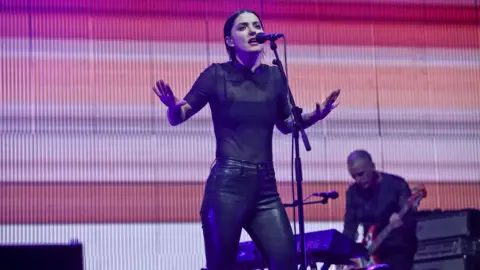
Ayse's solo record sees her use electronics, loops and programmed beats alongside her distinctive bass, and taking an experimental approach is partly why she believes the Glasgow exhibition - which runs until Monday - can be effective.
"It interests me to share knowledge," she explains.
"I mean, my vocal mic was a field recorder, something usually used for capturing wildlife. But it was an interesting way to develop my sound, and I wanted to see if I could use it successfully.
"My music has been played on the radio but I recorded the vocals for this album in my house. I think it's important to show to that you can do that".
 Getty Images
A key part of the exhibition is encouraging interaction. There will be several work stations set up to let children experiment with making music, as well as the chance to test the gear used on Chasing Desire.
The musician says that it's important the creative arts "aren't only for the wealthy", and encouraging interaction is one way to combat this.
However, there is also the intriguingly titled "desire transmission".
"So that will be a booth and it gives people the chance to say whatever they want into a microphone," laughs Ayse.
"I'll turn all the voices recorded into a track later on, adding electronics and vocals on it. It's a way of including the local community in the work."
Community spirit is important to Ayse, who is originally from London. She moved to Glasgow several years ago, partly due to wanting a new place for her young daughter to grow up in.
She has since settled in the city's Govanhill area, and has worked with a number of local designers, arts and printers from throughout Glasgow (and occasionally beyond) on both the album and the exhibition.
Meanwhile, the record itself calls upon the likes of alt-rock singer Sharon Van Etten and Laura-Mary Carter - one half of rock duo Blood Red Shoes - as guests.
Ayse believes she learned more and more as the project progressed.
"I've spent my entire life being in bands but I was ready for something where I was more in control, that I could really devote more time to," she says.
"It was a progression into teaching myself how to record properly, how to sing, how to make electronic music. Bass was always what I did, so carving a space for myself was a massive learning curve."
Now she hopes that people might check out the exhibition and go away buzzing with their own ideas.
"I want people to get insight through doing something, rather than reading," she concludes.
"There's a bit of magic in that."
