Can Ukraine's war-torn wheatfields be cleansed?

 Royal Agricultural University
Images of the devastation in Ukraine caused by four years of war with Russia, from bombed apartment blocks to the deaths of at least 100,000 soldiers, have become familiar to all of us. But not as visible, beneath the high-profile destruction, experts fear the very soil of Ukraine may be poisoned.
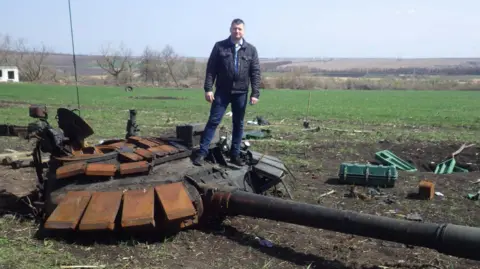
Fields of grain have been turned into battlefields, polluted by shells, bombs and burned-out tanks.
Now farming experts from the Royal Agricultural University in Gloucestershire and Sumy National Agrarian University (SNAU) in Ukraine have analysed the long term impact.
Much of the soil has been contaminated, they say, by toxic elements and heavy metals which will pollute the land and crops grown on it "for years to come".
So how do you clean up the country known as "Europe's breadbasket"?
Soon after Russian forces invaded Ukraine in 2022, farming experts at the Royal Agricultural University (RAU) near Cirencester realised there would be a big impact on farmland.
"We knew there was a serious threat to global food security," explained Prof Mark Horton, Pro-Vice Chancellor at the RAU.
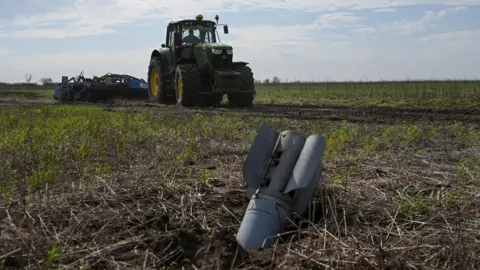
"We're looking at millions of shell holes, missile impacts, drone impacts, glide bombs - each of these leaves different residues and different remains on the farmland."
Prof Horton's team set up a twinning relationship with Sumy National Agricultural University in eastern Ukraine, just 30 km (18.6 miles) from the Russian border.
 Reuters
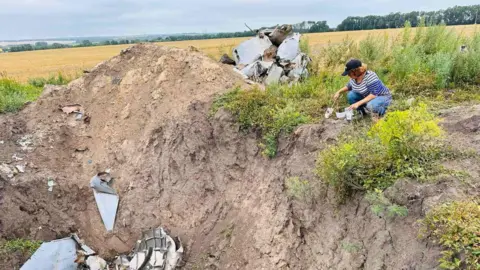
Ukrainian researchers took soil samples from battlefields, in craters and around burned out tanks. It is thought to be the first time soil has been analysed while the war is still raging.
A leading Ukrainian soil scientist, Dr Olena Melnyk, joined the Gloucestershire team to co-lead the project.
"We found cadmium, cobalt, copper, zinc, and nickel," she explained.
"These heavy metals have a very high level of toxicity, and really they can cause a carcinogenic, teratogenic, effect to human beings."
Bombing the 'breadbasket'
The scientists knew this massive pollution was happening in what is often described as the "breadbasket of Europe".
Before the war, Ukraine was the biggest exporter of sunflower seeds in the world, and the seventh biggest grain supplier. Grain exports earned Ukraine $27.8bn (£23.8bn) in 2021.
Grain ships and ports have been a major target in the war, with Russia frequently trying to cut off Ukraine's most lucrative overseas trade.
In the four years of the conflict, more than 800 square kilometres (a million square metres) of soil have been contaminated by bombs and projectiles, according to Ukraine's deputy minister of economy Ihor Bezkaravainyi.
Addressing a conference of all the scientists on the project held in Cirencester this week, Bezkaravainyi described his country's soil as "the foundation of our whole economy".
 Royal Agricultural University
They have counted more than 1,100,000 craters in farmland.
But while the big picture is clear, the detail really matters.
Dr Melnyk and the team knew they could not tell farmers to stop farming all the fields affected by war. They needed to know precisely where the soil was contaminated, and where it was safe.
To do that, they have taken more than 8,000 soil samples, many of them from fields still near the front line of the war.
'Encouraging results'
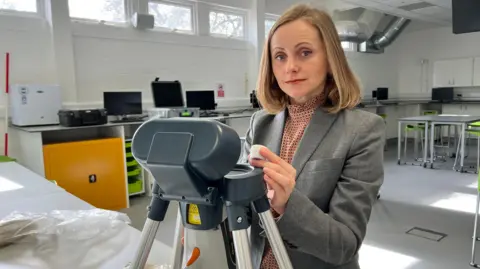
Analysing this many soil samples and the data produced from them is a huge complex task. Back in Cirencester, Dr David O'Connor showed me a new kind of "elemental microscope" that can be used to identify traces of dangerous elements in soil.
His team have supplied this kind of equipment to the Ukrainian researchers, and trained them in how to use it.
And, in a war that has brought little good news to Ukrainians, the results have been surprisingly encouraging.
"Interestingly, we haven't found huge quantities of heavy metals in the craters," O'Connor said.
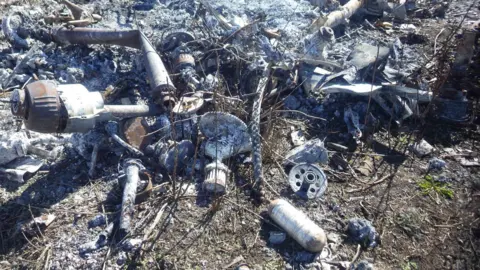
While the craters left by bombs and missiles look dramatic, they actually did not yield highly-contaminated soil. Instead, it was land where tanks had burned out and helicopters or drones had crashed that had the worst readings.
Dr O'Connor explained: "On these Ukrainian fields, we are finding a large number of destroyed military vehicles. And when we take soil samples from those locations, that's where we're seeing high levels of elements such as lead and zinc, which are toxic."
 Royal Agricultural University
The team are still analysing all the data before it can be published in academic journals. But already Dr Melnyk says there are practical results for Ukrainian farmers.
"We don't need to withdraw the whole area from agricultural use," she said.
"We just have to identify these areas - that we call hotspots - and we have to inform farmers what to do."
Working with Ukrainian authorities, the team from Gloucestershire aims to teach farmers how to seal off areas that are highly contaminated. They are also developing special ways to 'remediate' - or clean up - the soil from these toxic elements.
"Our land can continue to grow food for our people," Dr Melnyk concluded.
"And feed the rest of the world too."
Follow BBC Gloucestershire on Facebook, X and Instagram. Send your story ideas to us on email or via WhatsApp on 0800 313 4630.
