The pioneering coffee house serving since 1645

 BBC
BBCIn most modern cities and towns across England you cannot move for coffee shops and Oxford is no different.
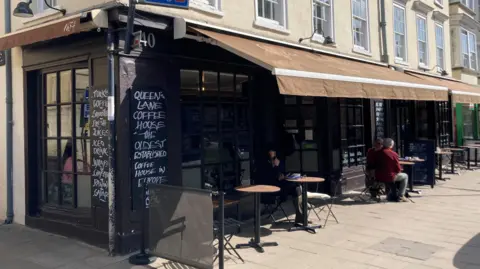
But among the dreaming spires and bustling streets of the cathedral city sits possibly the oldest continuously used coffee house in Europe.
Queen's Lane Coffee House has been serving hot cups of java since it first opened in 1654.
Radio Oxford's Lilley Mitchell visited the historic establishment with historian Tom Garner to find out more.
In the 1650s, coffee was viewed as an exotic non-alcoholic beverage, known for its reviving effect that "would stimulate the mind but won't make you legless", said Garner.
At the time, the coffee served would have been akin to modern-day Turkish coffee, he said, adding: "It would have tasted more bitter due to its long journey from the Middle East.
"By the time the coffee grounds got to Oxford, they would have been stale."
But how did Oxford become the self-proclaimed blueprint for the coffee house culture?
By 1650, Oxford had just come out of the devastating English Civil War and England became a republic for just over a decade under Oliver Cromwell.
Serving as Lord Protector, he looked to rebuild business links with Jewish people who had been banned from the country since 1290.
Garner said: "Cromwell knows that the Jewish people in Amsterdam and the Middle East are very prosperous and so many of them bring coffee with them as part of their business.
"Another Jewish businessman Cirques Jobson opens Queen's Lane Coffee House.
"It's a fascinating time of both social change, military change, political upheaval and, amazingly, it's still here."
He continued: "In those times, coffee houses were known as penny universities.
"That means you paid a penny to come into the coffee house, you can have a newspaper."
In Oxford, "runners" would go from coffee house to coffee house, picking up all the best news and delivering it back to customers, said Garner.
"You're talking human wi-fi.
"In this way, ideas ferment and it's the beginning of what is known as the Enlightenment [an intellectual and cultural movement].
"[Queen's Lane Coffee House] is right at the heart of what's the beginning of the modern world as we know it."
The shop is owned today by a Turkish family and continues to be a brewing pot of multiculturalism and ideas.
Eileen and her brother took over running the business from their parents.
"I feel very proud and you can see I haven't been able to retire, which I wanted to, but I think coffee is in our blood," she said.
Garner believes coffee shops are now replacing the "traditional British watering hole - the pub".
"It's now part of our culture again," he said. "In a sense, the wheel has come full circle from where we started in 1654, coffee is dominant."
You can follow BBC Oxfordshire on Facebook, X (Twitter), or Instagram.
