'Becoming a train driver in my 40s was the best thing I ever did'

 West Midlands Railway
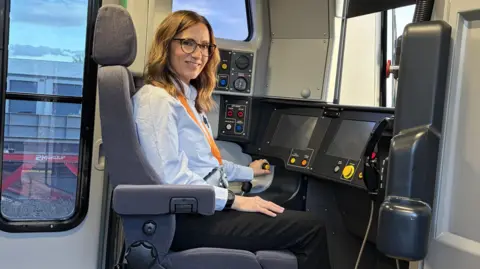
"I absolutely love it, I wish I'd done it years ago," Sharon Paton says, of her decision to change careers to become a train driver in her 40s.
"I don't have any deadlines, I don't have to answer emails, I've got the best office window you can have, driving around the countryside."
While just over one in 10 train drivers are women, the Birmingham resident said she had not come up against any negativity about being in the minority.
Paton said: "The first day I walked in, there was a cohort of eight drivers and I was the only woman and I thought, 'oh God, am I going to be accepted?'
"But it's been fine. You've earned your place."
Having previously worked in print and marketing for decades, Paton said she had got to a point where she fancied a change.
"I'd always wanted to do a practical job, and my brother-in-law had just gone through the training for a train driver and said, 'why don't you try it?'."
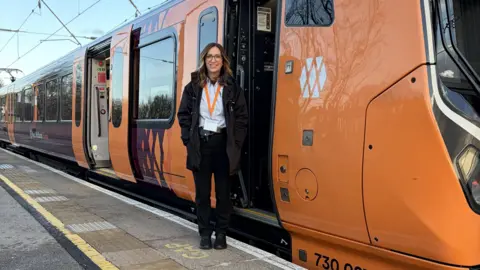
She jumped at the idea, and now drives West Midlands Railway services between Birmingham, Redditch, Lichfield, Wolverhampton and Rugeley.
 West Midlands Railway
Despite her enthusiasm, the rigorous 12-month training process caught Paton by surprise.
"There's about 12 different rounds of testing, psychometric, cognitive, safety-critical stuff, problem solving and a couple of quite meaty interviews," she said.
Trainees also sit exams about railway rules, train maintenance and have 270 hours of supervised driving practice.
Though she began classroom training in November 2023, it was at least four months before she got near a train.
At one point, she said she had found herself at a depot in the middle of the night looking at the underside of an engine, thinking, "what on earth have I done, how did I get here?".
"It's quite a shock to the system, that's for sure, after being in a marketing office," she laughed. "But also exciting and interesting too."
 Sharon Paton
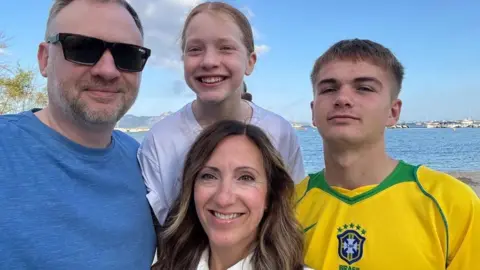
The early or late shift pattern works for her, with children aged 12 and 16.
"Getting out of bed at 03:00 in the morning is pretty brutal but then you're finished by lunchtime and I get to see my kids," she said.
However, she acknowledged it could be a challenge for some parents.
"I don't think I could do this shift pattern with young children - and there doesn't seem to be any alternatives to that, you either do it or you don't."
She qualified just over a year ago and still prefers routes with "a little bit of driving between stations".
"I love the actual driving. I love it when you have to go to the depot and pick them up and you have to drive them empty into New Street," she said.
"Once you're in the front cab, you are encouraged to forget what's behind you and concentrate on the job."
But it is far from relaxing, with constant monitoring of signals and safety systems.
"Customers are constantly pulling alarms and smoking in toilets - it all comes through the screens," she explained.
"I had the emergency brakes come in once and I panicked and thought 'what have I done?'
"But it turned out the conductor had fallen over in the back cabin and pressed the emergency button."
'Not a typical role'
West Midlands Railway, which has routes across the whole of the West Midlands, said it had increased the percentage of female trainee drivers in its workforce by nearly 9% since 2021, from 13.8% to 22.5%.
In 2025, 10.5% of all qualified drivers across the company were women, a spokesperson added.
Louise Ward, their head of talent, learning and early careers, said: "While the workforce is historically male-dominated, we are committed to encouraging more women into the industry and are pleased that a third of our new hires in the last year have been women.
"Sharon's story is a brilliant example of how you can join the railway with no prior experience and go on to thrive."
Paton added: "I get a lot of surprise when I say I'm a train driver, people are surprised by that. There's obviously a view that it's not a typical role done by women.
"I would fully encourage women to do it - it's a really great career."
Follow BBC Birmingham on BBC Sounds, Facebook, X and Instagram.
