Emergency services downgraded at city hospital

 Royal Wolverhampton and Walsall Healthcare NHS Trusts
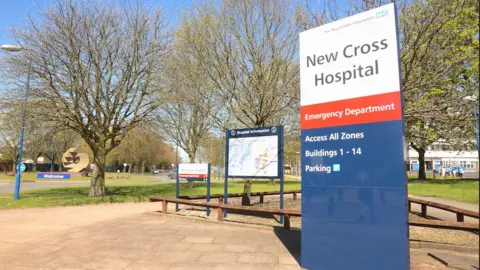
Emergency and urgent care services at a hospital in Wolverhampton have been downgraded from 'good' to 'needs improvement', the Care Quality Commission (CQC) said.
The rating for how safe these services at New Cross Hospital are was downgraded from good to inadequate after an inspection by the CQC in November 2025.
Joe Chadwick-Bell, Group Chief Executive at The Royal Wolverhampton NHS Trust, which runs the hospital, said the report was "disappointing for patients and staff".
He said they "accept that some of the observations the CQC made at the time of the inspection were not as we would have hoped".
The trust provides urgent and emergency services to people across Wolverhampton, Cannock and the surrounding areas.
"Following feedback on the day, and receipt of the report, we took immediate and widespread action to improve patient and staff safety in a very busy and often complex department," Chadwick-Bell said.
While the overall rating for the trust is 'good', the overall rating for New Cross Hospital remains as 'requires improvement'.
The CQC report said staff did not always listen to concerns about safety; and while safety events were investigated and reported, lessons were not always learnt to continually identify and embed good practice.
Staff were mostly emailed updates in the form of "making it better" alerts and "risky business", but not all staff had time to regularly check their emails or recall the changes or updates required.
Staff told the CQC updates also relied on word of mouth.
Investigators were told about an incident where allergies were not checked for a patient, which then resulted in harm.
The service has since changed so that medicine charts include two sources of cross checks for allergies.
'Poor pathways'
The investigation also found that people were regularly and inappropriately transferred to same day emergency care, which was used as an extra medical area to accommodate the volume of people in the emergency department, despite not fitting the criteria.
It was also discovered that while staff worked well together in their own environment, they didn't always work well across teams and services to support people, which risked creating a poor pathway for the person and conflict among teams.
Carolyn Jenkinson, deputy director of hospitals in the West Midlands, said they found the "lack of clinical management had the potential to put people's health at risk, and there weren't enough staff to deliver safe care to people".
"Although staff treated people with kindness, there weren't enough staff to meet people's needs due to the crowding and capacity of the department.
"Pathways were not always followed, such as the chest pain pathway. We saw people were not always in the appropriate area within the department for their health concern, putting them at risk of harm."
Jenkinson said the CQC has advised the trust they need to make several improvements, including redeploying a healthcare assistant into the waiting room to help with observations.
The hospital trust said it has since strengthened clinical oversight in the Emergency and Same Day Emergency Care (SDEC) departments, including the waiting room, and improving triage waiting times for those patients who do not arrive by ambulance.
"The report recognised that staff were kind and caring towards the patients we see and treat and we will continue to work with our dedicated colleagues in the Urgent and Emergency Care Services and our wider Trust teams to improve the services we provide," Chadwick-Bell added.
Follow BBC Wolverhampton & Black Country on BBC Sounds, Facebook, X and Instagram.
