How black woman in century-old postcard was found

 Hastings Museum & Art Gallery
A researcher who uncovered the identity of an anonymous black woman in a historical photograph has said the discovery filled her with joy.
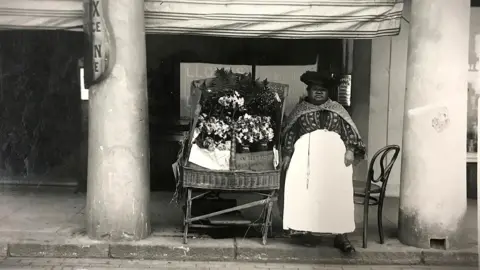
Claudine Eccleston, founder of arts project Playing the Race Card, identified the person selling flowers in an early 20th Century postcard as Margaret Sullivan.
She enlisted the help of others to identify the woman – pictured in St Leonards-on-Sea, East Sussex – shortly after she moved to the Hastings area.
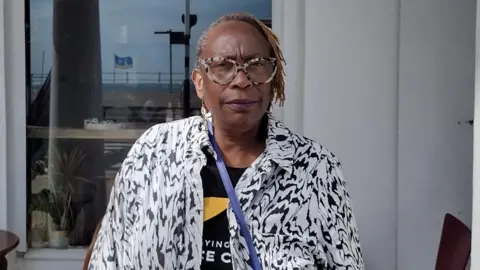
"It was amazing. It did actually fill me with joy that there was an image that was well-known, it was out there, and now we had a name for her," Eccleston said.
"But I was a little disappointed that the stories of working women, of working class people, was unimportant," she told Secret Sussex.
"Her genealogy and my genealogy – we can only go back so far, and we just have no idea where we come from."
Records were found of Sullivan's death in 1919. The earliest local census record she appears in is from 1881, according to Eccleston.
She said it was believed that Sullivan's husband died in a local workhouse and she had an unknown number of children.
 Fiona McCarthy
Eccleston found the image on social media in 2013 and thought it "seemed a bit lazy" that there was no record of the flower seller's name given that it was more than a century old.
"I showed it to a lot of people and they'd seen it, but it didn't occur to them that the person might have a name," she said.
She said she then sought help from a "community of amateur sleuths, history sleuths" on social media.
"I was actually surprised that within a very short period of time there was some evidence about who this person could be," Eccleston said.
Sullivan was pictured near the Royal Victoria Hotel in St Leonards.
"You can imagine some of the very, very well-heeled people walking past here and gazing at this woman and maybe stopping and buying a buttonhole or something," Eccleston said.
She told Secret Sussex: "I'm one of the so-called Windrush generation and there's this whole thing about us coming in the late 40s, 50s, 60s, 70s, but this was proof that people that looked like me lived, worked and contributed to this place."
Relatives of a son of Sullivan who was put up for adoption have travelled to Hastings from Canada to meet Eccleston, according to the campaigner.
She said they continued to send her information about Sullivan if they found it.
For the flower seller's descendants, the photograph "was a gift", Eccleston added.
Follow BBC Sussex on Facebook, on X, and on Instagram. Send your story ideas to southeasttoday@bbc.co.uk or WhatsApp us on 08081 002250.
