Homes still being built near oil depot blast site

 Phil Coomes/BBC
Twenty years after one Britain's worst industrial incidents, increasing numbers of residents are moving into new homes near the site of the massive explosion - and some say they were not even aware of the blast when they arrived.
The explosion at the Buncefield oil depot in Hemel Hempstead, Hertfordshire, on 11 December 2005 was the biggest blast in the UK since World War Two and injured 43 people.
Today, thousands of new homes are planned as part of major projects in the vicinity, including Beaumont Manor and Swallowfields, as well as the Hemel Garden Communities programme.
After the disaster, the Health and Safety Executive (HSE) introduced proximity zones for new developments, and Dacorum Borough Council says all planning applications near Buncefield follow that guidance.
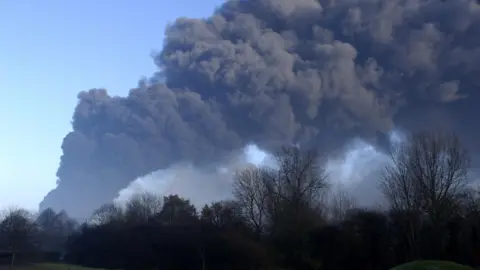
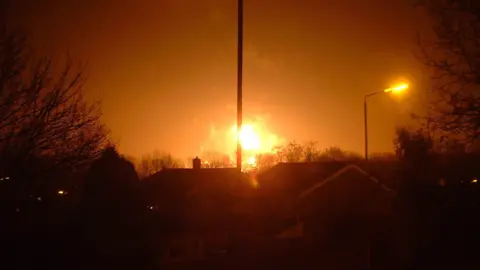
It was a cold Sunday morning when a vapour cloud ignited with the force of 30 tonnes of TNT. The explosion, just after 06:00 GMT, was heard as far away as the Netherlands.
Hertfordshire's chief fire officer declared it "the largest incident of this kind in peacetime Europe".
Thousands of homes were evacuated and people sheltered in village halls and leisure centres around Hemel Hempstead. Many homes were boarded up and nearby business premises were gutted by the force of the blast.
The fire burned for five days. The plume of smoke was visible from space and made front-page news around the world.
Remarkably, no-one was killed. Had the explosion happened 24 hours later, on Monday morning, the death toll could have been in the hundreds.
 Sue Ferguson
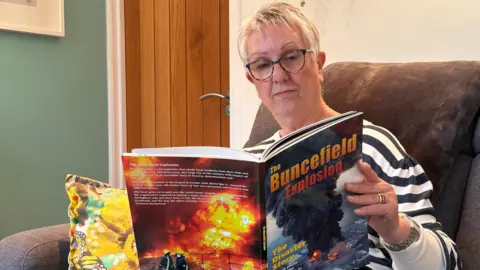
Sue Ferguson and her husband had moved into their home in Woodhall Farm in 1983 and immediately had concerns about the oil depot being so close.
"We actually had a conversation and we wondered what would happen if Buncefield ever went up," she says.
"Our conclusion was that we probably wouldn't know much about it because we'd be wiped off the face of the earth, so it would be quick and painless."
Years passed with their growing family living happily in the shadow of the site, which Mrs Ferguson says "grew and grew" near the property she still calls home.
When the explosion happened, her initial thoughts were not about Buncefield.
"We looked out the window and saw this massive ball of flame, and our first thoughts were that it was another Lockerbie," she says.
"We thought it was a plane crash because we're under the Luton flight path."
 Eric Johnson/BBC
Four decades since Mrs Ferguson moved in, new estates are continuing to spring up near the depot.
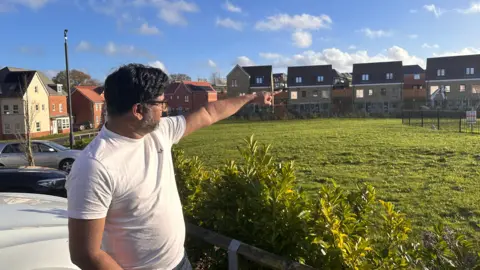
The Swallowfields estate – where construction began 10 years after the explosion – is near Buncefield, which is still operating, albeit on a smaller scale than 20 years ago.
Farish Lakhani moved there with his wife and two children. He says he "wasn't really aware of" the explosion until he bought the house.
"We drove past it every day and then it triggered a memory," he says. "That's when I started Googling it and remembered.
"Nothing was mentioned when we bought the house. It was down to us to look at the local area."
Zafar Shaikh, who put a deposit down on his new-build house in 2017, trusts the safeguards now in place.
"We found out about Buncefield during our research before moving in," he says.
"It was a big thing, absolutely – but given the safety precautions now and the time that's passed, we were OK to move here."
He believes the risk is minimal, adding: "I think the chances of something like that happening again are very slim. It was a one-off incident."
 Eric Johnson/BBC
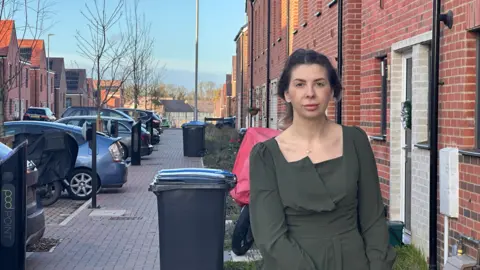
Just beyond Swallowfields is Beaumont Manor, another estate under construction and even closer to the depot.
Cristina Apopei, who moved into her new home in January this year, is glad she did not know about the explosion before she bought her property.
"If you hear something like that before you move in, you'll think twice," she says.
Vistry, the developer behind Beaumont Manor, says the site was thoroughly vetted.
"Beaumont Manor is outside the Buncefield no-build zone but within the HSE's consultation distance. The land was thoroughly examined and the HSE did not raise any objections," a spokesperson says.
Despite the assurances, Ms Apopei thinks housing developments "should be pushed a little bit away" from the site.
 Eric Johnson/BBC
Critics say the lessons of Buncefield are being forgotten.
David Herring, a former police community support officer who worked at the scene in 2005 and is now a Reform UK member of Hertfordshire County Council, remembers the day of the explosion clearly.
"It was one of the most awful days that I've ever experienced and an absolute miracle that the people who were affected weren't killed," he says.
"If it happens again once these estates are finished, I can't imagine what would happen."
The Swallowfields estate has 357 homes and, just beyond it, Beaumont Manor will add 600 more homes in two phases.
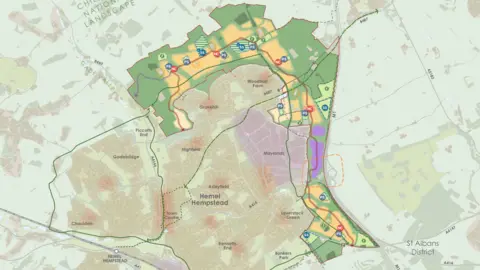
These developments form part of a much bigger picture. The Hemel Garden Communities programme, which aims to deliver up to 11,000 new homes by 2050, is reshaping the northern and eastern edges of Hemel Hempstead.
 Hemel Garden Communities
Andrew Cook, who was the managing director of Fujifilm Electronic Imaging and whose premises were badly damaged in the explosion, believes there has been overdevelopment too close to the depot site.
"There are now thousands of houses that are going to be nearby and there is a danger that in 20 years' time, 30 years' time, everybody's forgotten about the risk and it happens again," he says.
The HSE's development proximity zones cover new building near high-hazard sites. The aim is to prevent housing and sensitive developments from creeping too close to major fuel depots.
A spokesperson for Dacorum Borough Council says: "We have worked in line with updated guidance from the HSE and other relevant bodies to ensure land use planning reflects lessons learned.
"All planning applications in the vicinity of Buncefield have been assessed against this guidance, and risk considerations have been central to decision-making.
"Developments such as Swallowfields and Beaumont Manor were determined in accordance with these requirements, ensuring compliance with national safety standards.
"We remain fully committed to prioritising safety in all planning decisions to protect our community now and in the future."
Follow Beds, Herts and Bucks news on BBC Sounds, Facebook, Instagram and X.
