Police 'should consider inquiry into jail deaths'

 Supplied
A coroner has said she will be writing to police over concerns "there hasn't been sufficient consideration" over possible criminal inquiries into issues at a troubled prison.
Laurinda Bower's concerns come after the inquest of Matthew Osborne, who was serving a term at HMP Lowdham Grange when he was found hanging in his cell on 25 November 2023.
The jury returned a conclusion of suicide on Wednesday, adding Osborne should not have been held in the jail's segregation unit.
The court also heard two prison officers who were filmed playing football with a toilet roll on the afternoon of Osborne's death were dismissed for gross misconduct. Another resigned before disciplinary procedures were taken.
 Getty Images
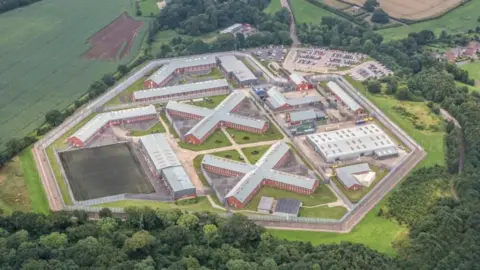
Lowdham Grange, a Category B prison in Nottinghamshire, was run by Sodexo at the time of Osborne's death, following the first private-to-private prison transfer in England and Wales on 16 February 2023.
Osborne, 39, was the fifth inmate at the jail to be found hanging in his cell that year following the transfer.
He arrived on 20 June, and Nottingham Coroner's Court heard he made three serious attempts on his life the following month.
He was placed under a check system on vulnerable prisoners known as assessment, care in custody, and teamwork (ACCT) on 29 June, and at the time of his death required three checks on his welfare per hour.
On 3 October he was put into the prison's segregation unit, but the jury found an algorithm used by healthcare staff to judge his suitability was "inaccurately completed" and "failed to evidence if there was consideration of whether Osborne's mental health might deteriorate significantly if segregated".
A care plan was made on 10 October, but this was made to a template, which the jury said "created a false impression that personalised care was happening".
Numerous reviews on whether he was fit to remain in segregation were not properly carried out and did not involve prison and healthcare staff working together, and despite being deemed eligible for reintegration by 16 November, he was not returned to a wing.
Understaffing among both healthcare and prison staff was identified as an issue, and "risk pertinent information" was not shared, the inquest heard.
The court heard a series of ACCT checks were not carried out in the days before his death, with "multiple false entries" made in records that were shown by CCTV not to have happened.
On 25 November, Osborne was not seen between 14:32 and 16:22 GMT, when he was found hanging in his cell.
The jury said some staff on the segregation unit "were using the TV in the adjudication room for entertainment purpose to keep track of the football reporting", which it said was "a gross failure to carry out their core responsibilities, including ACCT checks".
CCTV showed two prison officers - Asa Whibberley and Stefan Wilson - playing football with a toilet roll in the segregation unit that afternoon.
The court heard Whibberley and Wilson were both dismissed for gross misconduct, while another prison officer, Josh Clark, was suspended by Sodexo but resigned and moved to a different jail.
'Past failings repeated'
Delivering their conclusions, the jury said there were "no documented reasons to evidence the exceptional circumstances or knowledge of the required criteria for Matthew's segregation", and said his detention after 16 November was "unlawful".
"There was insufficient consideration or risk assessment regarding the impact of full lockdown in prisoners in segregation, with no measures put in place to alleviate [or] reduce risk," they said.
With regards to the segregation unit, the jury found "sickness, annual leave and resignation" had left staff "without consistent oversight and support by operational management", and said a visit by the deputy director of the prison on 24 November "was a further missed opportunity to assess Matthew's presentation and needs".
Finding Osborne's death was "suicide contributed to by neglect", the jury said numerous failings more than minimally contributed to his death, including insufficient staffing across prison and healthcare teams, a "lack of management oversight", and failures with ACCT checks.
When asked if both Sodexo and Nottinghamshire Healthcare NHS Foundation Trust had failed "to adequately embed learning from previous deaths in custody, meaning past failings were repeated", the jury agreed.
In December 2023, the Ministry of Justice (MoJ) stepped in to manage the jail, initially on a temporary basis before it was made permanent the following year.
The jury said before the transfer that "the existing supplier [Serco] removed necessary technology and reduced funding without adequate planning" and "failed to supply vital documents", while "the new prison operator [Sodexo] failed to adequately recruit experienced staff" and "failed to ensure promoted staff were adequately trained to deliver their new job responsibilities".

Bower, area coroner, thanked the jury for their service during the inquest, which began on 15 December, and offered condolences to Osborne's family.
She said she would issue a prevention of future deaths report due to a number of concerns over issues, including the safety of the segregation unit, the clinical safety of the unit, and the retention of information for investigating deaths in custody.
Citing the deaths of other prisoners at Lowdham Grange and repeated issues around segregation, healthcare and other factors, Bower said she would also write to Nottinghamshire Police regarding her concerns over whether criminal investigations could take place on either an individual or organisational basis.
"I'm concerned that there hasn't been sufficient consideration given by Nottinghamshire Police," she said.
The coroner also criticised the MoJ, which now runs Lowdham Grange, for problems accessing "crucial" CCTV evidence using "a system that's simply not fit for purpose", which she said had been experienced by other coroners across the country.
'Prison crisis'
Following the inquest, Sodexo apologised to the Osborne family, accepted the findings of the jury, and said it was "appalled by the actions" of some prison officers.
"Lowdham Grange is a prison with long-standing cultural and operational challenges, which we were working tirelessly to rectify," it said.
"We regret that despite the steps we were taking, sufficient progress had not been made.
"Our focus is on learning from what happened, including strengthening our observation policies and practices, to ensure the safety of those in our care."
Diane Hull, chief nurse at Nottinghamshire Healthcare NHS Foundation Trust - which no longer provides healthcare services at Lowdham Grange - apologised on behalf of the trust "for the elements of care that were not of the standard Matthew deserved".
She said: "We are committed to learning from this case within the services we still deliver, and to sharing all relevant information and learning with the new provider to support the future delivery of safe, high-quality care."
The MoJ said: "The government is gripping the prison crisis it inherited and progress is being made at HMP Lowdham Grange since we took it over, with strengthened safety measures and better support for prisoners at risk of self-harm."
Speaking at the inquest, Osborne's sister - Jasmine Osborne - said her brother's death had been "very difficult" to deal with, and the family were "shocked" by the failings but welcomed the jury's findings and coroner's comments.
"With the prison and the healthcare [staff], again and again, there seems to be a very clear lack of care for human life," she said.
"It's been very hard, we're all broken, but hopefully now we've got some answers, we can heal the best we can."
Clarification 16 March: This article's headline originally said that the coroner criticised police and this was updated on 5 February to explain that the coroner said police "should consider an inquiry" into the deaths, more precisely reflecting the details in the article.
Follow BBC Nottingham on Facebook, on X, or on Instagram. Send your story ideas to eastmidsnews@bbc.co.uk or via WhatsApp on 0808 100 2210.
