New Zealand drafts in Asian hornet hunters from UK

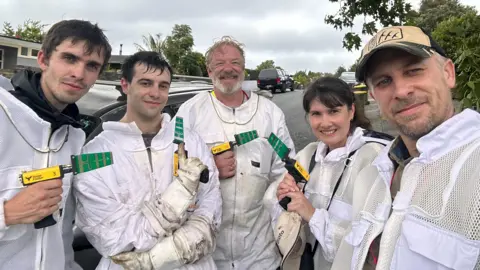 Dan Etheridge
British bee inspectors have been sharing their expertise in tracking the yellow-legged hornets with teams hoping to eradicate the invasive predator in New Zealand.
The yellow-legged hornet, also known as the Asian hornet, was first spotted in New Zealand last year.
The fight against the insects in the South East of England has seen Animal and Plant Health Agency (APHA) officers fit tiny radio tracking devices in a bid to find their nests.
Dan Etheridge, who led the teams hunting the hornets in Kent and Sussex, spent more than a month in New Zealand teaching staff at Biosecurity New Zealand the "fieldcraft" of how to fit and use the trackers.
The first sightings of yellow-legged hornets in New Zealand were at the end of June last year when two male "drone" hornets were spotted in Auckland.
As the sightings were in the middle of winter for the southern hemisphere, it wasn't until the middle of October last year that the Queen hornets started emerging.
Yellow-legged hornets are seen as a significant threat to honey bees and other pollinators.
One nest of hornets can eat up to 11kg (1.7 stone) of insects in a single season.
Scott Sinclair from Biosecurity New Zealand says the group looked to the UK for advice on how to tackle the incursion because of its "active eradication" goal.
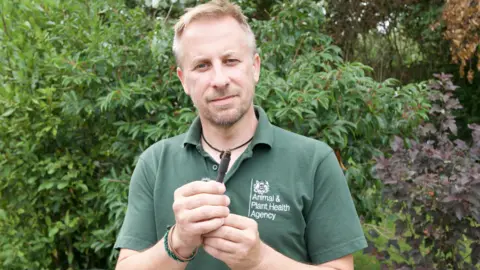
Etheridge, who developed the fieldcraft of tracking the hornet, taught the New Zealand team how to narrow down where a nest might be using traditional tracking methods and how to fit radio trackers to female worker hornets.
He showed them how to hook the radio transmitter onto the petiole, or waist, of the hornet before she is released, in the hope that she flies back to her nest.
Using the receivers a hornet can be tracked up to 0.6 miles (1km) away.
Etheridge says the team in New Zealand were much bigger than the UK team and the level of organisation in the team was "impressive".
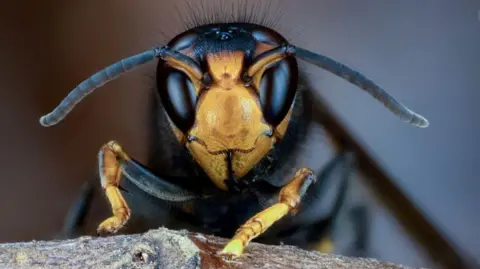 Science Photo Library
Sinclair says the "skills and guidance" that the UK inspectors passed on has been "amazing" and has "made a real difference" in their battle with the invasive hornet.
Now at the end of the nesting season New Zealand authorities have found and destroyed more than 130 yellow-legged hornets nests.
Around 75 percent of those have been found using radio trackers.
Mike Inglis, from Biosecurity New Zealand, says they were "cautiously optimistic" of eradicating the hornet from their islands saying they've gone in "hard and early" to tackle them.
Back in the UK, Etheridge and his team of hornet hunters are gearing up for their own fight against the invasive predator.
Last year the team found and destroyed a record 163 hornet nests, most of them in Kent and Sussex.
Follow BBC Kent on Facebook, on X, and on Instagram. Send your story ideas to southeasttoday@bbc.co.uk or WhatsApp us on 08081 002250.
