WW2 marine's journey home for 'Victory Christmas'

 BBC
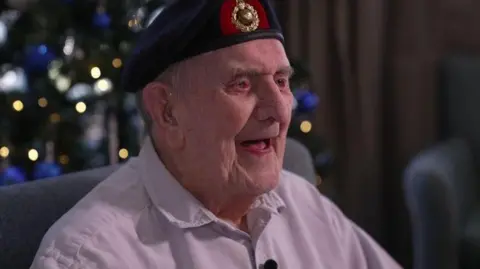
BBCA centenarian has shared his precious memories of Christmas 1945. Dubbed "Victory Christmas", it was the first time Britain had celebrated a peacetime festive period after six long years of brutal war - and Royal Marine Jim Gettings just wanted to get home to his pregnant wife.
With two days' leave from the Royal Navy, Jim Gettings boarded a train home for Christmas.
He did not even have enough money to pay for a ticket, but his yearning to be reunited with his pregnant wife was stronger than any penalty that might be meted out.
Mr Gettings, from Hessle, East Yorkshire, joined the Royal Marines as soon as he turned 18.
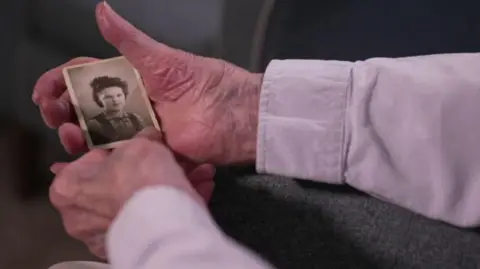
Today, these 100-year-old hands are holding a tiny, black-and-white portrait of his late wife Joan.
"I said, 'Look, I'm on leave, legally on leave'," he says. "I showed him my pass, but I said, 'I'm skint! I've no money, what can we do?'
"I said it's Christmas, I've got to get home for Christmas. He looked around and there was nobody around. He said, 'Go on then. Clear off!' I think I had a few coppers for my bus fare!"
Mr Gettings, who served with the 28th Battalion, remembers rations still being in place that Christmas.
But people could hang festive lights and celebrate free from the fear of bombing and losing loved ones in the fighting - at least in Europe. Fighting continued in the Far East until August 1945.
Christmas holds many special memories for him.
The year before Victory Christmas, in 1944, Mr Gettings had asked his sergeant for permission to return home to marry his fiancé. Initially, permission had been refused.
"He [the sergeant] told me war isn't time for stuff like that," says Mr Gettings. "But he said I'll give you a week's leave and you can do what you like with that."
The couple met while working in a library, with the future Mrs Gettings being three years older.
Aged 16, Mr Gettings joined an anti-aircraft battery in Hull. Earlier in the war, he had been caught in the blast of a parachute mine dropped on his neighbourhood.
Towards the end of the war, Mr Gettings was posted in Holland where he and his comrades held the south bank of the River Maas. The Germans held the north bank.
In May 1945, following Germany's unconditional surrender, people flooded Britain's town squares. Street parties followed.
But in war-torn Europe the mood was more sombre, says Mr Gettings.
"It was just the end of the war. We didn't celebrate at all."
He tells how Royal Marines had taken over barracks previously occupied by the Germans.
Mr Gettings says: "After a while, the German lads started to drift back into the barracks and we were all mixed up together. We would give them bully beef [canned corned beef] and we were just soldiers together. No hatred. Just soldiers."
'No hatred, just soldiers'
He and his wife went on to have two more children. Mr Gettings has eight grandchildren and 17 great grandchildren.
Reflecting on the war, he says: "It would be years of hard work to beat the Germans, but we never stopped.
"If anyone tried to stop us the marvellous RAF sorted them out and we carried on through Germany like that with the RAF shielding us, bless them."
Listen to highlights fromHull and East Yorkshire on BBC Sounds, watch the latest episode of Look Northor tell us about a story you think we should be coveringhere.
Download the BBC News app from the App Store for iPhone and iPad or Google Play for Android devices
