Air strike hit Kabul rehab centre as patients ate dinner, survivor tells BBC

 EPA/Shutterstock
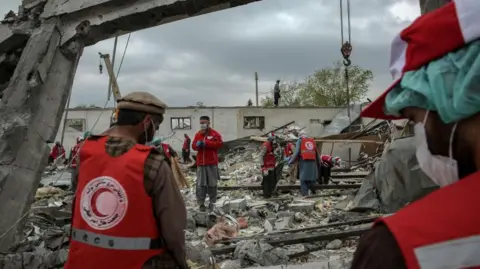
Rescue teams are continuing to pull bodies from the smoking rubble of a drug rehabilitation centre in the Afghan capital, Kabul, which was hit on Monday night in a devastating Pakistani air strike.
The attack on the Omid Addiction Treatment Hospital, which happened at about 21:00 local time (16:30 GMT), is the deadliest in recent violence between Pakistan and Afghanistan.
The strike happened as residents broke their daily fast for the Muslim holy month of Ramadan.
The death toll has continued to rise, and the Taliban government says it believes the number of people killed is about 400, although this figure has yet to be confirmed. Many people were also injured.
Mohammad Shafee, a patient in his 20s, survived the attack.
"I was in the kitchen helping to serve dinner when I heard a loud bang and ran for safety," he told the BBC.
"When I returned later, I found most of our colleagues and people in the dining room hit. Only five of us survived."
Maiwand Hoshmand, a doctor who works at the facility, said patients had just finished dinner on Monday and some were at congregational prayer when jets hit three parts of the centre.
"I heard the sound of the jet patrolling," Omid Stanikzai, 31, a security guard at the centre, told the AFP news agency.
"There were military units all around us. When these military units fired on the jet, the jet dropped bombs and a fire broke out."
"The whole place caught fire. It was like doomsday," said Ahmad, 50, who was also receiving treatment at the facility - a former military training camp that was turned into a makeshift rehab centre a decade ago.
"My friends were burning in the fire, and we could not save them all," he told the Reuters news agency.
It is still unclear why the hospital was struck. Pakistan says Afghan claims that it attacked the facility on purpose are "entirely baseless" and maintains it "precisely targeted military installations and terrorist support infrastructure".
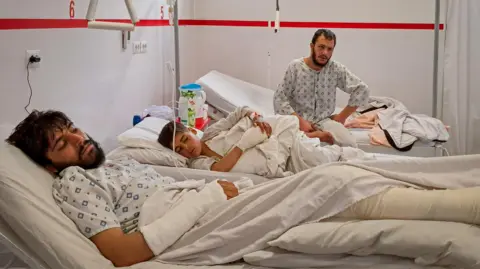
Medics could be seen treating dozens of wounded people in the smouldering ruins of the single-storey building on Tuesday. Splintered chairs and beds poked out from the debris, while blankets and belongings were scattered around.
A large crowd of people, whose relatives were being treated at the hospital, had gathered at the facility - hoping for updates on their loved ones. Police vehicles and ambulances were parked near the centre's gate.
One woman told BBC Afghan she was searching desperately for her husband.
"Gul Meer was in the facility for over seven months now. Since last night when the attack happened, we have no information about him, I don't know what happened to him, I am waiting for the list to be announced later," said the woman, a mother of nine.
Another woman, who had tears running down her face, said her son had spent the last four months in the facility.
"I asked about him here from the officials - nobody knows where he is," she told the BBC.
"I searched other facilities but couldn't find him. I came here at dawn to find out what happened to him, but no information. He was here for treatment."
So far, at least 100 bodies have been taken to the Kabul Forensic Medicine Department, sources there told the BBC. The exact death toll is still unclear.
Some of those killed have been identified and their bodies handed over to their families. But several more are reported to be severely disfigured, making identification difficult.
Scores of people have been killed on both sides of the border during months of hostilities between Pakistan and Afghanistan. Islamabad accuses Kabul of harbouring militants who attack targets in Pakistan – something Taliban officials deny.
UN officials, who are urging restraint on both sides, say the upsurge in hostilities has resulted in at least six health facilities reportedly being impacted in Afghanistan since late February.
 Reuters
Afghanistan, which for years was the world's leading source of illegally produced opium, has a major drug addiction problem.
The Omid Addiction Treatment facility used to be known as Camp Phoenix a decade ago during the war in Afghanistan, when US-led forces were fighting Taliban militants.
It served as a military training compound used by the US and Nato, but the facility was later abandoned by the Americans and converted by the Afghan republic government around 2016 into a rehabilitation centre.
After the Taliban seized control and set up their government in 2021, it continued to house patients as a detention and rehabilitation facility.
The centre had become overloaded in recent years, when the Taliban government rounded up drug addicts from the streets of Kabul and other provinces.
At one point, the Taliban government said the number had reached 5,000 at the centre, which was designed to hold up to 2,000. A former addict who spent time there said some rooms held up to a hundred patients.
Drug users were kept in the facility for as long as six months.
A separate small facility for male addicts nearby does not seem to have been affected by the attack.
