'Chippies will die unless we eat cheaper fish'

 BBC News
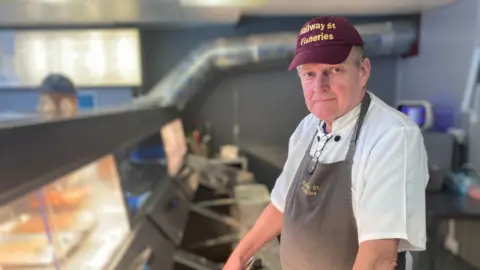
The owner of an award-winning fish and chip shop has taken cod off the menu, saying the fish has become too expensive to buy from his suppliers.
Andrew Arnold, who runs Railway Street Fisheries in Pocklington, near York, said a 45lb (20kg) box of cod, which cost £110 in December 2024, now costs £330, an increase of 200%.
The price of haddock had also risen sharply, meaning he had to charge £12.50 for a portion with chips, up from £8.50 in December 2024.
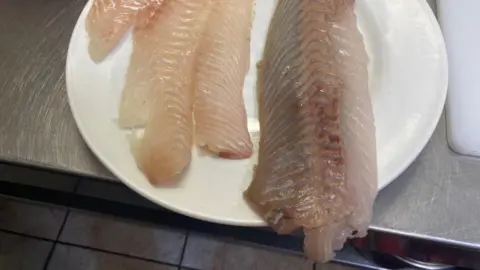
Arnold is now encouraging customers to try cheaper species, such as Norwegian pollock, a member of the cod family, which he said tasted just as good.
"The traditional fish and chip shop is going to go, if we don't diversify and do different things," he said.
"I can sell pollock at £10.50 and still make a reasonable profit on it, but there's still a lot of customers who want haddock or cod.
"I tell them that if I went and got cod, I'd be charging £17 and nobody wants to pay that."
 BBC News
Arnold, who won a gold seal in the 2025-26 Good Food Awards, a scheme to promote independent businesses, added: "People's mindset is going to have to change."
Andrew Crook, the president of the National Federation of Fish Friers, said a growing number of fish and chip shops were now offering alternative species.
"We've seen it pick up in the last few months," he said.
"Shops are now offering marine species such as pollock, hake from South Africa, hoki from New Zealand, and there's also farmed species like tilapia."
 BBC News
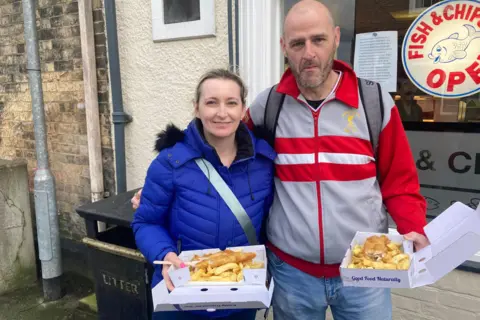
Customers Darren Goddard, 48, and Olivia Broadbent, 40, gave their verdicts after being persuaded to try pollock for the first time.
"It tastes very similar to cod, it's really good quality, I like it," said Olivia.
Darren, who normally orders cod, added: "It is what it is – you have to change with the times."
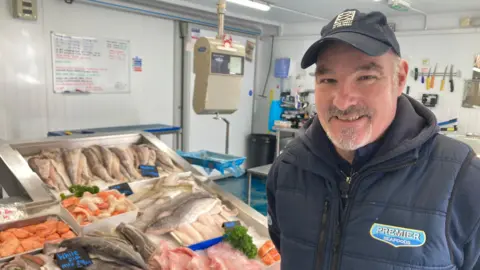
Fish merchant Nathan Godley, from Grimsby, supplies chip shops and sells about two tonnes of fish each week from his premises on the town's fish docks.
He explained that the rising price of cod and haddock was due to limited supply.
"Everybody wants it, but there simply isn't enough being caught, landed, processed and sent to the fish and chip shops," Godley said.
 BBC News
Godley is sceptical that offering alternative species would provide a solution.
"You have to be able to take the customer with you," he said. "The British people tend to love their cod or their haddock, depending on where they live.
"In the long term, you've just got to pay the price, I think."
Listen to highlights fromHull and East Yorkshire on BBC Sounds, watch the latest episode of Look Northor tell us about a story you think we should be coveringhere.
Download the BBC News app from the App Storefor iPhone and iPad orGoogle Play for Android devices
