Cranes return to the UK due to rewilding effort

 PA Media
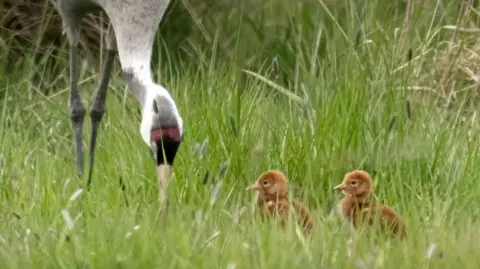
A record number of cranes bred in the UK last year as the once-vanished bird continues its comeback, conservationists have said.
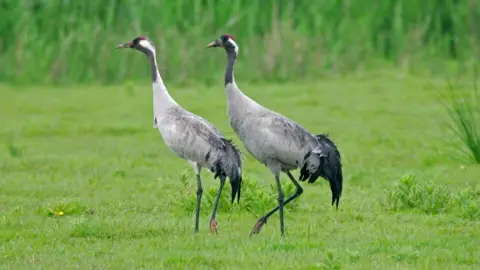
Cranes are still on the endangered species list but there are currently 87 breeding pairs in Somerset and they raised 37 young last year. In total, the UK crane population stands at about 250 adults and young.
RSPB West Sedgemoor and Greylake, in Somerset, played a key role in bringing the species back.
Harry Paget-Wilkes, site manager there, said: "There are pairs now breeding in other places, like Oxfordshire, Gloucestershire, Wiltshire. It was never about bringing them back to just Somerset - it was about bringing back a core population."
Cranes went extinct in the UK about 400 years ago as a result of over-hunting and the loss of their favoured wetland habitat.
"The reason the Somerset sites are important is that they were restored as wetland habitats," Paget-Wilkes said.
"For a while they were intense agricultural sites but we restored wetlands on them.
"They're big open spaces, quite quiet, and that's what cranes need."
He said that cranes were "fairly tolerant" of climate change in the UK.
"Having said that, in other parts of Europe, as it gets hotter and drier, their range will be restricted there," Paget-Wilkes added.
"It's really important that places like the UK can provide the sanctuary for them."
 PA Media
According to the RSPB, at least 80% of the breeding population are now found on protected sites, with a third on RSPB reserves alone, including its West Sedgemoor reserve in Somerset and Lakenheath Fen in Suffolk.
Over in Gloucestershire, Geoff Hilton, head of wetland evidence at Slimbridge, said in 2010 they were the ones to take crane eggs and hatch them.
"We were up all night, trying to get these birds to hatch," he said.
"It was a phenomenal effort."
Once they were hatched, they were released on the Somerset Levels.
"There's lots more work to do but they are a pleasure to enjoy at the moment," Hilton said.
Follow BBC Somerset on Facebook and X. Send your story ideas to us on email or via WhatsApp on 0800 313 4630.
