Food waste trial reduced over 'disappointing' uptake

 BBC
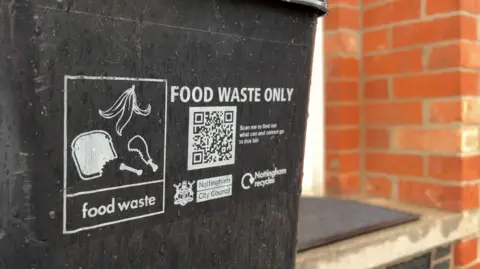
BBCA food waste collection trial in a part of Nottingham has been scaled back after a "disappointing" uptake, it has been confirmed.
All councils will be required to offer free collections of food waste from 31 March 2026, unless granted an extension by central government.
The trial initially covered 3,343 properties in the Berridge ward, but data from March 2023 to February 2024 shows a participation rate of between 10.81% and 17.56%.
The city council said it reduced the number of properties served by the scheme after a year to focus on households that "demonstrated regular participation", and there are now about 600 to 700 taking part.
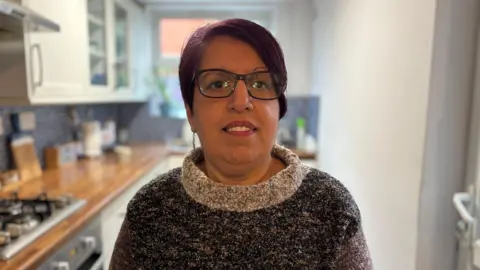
Green Party councillor for Berridge, Shuguftah Quddoos, said it had been difficult to get people involved.
"Overall, it's been disappointing, take-up has been low," she said.
"It's a challenging neighbourhood because we have a really mixed community here of all ages and all backgrounds, so it's been a real challenge to raise awareness."
She added she was optimistic, however, that more people could be convinced.
"A generation ago, none of us had a brown [recycling] bin, none of us recycled at all, it was a new concept, so changing behaviour and changing your routine to do things differently is always going to be a challenge," she said.
"It was a challenge for me, and once I understood that this food waste is going to power buses and heat homes, I was like - 'this is great'."
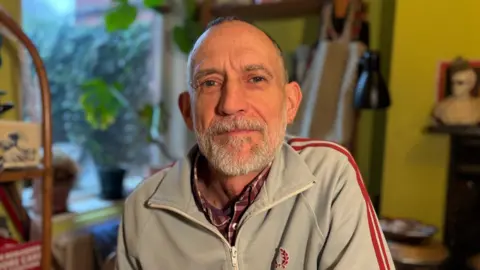
Local resident Mark Shotter said taking part had been very straightforward.
"The peelings and other bits of food that can't be used for whatever reason simply go into the little food waste bin which I've got next to my general waste bin," he said.
"When it gets full enough, I take it outside and put it into the larger food waste bin provided by the council. There's no real extra work involved as far as I'm concerned, it's just a case of which bin you put it in."
The Labour-run council's executive member for waste, Corall Jenkins, said the authority was listening to feedback from the trial.
"It can be made better by improving our educational programmes, the time we're spending engaging with residents, getting the message across why it is important to separate waste because of the additional contamination costs, but also the benefits that they themselves get out of separating the waste," she said.
Food waste is taken to an anaerobic digestion facility where it is turned into biogas, which can be used to generate electricity and heat.
Collections will not start across the rest of Nottingham city until 2030.
Jenkins said the delay was due to the council being "wrapped up" in a contract with a waste collection company, but that it would enable the authority to make the rollout "as smooth as possible".
The council said it "remains open to providing food waste collections to any household within the original trial boundaries that wishes to take part".
Other councils in Nottinghamshire have also been granted an extension.
A spokesperson for Nottinghamshire County Council said it had secured a short delay to implementing food waste collections across the county on behalf of waste collection authorities until October 2027.
It added that this was due to the "complexities" of renegotiating its private finance initiative contract with Veolia to provide suitable and appropriate anaerobic digestion treatment capacity for separately collected food waste.
Follow BBC Nottingham on Facebook, on X, or on Instagram. Send your story ideas to [email protected] or via WhatsApp on 0808 100 2210.
